| This electronic brochure highlights our
capabilities and activities in the area of Polymers and Polymer Composites.
Please sign our guestbook.
For more
information, contact the appropriate Institute
staff member. |
Polymers and Polymer Composites
The versatility of polymers, polymeric fibers, and polymer
composites is creating a growing worldwide demand for these materials in a wide variety of
applications.
For more than 40 years, Southwest Research Institute (SwRI) has
helped chemical and polymer producers, material suppliers, manufacturers, government
agencies, and industry research groups solve problems in polymer materials, manufacturing,
and design. SwRI scientists and engineers have incorporated polymers into military and
aerospace applications, biodegradable products, bioreactive capsules, and biocompatible
prosthetic materials.
The Institute offers integrated solutions to problems in
polymer and polymer composites, with programs ranging from performing basic molecular
research to developing prototype structures. The thrust of the SwRI polymer research
program is conducted in its Chemistry and Chemical Engineering Division and its Mechanical
Engineering Division, augmented by multidisciplinary specialists -- such as
physicists and electrical, civil, petroleum, aerospace, and automotive engineers -- from
other Institute divisions.
The Institute's broad range of polymer and polymer-related
capabilities include:
Polymeric materials modeling
Surface and interfacial analysis
Intelligent materials processing
High-performance thermoset composite development
Polymeric biomaterials
Specialty polymer development
Polymer and composite processing, fabricating, and testing
Additional Polymer-related Services
 |
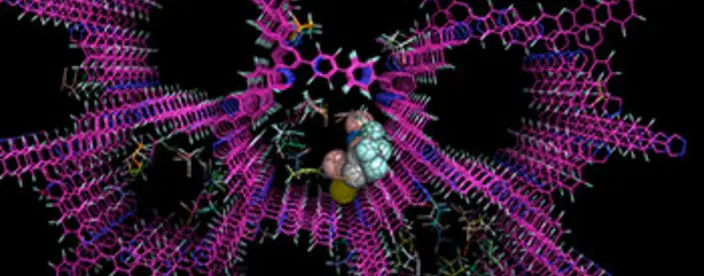
Using molecular dynamics computer simulation,
Institute scientists illustrate the structure of a composite material. The heteronuclear
polysulfone molecule is shown confined between two graphite surfaces.
|
Using computational modeling of materials at the molecular
level, SwRI staff members develop crucial insight into the relationship between the
molecular structure of a material and its end-use physical properties. The advanced
software used at the Institute solves a wide spectrum of problems, including those related
to:
- Molecular dynamics and Monte Carlo simulations of polymers and
interfaces. Molecular modeling permits new material properties to be predicted before
being produced in the laboratory, saving production costs.
- Chemical kinetics and transport properties. SwRI-developed
computer models allow the prediction of molecular weight distribution, degree of cure, and
relative viscosity of reactive polymer mixtures, including curing epoxies and polyimides.
- Moisture and fluid diffusion. Institute-developed computer
models predict the diffusion of moisture into plastics and composites.
The surface and interfacial properties of polymers and polymer
composites depend on the nature of the surface of the material. SwRI addresses a wide
spectrum of issues in the determination of surface and sublayer properties. Institute
staff members provide concrete solutions in areas such as corrosion studies, interfacial
analysis, joining and bondline analysis, adhesives, thin films, polymers, thermal barrier
coatings, and oxidation studies. SwRI capabilities include:
- Scanning tunneling and atomic force microscopy
- Near-infrared Raman spectroscopy
- State-of-the-art Raman imaging spectroscopy with spectral
resolution of 0.2 cm-1, confocal microscopy, and direct two-dimensional Raman imaging
(spatial resolution of one micrometer), enabling precise, spatially resolved chemical
analysis of the surface and near-surface regions
- Electrochemical impedance spectroscopy
- Lifetime prediction of polymers and polymer surface adhesion to
address the coupled chemical and mechanical problems incurred by service life within a
chemical environment
- Fourier transform infrared spectroscopy by diffuse reflectance,
specular reflectance, transmission, and attenuated total internal reflectance modes, with
microscope attachment permitting analysis of microscopic materials
 |
Using fiber optic sensors, kinetic and transport
models, and process-control software, SwRI engineers and scientists developed the
knowledge-based system to control and adjust autoclave operating parameters. The
innovative technology has been extended to fiber-reinforced advanced polymeric composites.
|
Recognized leaders in the emerging technology of intelligent
materials processing (IMP), SwRI staff members integrate advanced sensor technologies,
sophisticated computational control algorithms based on artificial intelligence, and
materials modeling to produce smart processing machines that control the manufacturing
process by:
- Conducting physical and chemical analyses of the material being
processed
- Comparing results of analyses with theoretical predictions
- Making decisions based on information received to adjust
necessary process variables
- Implementing adjustments to required equipment control settings
Using IMP technology, the smart machines quickly process
material with optimal cure rates to obtain the desired material properties. SwRI has
established an international reputation in IMP, working in areas such as:
- Advanced composites for aerospace application, with emphasis in
polymers and polymer composites
- State-of-the-art autoclave, press molding, and MechanoclaveŞ
technology, successfully completing projects for major industrial consortia, aerospace
manufacturers, and the electronics industry
- Advanced fiber-coating technologies, including chemical vapor
deposition
- Pulsed laser deposition of thin films of yttrium barium copper
oxide, producing films with high-temperature superconductivity
 |
Using high-service temperature thermoset resins and
carbon or glass fibers, Institute staff members fabricate experimental components for
stationary engine tests and other applications.
|
SwRI-developed low-flammability formulations are used
in fabricating high-strength and lightweight honeycombs and foams for aircraft, marine,
and automotive applications. (Photo courtesy of PEAR Development Corp.)
|
 |
SwRI possesses experience, equipment, and processing
technologies to fabricate a wide range of thermoset resin composites, using commercial and
newly developed resins. Recent Institute composite efforts have focused on innovative,
readily processible thermoset formulations for high-temperature, high service-load
applications.
SwRI's newest formulations are adaptable for cost-effective
processing by:
- Vacuum-assisted resin transfer molding
- Filament winding
- Pultrusion techniques
- Injection molding
- Autoclave curing
 |
A scanning electron micrograph shows SwRI-developed
biodegradable microspheres used for sustained or targeted release of injected therapies.
|
With expertise in designing polymer shell materials for
microcapsules, developing dental polymers, and modifying polymer surfaces, SwRI has earned
international recognition in biomaterial development. Using the Institute's
state-of-the-art facilities, experienced staff members offer integrated solutions to
biomaterial-related problems, including:
Microencapsulation Design
- Cell entrapment and cell immobilization
- Controlled release of injectable and implantable drugs
- Biocompatibility evaluation
- Biodegradable and biocompatible polymer evaluation for
implantation
- Preclinical trial facilities meeting Good Laboratory Practices
and Good Manufacturing Procedures criteria
Dental Polymer and Composite Development
- SwRI proprietary hydrophilic acrylic monomers containing amino
acid half esters
- Inorganic-organic hybrid nanocomposites with low shrinkage and
superior mechanical properties as dental restorative materials
Polymer Surface Modification
- Chemical surface treatments
- Ion implantation
- Ion beam-assisted coatings
- Diamond-like carbon coatings
 |
SwRI technicians measure the film thickness of a newly
applied aerospace primer to ensure compliance with military specifications and industry
procedures. The Air Force CTIO facilities and SwRI laboratories are well equipped to
develop, characterize, and assess processes, equipment, techniques, and materials with
system performance and environmental impacts.
|
SwRI staff members continuously assist clients with technical
aspects of commercializing specialty materials, such as controlled-release biocidal films
and nanoparticle-polymer composites, both invented by SwRI. The Institute is committed to
helping clients understand market needs and adapting or developing technology that
addresses factors such as improved performance, cost, intellectual property, scale-up
requirements, and environmental or regulatory concerns. SwRI-developed applications
include:
- Protective packaging composed of controlled-release biocidal
films
- Nanoparticle-polymer composites for medical applications,
including dental restoratives and sun screens
- Films having special electro-optical and sensing properties
- Glass coatings for specialized surface properties
- Nonhalogenated, nonemissive fire-retardant technologies for
plastics, including low-density polyolefins
SwRI serves as primary technical contractor for the U.S. Air
Force Coating Technology Integration Office (CTIO). The Institute uses a
multidisciplinary, integrated approach to improve external aircraft coatings by optimizing
the materials, processes, and equipment and incorporating state-of-the-art technology.
SwRI technical contributions to coating technology include:
- Materials chemistry and polymerization studies
- Analytical techniques and instrumentation
- Corrosion control and assessment
- Environmental regulations and pollution prevention
- Robotics, automation, and equipment design/specification
- Composites structural assessments
 |
To support the development of new advanced aerospace
and industrial thermoset resin composites, the Institute uses a highly versatile hot melt
(or solvent) prepreg machine that produces thermoset precursors-coated unidirectional tows
of carbon, glass, KevlarTM, or other fibers. Accessories allow 20-cm wide cloth
prepregs to be produced.
|
The Institute has extensive experience in compression and
autoclave curing, extrusion, polymer blending, and vacuum-assisted resin transfer molding.
SwRI-developed polyether amide thermoset resin formulation technology allows filament
winding, pultrusion, and resin film infusion. State-of-the-art laboratory facilities are
equipped with a wide variety of instrumentation to synthesize, analyze, and test polymers
and polymeric products. Experienced SwRI staff members provide the following services:
Polymer Processing
- High-strength, heat-resistant thermoset resin composites
fabrication
- Thermoplastic extrusions (to 425 degrees Celsius)
- Thermoplastics and blends reinforced with high- strength short
fibers and small particulate fillers
- Adhesive formulations vacuum mixing
- Elastomer formulations mixing and curing kinetics
- Epoxy repair adhesives not requiring refrigerated storage
Materials Analysis
- Chromatography, including high-performance liquid, gas, and
high-temperature gel permeation
- Spectroscopy, including nuclear magnetic resonance, X-ray
diffraction and energy-dispersive analysis, ultraviolet-visible, infrared and Raman,
surface (Auger and X-ray photoelectron), atomic absorption, and inductively coupled plasma
- Electron microscopy, including transmission, scanning, and
scanning transmission
- Thermal, including differential scanning calorimetry and thermal
gravimetric analysis
Polymer Rheological Testing
- Time and frequency
- Strain
- Curing kinetics
- Viscosity and flow
- Deformation and stress relaxation
- Extended-time predictions
 |
Using a cone calorimeter, the flammability of linear
low-density polyethylene is compared to that of an Institute-developed nonhalogenated,
fire-retardant formulation. The incident heat flux in each case is 20 kW/m2.
|
The diverse capabilities of the Institute allow its engineers
and scientists to provide comprehensive and cost-effective evaluation, analysis, and
testing services to the polymer industry. Specific capabilities include:
Flammability Evaluation
- Laboratory and full-scale standard and custom flammability tests
for most polymeric materials used in aircraft, ship, rail, and rapid transit applications
- Performance evaluation of full-size polymer-containing
assemblies, including cars, buses, railcars, and building modules
- Assessment of composite's remaining strength after undergoing
fire testing
- Computer-modeled fire scenario evaluation
Failure Analysis
- Fiber-reinforced composite structures
- Polyethylene gas distribution pipes
- Acrylic windshields
Nondestructive Evaluation
- Nondestructive methods such as shearography, radiography,
computer-assisted tomography, pulsed infrared thermography, liquid-coupled and dry-coupled
ultrasonics
- SwRI-developed methods to detect delamination, lack of adhesion,
excess adhesive, matrix cracking, impact damage, and fiber damage in composites
- Institute-developed method to inspect polyethylene pipe fusion
joints
Composites Mechanical and Environmental Testing
- Mechanical tests include creep, torsion and shear, shock and
vibration, high-speed impact, compression and tensile strength
- Standard environmental tests include thermal, ultraviolet,
humidity, altitude, acoustic, rain or fog, salt, and sand or dust
This brochure was published in May 1997. For more information,
contact the appropriate Institute staff
member.
Chemistry
and Chemical Engineering Brochures
Mechanical Engineering Brochures
SwRI Brochures
SwRI Publications
SwRI Technical Divisions
SwRI Home
|