
ICE Powertrain Research & Development
The internal combustion engine, a fixture of automotive powertrains and power generation since the late 1800s, is quietly undergoing a revolution to meet modern demands for efficiency, productivity and sustainability. Gasoline and diesel engines continue to be dominant platforms, but the automotive, heavy equipment and power generation industries are investing in future-forward hybrid powertrains and new platforms that enable multifuel combustion with a single engine architecture.
Southwest Research Institute (SwRI) offers several engine analysis tools, engineering services and test facilities to support the development and advancement of ICE powertrain and engine combustion systems used in on-highway, off-highway, power generation, and propulsion systems from kilowatt-scale to utility-scale.
IC Engine Combustion R&D Services
With decades of experience assessing and improving engine systems, SwRI is a leader in IC engine combustion for advanced power systems, including the design, analysis, prototype fabrication and testing of combustion systems.
|
Unique Capabilities |
Engine Development Laboratories |
|
|
Multifuel Compatibility Engineering
SwRI provides unique internal combustion engine solutions for mobile, stationary, marine and aerospace applications for an increasing variety of fuels. SwRI’s IC engine combustion and emissions experts support full design and development of fuel-flexible engine architectures to achieve power, performance and emissions targets for light-duty, heavy-duty and off-highway engine systems. Our proprietary design features can be integrated into existing engine designs to emphasize in-cylinder swirl or tumble motion providing combustion optimization pathways for both spark-ignited and diffusion combustion within the same cylinder head architecture.
In addition to flexible engine design, SwRI also specializes in control architectures and algorithms that allow for combustion optimization as fuel properties change. Our Fuel Smart Performance & Optimization Technology (Fuel-SPOT™) involves a unique ‘sensor fusion’ approach to utilize signals from existing production sensors to measure and react to key combustion metrics, allowing the engine to operate at peak efficiency on a wider range of fuels. We have Fuel-SPOT engine platforms available for research and testing on unique fuel formulations. Fuel-SPOT algorithms can also be implemented into existing commercial control architectures for future production development.
|
Fuel Types |
Industries |
|
|
Case Studies
- Combustion System Simulation for Hydrogen Engines
- Method Development for On-board Fuel Diagnostics and Adaptation of Engine Operating Strategy
Alternative Fuel & Combustion System R&D
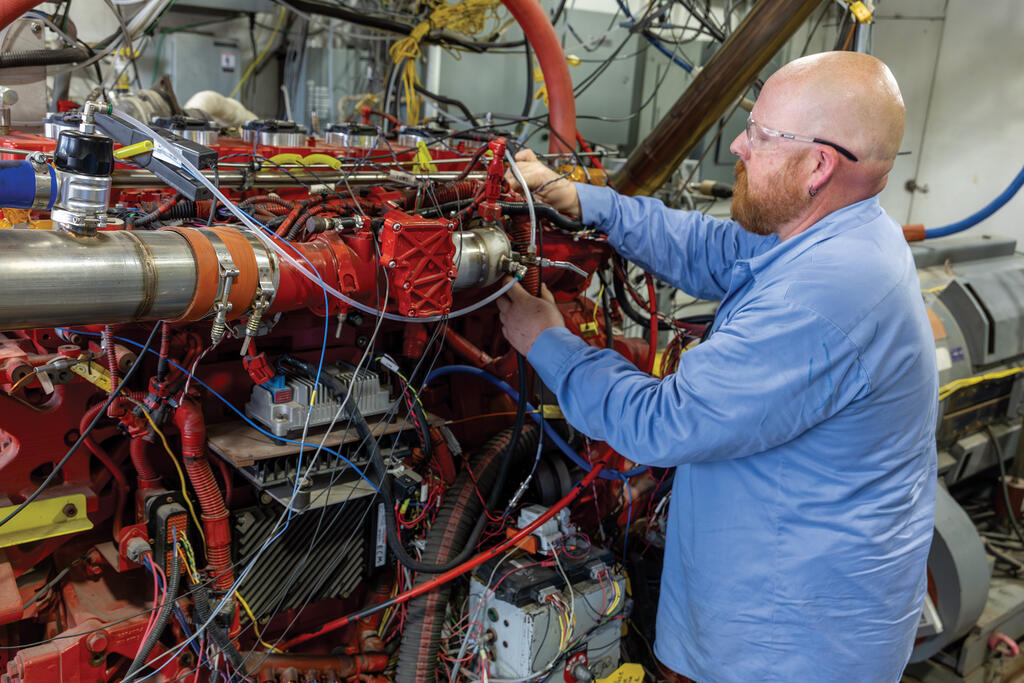
A hydrogen ICE vehicle test cell in SwRI's multifuel R&D laboratories.
Although many transportation end-uses require the energy density of liquid fuel, there’s an industry-wide push toward decarbonization. To balance these seemingly contrary realities, SwRI helps clients with the utilization of low-carbon, alternative fuels such as ethanol, methanol, LPG and even ammonia. Liquid fuels will play a vital role in the transportation sector for the foreseeable future. We develop new and modify and optimize existing ICE powertrain systems to run on low-carbon, alternative fuels.
Case Studies
- Combustion System Simulation for Hydrogen Engines
- Investigation of NH3 Combustion with Diesel Pilot Ignition
Expanded list of SwRI advanced combustion capabilities:
|
Computational Modeling |
Experimental Diagnostics |
|
|
Diesel Engine Conversions
Whether driven by legislative or market initiatives, traditional Diesel engine manufacturers are considering adapting their engine platforms to spark-ignited, alternative fuels. SwRI helps clients identify solutions to meet performance objectives and financial realities. In support of these initiatives, SwRI leverages its digital engineering capabilities to develop and deliver hardware solutions ranging from prototype demonstration through pre-production to final engine certification.
Case Studies
- Advanced Combustion System Development for Efficiency Improvement in Heavy-Duty Natural Gas Engines
- Far-Square Port Parameter Identification for Turbulent Natural Gas Combustion
- SwRI develops low-emission natural-gas-fueled hybrid truck
Abnormal Combustion Mitigation
SwRI has been a pioneer in abnormal combustion mitigation by designing spark ignited combustion systems for many decades. Starting with high-fidelity ignition and knock models, SwRI develops combustion systems that achieve the targets for power, fuel efficiency and emissions. These models have been calibrated with decades of advanced combustion research and client development programs across a broad range of fuel types. After modeling and design, SwRI offers several standard and R&D test stands to assess knock and preignition performance through high-speed data acquisition and advanced ignition and controls solutions. In addition to hardware systems, SwRI has been at the forefront of studying the impact of fuels and lubricant properties on abnormal combustion.
Case Studies
- Development of a Stochastic Pre-Ignition (SPI) Test for Hydrogen-Fueled Engines
- Development of a Passive Pre-chamber Ignition System for Light Duty Gasoline Engines
- Demonstration of SACI and D-EGR on Engine
SwRI Tackles Pre-Ignition Challenges
Stochastic pre-ignition research leads to the development of a testing methodology for hydrogen ICE applications.
Leading Joint Industry Powertrain & Vehicle System Projects
SwRI is uniquely positioned to start and direct industrial consortia in which member companies pay an annual fee to fund advanced, pre-competitive research. SwRI has been a leader in combustion research consortia for nearly 40 years. Programs like HEDGE and CHEDE have set the benchmark for the industry’s understanding and study of advanced combustion and emissions phenomena of conventional and alternative fueled engines.
R&D Consortia
- SwRI Supercharges Hydrogen-fueled Internal Combustion Engine
- SwRI’s CHEDE-9 Consortium Expands Decarbonization Research Priorities
- Clean Highly Efficient Decarbonized Engines (CHEDE-9)
- Hybridized Efficient Dilute Gasoline Engines (HEDGE-V)
- Hydrogen Internal Combustion Engine (H2-ICE)