
Southwest Research Institute (SwRI) is an independent, nonprofit research and development organization based in San Antonio, Texas. The following FAQ provides information about our company, areas of technical expertise, the markets we serve, the services we offer, and the many ways that we work with government, industry, and academia to provide innovative, applied R&D solutions from deep sea to deep space.
Visit About Us and What We Do for more overview information. To send a general inquiry to SwRI, visit the Contact page. Users can search for technical staff contacts in the Directory or use the search bar at the top of our site to find more information.
1. What is SwRI?
Southwest Research Institute (SwRI) is a premier independent nonprofit, specializing in applied research and development (R&D). We support government and industry clients with scientific discovery, the development of new technologies, independent testing, analysis and verification, and industry-specific consortia. Spanning 10 technical divisions that serve an array of market segments, we like to say our research extends from Deep Sea to Deep Space® and practically everywhere in between. SwRI’s mission champions science and technology for the benefit of government, industry and humankind.
2. What does SwRI do?
SwRI provides applied science and engineering R&D, and standard and custom testing while maintaining strict quality controls. From pilot plant fabrication to instrumentation development for spaceflight missions and pharmaceutical development, SwRI supports approximately 4,000 client projects each year and publishes and presents numerous papers across scientific and technical disciplines. Since 1947, SwRI has earned more than 1,500 patents and more than 50 R&D 100 awards, which are considered the “Oscars of Innovation.”
3. Where is SwRI located?
SwRI is headquartered in San Antonio, Texas, with additional offices around the United States. See locations.
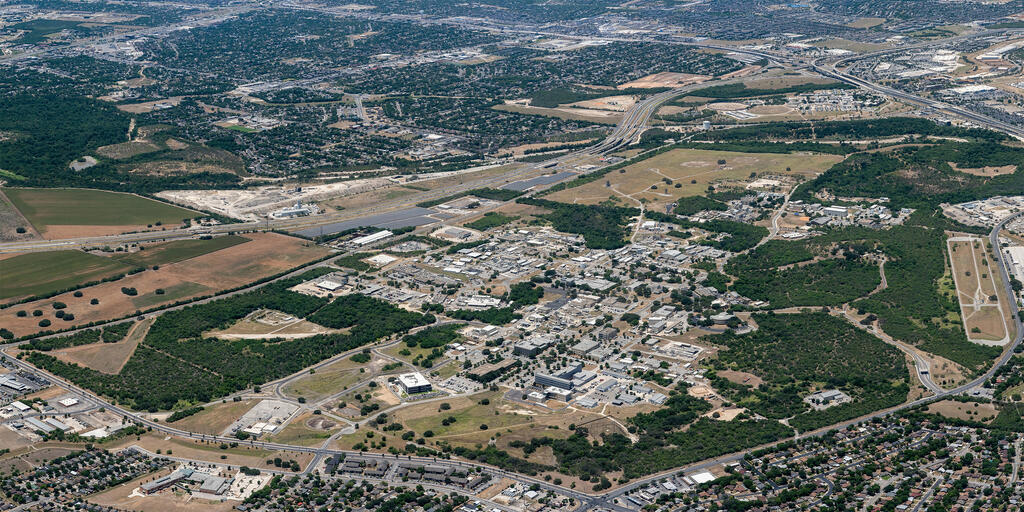
Aerial photo of the 1,500 acres that encompass the Southwest Research Institute campus in San Antonio, Texas.
4. Who owns SwRI?
SwRI is an independent nonprofit organization founded in 1947 by oilman and inventor Tom Slick Jr. SwRI is governed by President and CEO Adam L. Hamilton, P.E., executive leadership and a Board of Directors.
Read the president’s message.
5. Who funds SwRI?
SwRI’s research and development program is client funded. Government and industry clients contract with SwRI to solve challenging problems, develop new technologies, participate in consortia research, seek testing or validation services, or license various technologies, including software such as NASGRO® and SwRI’s molecular docking software Rhodium™. Each year, SwRI reinvests funds into its robust Internal Research and Development (IR&D) program to advance multidisciplinary research for the benefit of clients.
6. What kind of testing does SwRI perform?
SwRI performs a variety of testing, verification, validation and calibration services in areas such as fuels and lubricants, fire technology, pharmaceutics, nondestructive inspection and much more. SwRI also develops and performs custom testing for emerging technologies that may lack standards.
7. How big is SwRI?
Located on 1,500 acres, SwRI’s headquarters offers more than 2.4 million square feet of laboratories, test facilities, pilot plants, fabrication workshops and offices. SwRI conducted approximately $966 million research volume in fiscal year 2025 with 3,200 employees.
8. What are some of SwRI’s notable successes?
Since our founding in 1947, SwRI has made numerous technological advances and scientific contributions across a variety of disciplines. SwRI scientists, engineers and researchers have helped develop national safety and emissions standards, satellites, automated vehicles, energy storage solutions, medical countermeasures for the military, intelligent transportation systems and more.
In the early 1960s, SwRI tested an early iteration of the Alvin submersible prior to its 1964 launch and later supported the United States Navy and the Woods Hole Oceanographic Institution with a redesign of the deep-ocean research sub. In the 1970s, SwRI staff collaborated with the University of Mississippi to develop one of the first manuals related to training dogs to identify narcotics and explosives. In 1998, SwRI was one of the organizations inducted into the Space Technology Hall of Fame for the development of TEMPUR-material™.
Now housed at the Smithsonian’s National Air and Space Museum, SwRI manufactured a specialized fire extinguisher for NASA’s Apollo spacecraft and Skylab space station. SwRI is home to two historic landmarks. The American Society of Mechanical Engineers recognized the Split-Hopkinson Pressure Bar apparatus as an ASME National Historic Engineering Landmark in 2006. The Southern Gas Association Analog, developed by SwRI in 1955 for the natural gas industry, was also named a 1990 ASME landmark. SwRI supports the maintenance of military aircraft and develops defense and security solutions for the U.S. and friendly foreign governments.
SwRI’s contributions to space science are particularly well known. SwRI has designed and built an array of spaceflight instruments and electronics that have observed the Sun and nearly every planet in the solar system. Teams led by SwRI produced the first high-quality images of Pluto and its moons as well as the invisible interactions of the magnetosphere that surrounds and protects Earth as it’s impacted by the solar wind streaming out from the Sun. Other missions led by SwRI and its staff include the Juno mission to Jupiter, the Lucy mission to the Trojan asteroids, and the PUNCH mission to study space weather and how the Sun’s corona and heliosphere transitions into the solar wind. Staff members built the PUNCH satellites as well as a constellation of eight microsatellites for the Cyclone Global Navigation Satellite System (CYGNSS), which studies the formation and movement of hurricanes on Earth. Staff members also operate several NASA missions from a mission operations center based at SwRI’s Boulder, Colo., location.
SwRI is home to the Supercritical Transformational Electric Power (STEP) Demo pilot plant, led by GTI Energy in collaboration with GE Vernova and the U.S. Department of Energy/National Energy Technology Laboratory (U.S. DOE/NETL). SwRI led the H2-ICE consortium to develop one of the first heavy-duty Class 8 demonstration vehicles fueled by hydrogen in the world. SwRI also identified cybersecurity vulnerabilities in fast-charging electric vehicle stations. See some Highlights from 2025.
9. How do I get a job at SwRI?
SwRI employs engineers, scientists and researchers along with skilled technicians and other professional support staff. We offer internships, recruit at colleges and universities and actively hire veterans. SwRI offers competitive pay and benefits. Visit SwRI Careers for information on current opportunities.
10. How is SwRI different from a university or commercial lab?
As an independent research and development provider, SwRI is neither a university nor a commercial lab. SwRI collaborates with universities in Texas and across the country on a variety of projects and initiatives. Its technical divisions cover core scientific disciplines such as mechanical engineering, physics and chemistry that are often brought together to solve client challenges using a multidisciplinary approach. Although SwRI is not a university, SwRI’s headquarters has an on-campus credit union, library, print shop, fitness center, café and walking trails spread over 1,500 acres of sprawling ranchland with native trees and wildlife. SwRI supports government and industry clients with unique services, testing, analysis and contract R&D. For example, SwRI’s process engineers support the design, development and fabrication of customized pilot plants to reduce project risk and validate ideas. Although SwRI is not a commercial enterprise, SwRI excels in bridging the gap between research and industry to help clients scale up manufacturing or commercialization.
Have a question you don't see answered here? Visit SwRI's Contact page.