
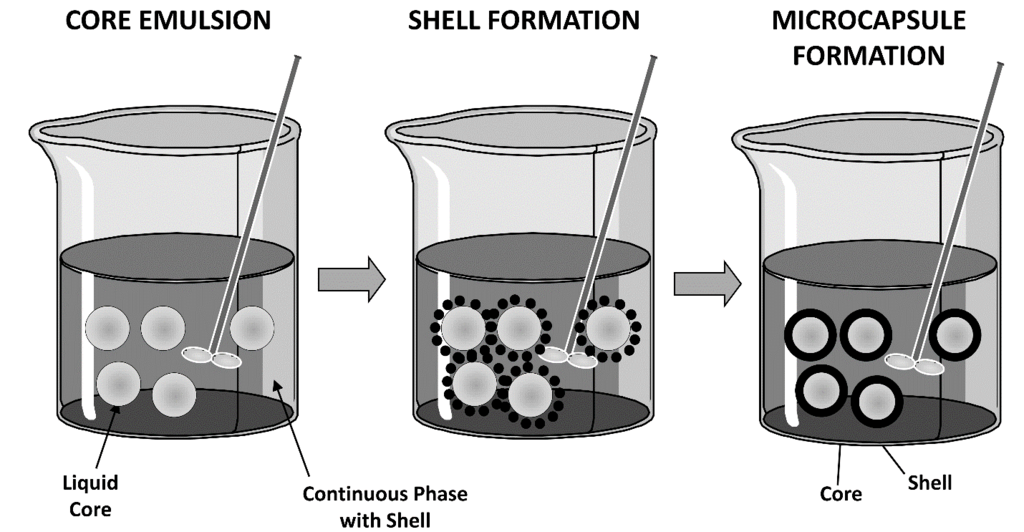
Emulsion-based encapsulation forms droplets in a two-phase liquid system. Emulsion formation disperses a core material into an immiscible liquid containing dissolved shell material.
Adjustments made to the two-phase system induce shell formation around the dispersed phase droplets. Oil-and-water is the most common two-phase system used for encapsulation. Variations of this process available at SwRI include simple coacervation, complex coacervation, in situ polymerization, interfacial polymerization, liposomes, layer-by-layer emulsions, micelles, solvent evaporation, in-water drying, solid- lipid nanoparticles and sol-gel chemistry.
Image
Morphologies & Capabilities
SwRI Staff have extensive expertise in emulsion-based microencapsulation and nanoencapsulation processes. We host a wide variety of emulsification options and scalability.
- Core-shell and matrix morphologies
- Oil-in-water, water-in-oil and double emulsions
Image
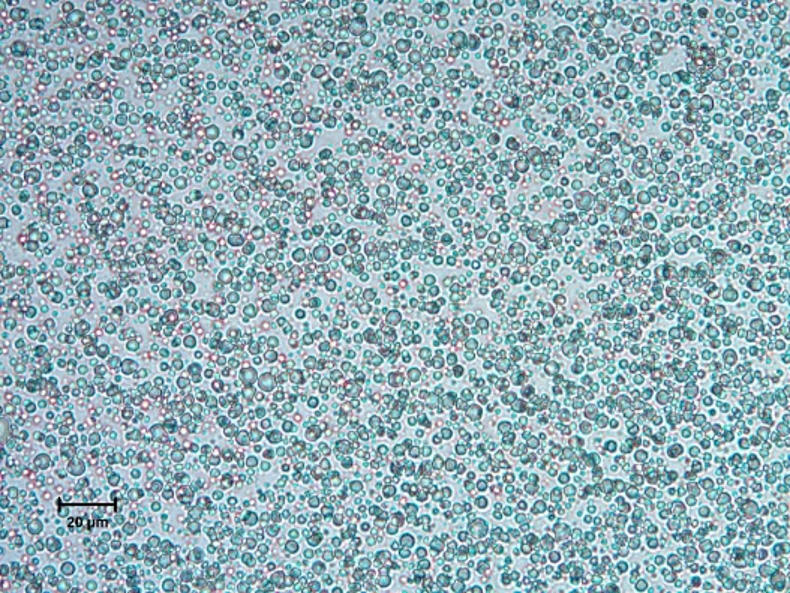
Microencapsulation with emulsion process.
- Droplet and particle size range of 100 nm to 1 mm
- Monodisperse droplet and particle generation
- Emulsification by rotor-stator homogenization, in-line static mixer, high pressure homogenization, or membrane emulsification (monodisperse)
- Tank/vessel capacity up to 750 L
- Synthetic, natural and/or biodegradable shell and matrix materials
- Aqueous and non-aqueous core materials
For additional information, please contact James Oxley at +1 210 522 2913 and Joseph Persyn at +1 210 522 2691 or visit Microencapsulation and Microencapsulation Techniques.