
Atomization creates an aerosol, suspending small droplets in a gas phase. For encapsulation, the gas phase is generally air, and the small droplets contain a mix of shell and core materials. This process is the foundation for several encapsulation variations, including spray drying, spray chilling, spray congealing, rotating disc atomization, electrospraying and prilling.
The atomized mixture may disperse core materials in a solvent/water (spray drying) with a dissolved or suspended shell material. Alternatively, the core material may be dispersed in a molten shell material (spray congealing, prilling) or thermally gelling mixture (spray chilling). SwRI has a long history and deep expertise in the use of atomization for encapsulation.
Image
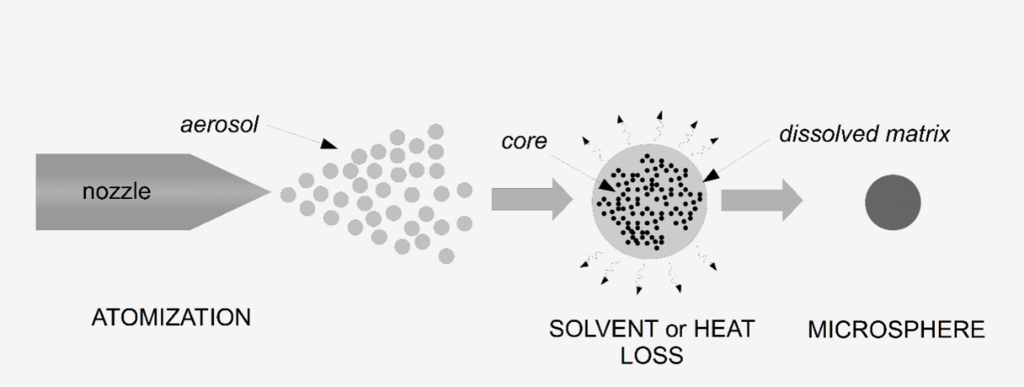
Spray Drying
SwRI atomization instruments include multiple spray dryers and custom spinning disk atomization systems. Pilot-scale spray drying (up to 30 L/hr) is available for aqueous formulations to make particles up to approximately 150 µm. Labscale spray drying (up to 1 L/hr) is available with multiple options/configurations:
Image
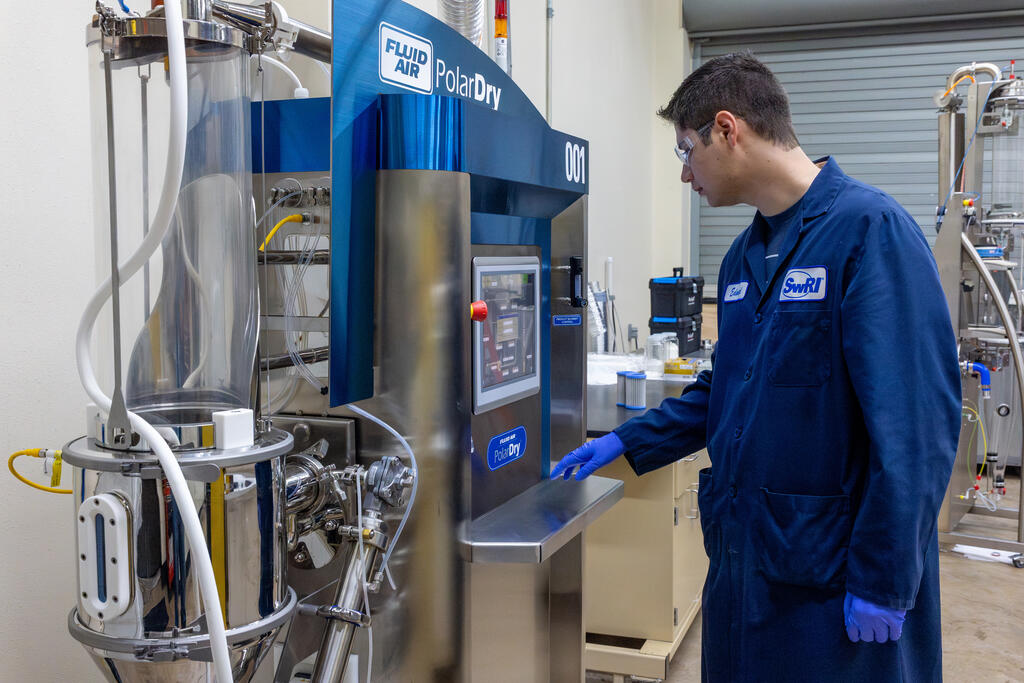
Electrostatic spray dryer.
- Solvent aqueous melts (spray congealing)
- Open- or closed-loop systems
- Nitrogen atmosphere
- Electrostatic spray drying (ideal for temperature-sensitive formulations)
- Two-fluid and three-fluid nozzles
Spinning Disc Atomization
SwRI pioneered spinning disc atomization technology and frequently uses this highly versatile encapsulation process to prepare matrix morphology and core-shell microcapsules. SwRI staff have refined the disc process to yield similar-sized micron-scale particles and process gram-scale batches while maintaining particle size distributions. To meet client needs, SwRI offers a wide variety of custom spinning disc systems, which have several advantages over conventional atomization, including:
Image
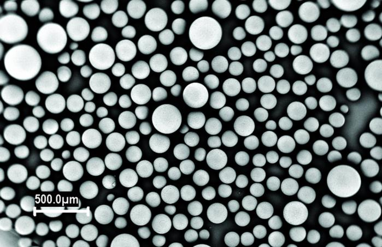
Microspheres from spinning disk atomization
- Production rates from tens of g/min to kg/min
- Adjustable particle size from 5 µm to 2 mm
- Narrow particle size distributions
- Atomization of aqueous, solvent and melt-based feeds
- High-solid and high-viscosity feedstocks
- 40-foot atomization tower
- 15-foot, -30 °C atomization cold room
- Liquid nitrogen collection
For additional information, please contact James Oxley at +1 210 522 2913 and Joseph Persyn at +1 210 522 2691 or visit Microencapsulation Techniques.