Encapsulation Process Engineering
Micro Nano Encapsulation
Microencapsulation Workshop
Advanced science. Applied technology.

Multiple encapsulation processes offer a wide range of capabilities for producing particles with various sizes, morphologies, payloads, materials and costs. Each process has a unique set of strengths and weaknesses related to these variables. Southwest Research Institute (SwRI) offers decades of Microencapsulation expertise.
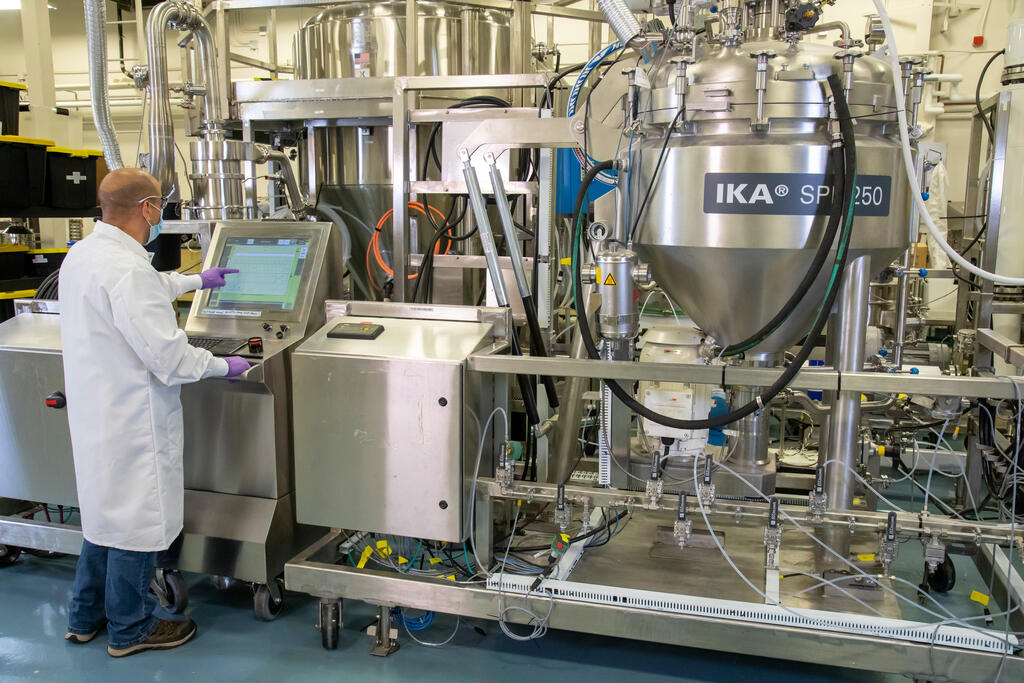
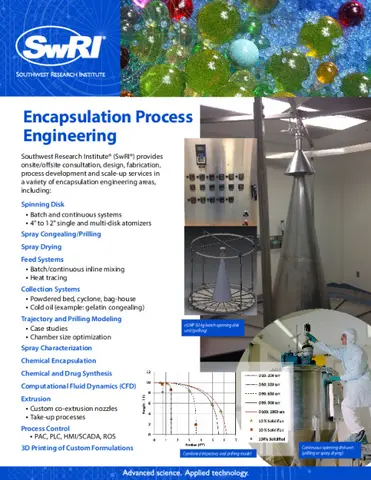
Spinning disc atomization (above) is one of many technologies available at SwRI for spray drying or spray congealing.
SwRI works closely with clients to assist with the down-selection and evaluation of the most appropriate encapsulation techniques and formulations for each project. Process selection begins with an understanding of the project objectives. By evaluating potential processes, materials combinations and constraints, scientists can determine the feasibility of an encapsulated product.
Processes available at SwRI include:
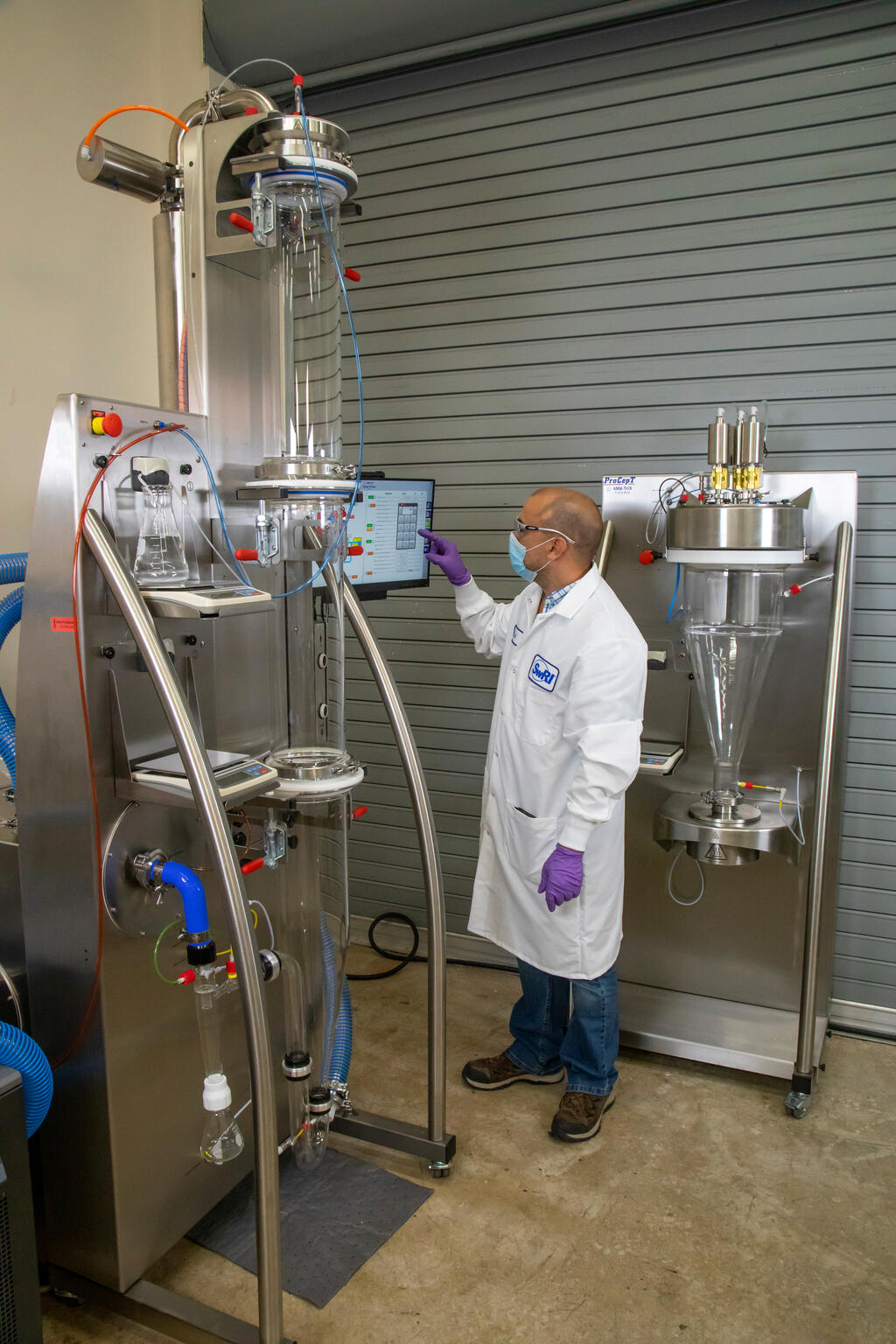
SwRI's laboratories encapsulate solids, liquids, and gases using different formulations and morphologies.
The primary components of an encapsulation system are the core material and shell/matrix material. SwRI staff are experienced with the encapsulation of solids, liquids and gases for a wide variety of applications. Our labs and equipment handle potent, hazardous, biological and DEA-classified substance materials. SwRI offers pre-processing to prepare materials for encapsulation, including milling to reduce particle size, granulation to increase particle size and homogenization to reduce droplet size.
There are hundreds of shell materials and thousands of variations and combinations. Material selection is based on multiple factors including encapsulation technology, performance metrics, economics, material supplier, application and regulatory restrictions. SwRI works closely with clients to select materials that meet these criteria. SwRI also works with clients interested in testing their own novel shell or matrix material for encapsulation applications. Material performance considerations include controlled release properties and barrier properties against oxygen, water, external chemicals and other environmental concerns. Examples of materials often used include but are not limited to:
The most common encapsulation morphologies are matrix and core shell. Each morphology offers different advantages and challenges that require careful consideration at the beginning of a project to guide selection of an encapsulation process and formulation. The breadth of SwRI’s capabilities can prepare either morphology in addition to more complex or alternative morphologies.
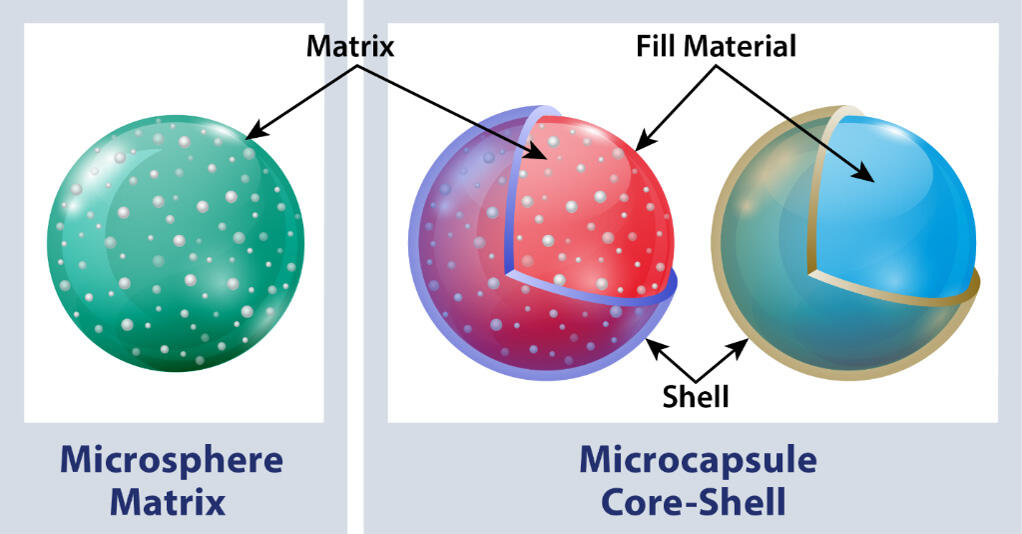
The two most common types of encapsulation morphologies are matrix and core shell. In a matrix morphology, active ingredients are homogeneously dispersed throughout the particle. In a core-shell microscapsules, the active ingredient forms a distinct inner core within a continuous outer shell.
The size of encapsulation particles can range from 10 nm to 10 mm. No single process can prepare particles in this range, though the entire range is covered by the diversity of processes and technology available at SwRI. In addition to controlling size, SwRI also hosts multiple processes such as coextrusion or fluid bed coating, to control the size distribution and prepare monodisperse particles.
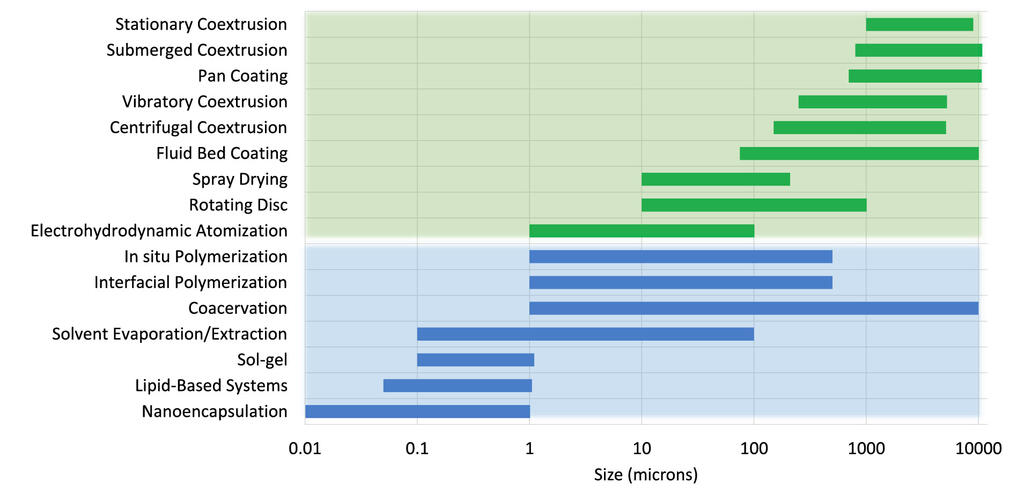
Each encapsulation method has size limitations. SwRI hosts multiple methods to enable the preparation of capsules with sizes from 10nm to 10 mm.
The capsule payload is the active material contained within a protective shell or matrix and typically ranges from 20-80% of the total weight or volume of the capsule. Payloads outside of this range are possible and prepared on a case-by-case basis. The matrix morphology is generally limited to a payload of 20-40%, while core-shell morphology can accommodate payloads in excess of 80%.
The largest production-scale encapsulation processes in the world can accommodate tons per hour, and SwRI offers many of these processes at lab and pilot scales. For projects with limited quantity of active ingredients, some processes can support encapsulation at the milligram scale. When larger quantities are needed, several SwRI processes support a capacity in excess of 100 kg.
Encapsulation is often used to protect and control the release of an active ingredient. Release profile kinetics include burst release for a rapid initial discharge or sustained release for a constant, prolonged emission. Other methods include triggered release, which is controlled by external stimuli, or a combination of profiles to meet specifications.
SwRI staff can help with the design and formulation of encapsulation systems that are responsive to a variety of release mechanisms:
Mechanical rupture
Thermal
Permeation/diffusion
Dissolution
Delayed
Targeted
pH release
moisture/osmotic
biodegradation
photochemical
chemical
electromagnetic
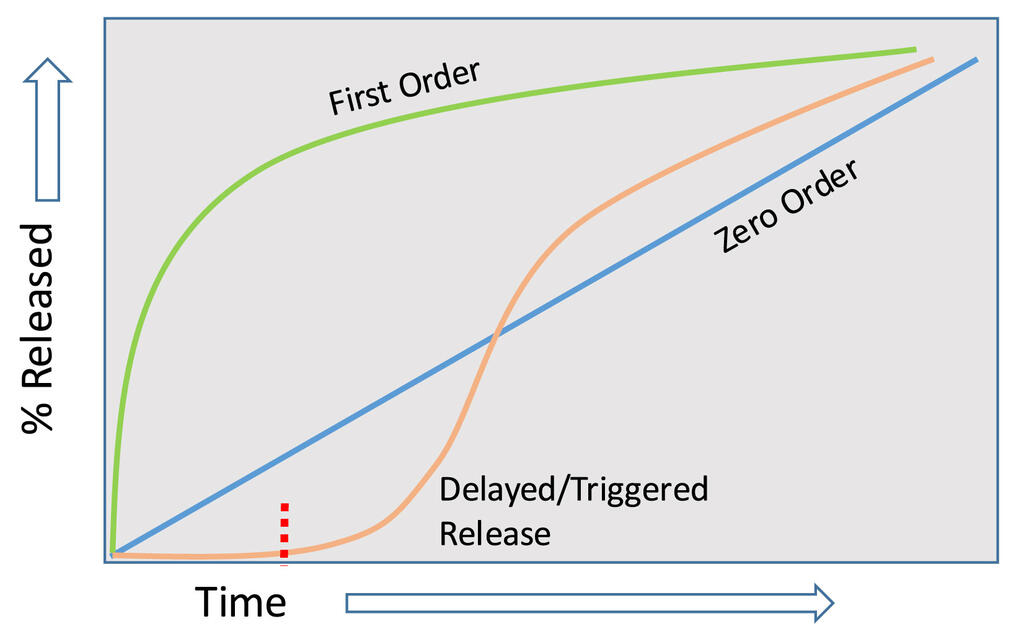
Example plot of various release profiles achievable with micro- and nanoencapsulation.
To learn more, watch our free one-hour webinar at the link below, which provides an overview of SwRI’s two-day Introduction to Microencapsulation Workshop.
SwRI's Dr. James Oxley discusses morphologies, processes, formulations and release in a one-hour webinar.
Featured Expert

James D. Oxley, Ph.D.
Institute Scientist
Dr. Oxley uses his expertise in micro- and nanoencapsulation to support the development of innovative pharmaceuticals, nutraceuticals, foods, cosmetics, consumer products, paints, coatings, agricultural, energy storage, and numerous industrial applications. Dr. Oxley assists clients with process selection, formulation development, and a variety of analytical methods. He’s also developed novel controlled release formulations and is recognized as a Fellow by the Controlled Release Society. Dr. Oxley hosts microencapsulation workshops at SwRI twice a year. Contact
For additional information, please contact James Oxley at +1 210 522 2913 and Joseph Persyn at +1 210 522 2691 or visit Microencapsulation.