Sustainable Energy Solutions
Innovative research and development in sustainable energy solutions holds the key to addressing the pressing energy and environmental challenges of our time. Cutting-edge advancements in renewable energy technologies such as bioenergy, hydrogen fuels and blends, and carbon sequestration can be coupled with environmentally conscious improvements to the existing energy infrastructure for a more resilient energy landscape.
Decarbonization Technology Solutions with Fluids Engineering
Southwest Research Institute (SwRI) is exploring new frontiers in carbon capture and sequestration, green hydrogen production sustainable biofuels and clean water paving the way to combat climate change and promote environmental sustainability.
| Greenhouse Gas Emissions | Flare Combustion Efficiency |
|
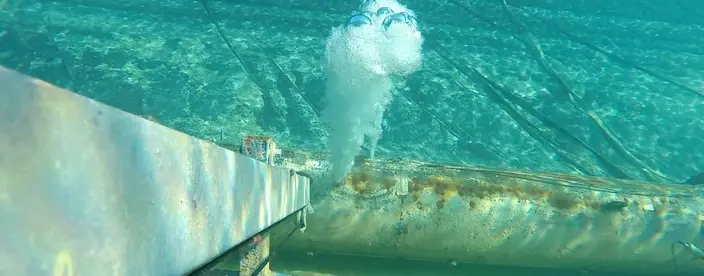
Reducing emissions and transitioning to sustainable energy will help to mitigate the effects. SwRI’s greenhouse gas leak detection research and testing can help validate leak detection technologies for many different gases, including methane and hydrogen, in realistic field conditions. |
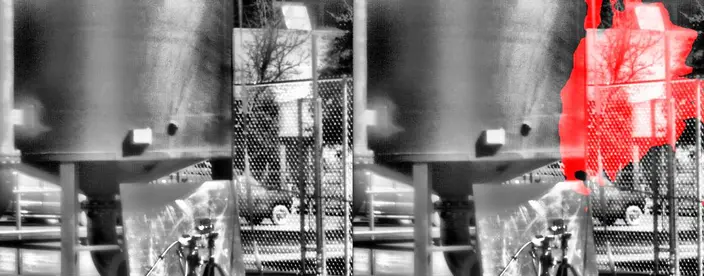
Flare burners may perform below target specifications, resulting in greenhouse gas releases. SwRI designed and built a first-of-its-kind, field-scale laboratory facility and test method to test commercial and novel flare tip designs, measuring destruction efficiency of methane outdoors. |

Flare Gas Methane Mitigation
Advanced new flare burner eliminates 98% of methane vented during oil production.
Air Quality
Poor air quality can negatively impact the respiratory health of residents. SwRI performs research in air quality monitoring, specifically for ozone and its constituent components: nitrogen oxides and volatile organic compounds. This work includes field testing and sensor validation.
| H2 Infrastructure | Hydrogen & Methane Blending |
|
SwRI’s R&D enables diverse clients in the hydrogen economy to draw upon deep expertise for a variety of technical challenges. We are researching hydrogen as a combustion medium in addition to developing materials, components and infrastructure solutions for the hydrogen fuel cell supply chain. |
SwRI’s natural gas facility allows for testing the effects of transporting natural gas and hydrogen blends in the same pipeline. Here we can help clients research hydrogen-based solutions to understand if infrastructure for climate-warming greenhouse gases can be transitioned to handle more sustainable resources. |
CO2 Sequestration

Supercritical CO2 foam textures at varying qualities, visualized at 1200 psi and 302°F.
Transporting and storing carbon dioxide (CO2) poses several challenges, including the need for additional infrastructure and equipment that can manage impurities related to diverse CO2 capture sources. SwRI studies two-phase CO2 flow to characterize pressure drop, liquid holdup and flow patterns. This fundamental knowledge is utilized to support equipment design and experimental testing environments for future CO2 infrastructure.
Water Treatment and Beneficial Reuse
Effectively treating produced water from oil wells is challenging due to its complex and variable composition, which includes high levels of salts, heavy metals, hydrocarbons and other contaminants. Developing and validating cost-effective and efficient water treatment processes is crucial to mitigate environmental impacts, enabling safe reuse or discharge while addressing both ecological and economic concerns associated with oil production.

Atmospheric Water Harvesting
SwRI investigates methods of pulling water from air, using silica gel beads, to decontaminate existing water sources.
Environmental Urban Data Analysis
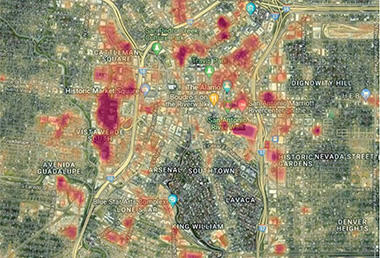
Data analysis of urban heat islands in San Antonio, Texas.
When dense concentrations of pavement and buildings replace green spaces, a community risks becoming urban heat islands (UHI) where temperatures can be 20 degrees higher than surrounding areas. SwRI research identified UHIs and pinpointed areas where people will most benefit from covered bus stops, water features and green spaces. SwRI is integrating and is analyzing data to strategically combat high temperatures.
To learn more, listen to a podcast featuring SwRI’s Shane Siebenaler and Justin Long discussing SwRI’s data fusion tool used to identify areas that most need relief from the scorching summer heat.