
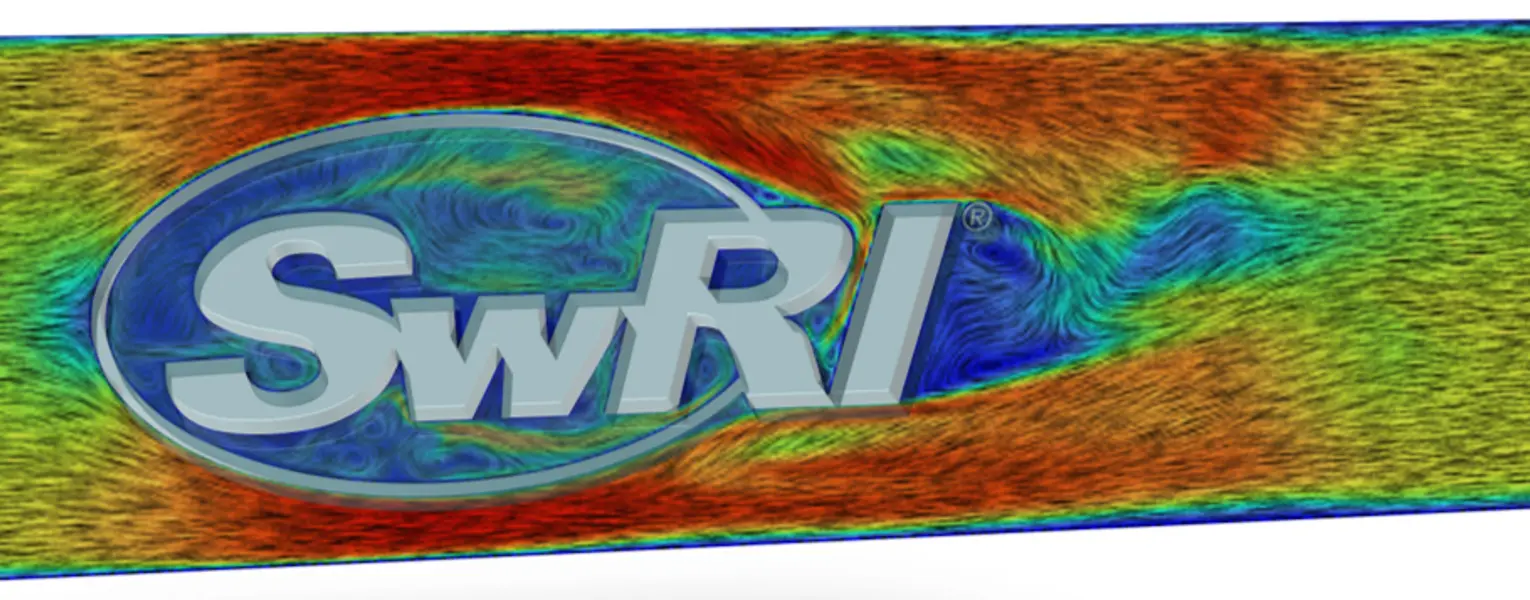
The emerging field of computational fluid particle dynamics (CFPD) is unlocking valuable insights into liquids, gases and particles for a broad range of applications. CFPD predicts the behavior of particles and fluids under various conditions, helping engineers optimize the performance of parts, structures and systems.
Southwest Research Institute (SwRI) offers CFPD modeling, simulation and evaluation services focused on fluid dynamics, particle dynamics, heat transfer and fluid-structure interaction. We specialize in coupling computational fluid dynamics (CFD) with discrete element modeling (DEM) and other methods.
CFD Particle Tracking & Simulation Services
SwRI uses simulation and modeling tools to track particle behavior, fluid flow and heat transfer. We apply a variety of CFPD particle tracking and simulation techniques and tools to unique applications, and we offer physical testing when applicable.
|
CFD & DEM Services |
Industries Served |
|
|
|
|
Performance Evaluation |
Design Optimization |
| Simulation offers a fast and cost-effective way of evaluating system performance. We apply target test conditions in virtual models and generate detailed plots (velocity, pressure, temperature) to assess performance before prototyping begins. | Beyond providing performance evaluations, we support clients with optimizing component and system designs. Our expects run iterative simulations with varying design parameters to identify configurations for improved performance, efficiency, and durability . |
CFD-DEM Coupling & CFD CAD Software
Our work is supported by a diverse set of advanced modeling tools, ensuring flexibility and accuracy across applications. Using CFD and computer-aided design (CAD) tools, the physical domain is replicated and discretized into a mesh. CFD solvers then apply the Navier-Stokes equations governing fluid motion to predict velocity, pressure, temperature and other flow characteristics.
- CFD-DEM Coupling Software:
- ANSYS Fluent, OpenFOAM, OpenFOAM + LIGGGHTS (for CFD-DEM coupling), MFiX, Flow3D and COMSOL Multiphysics.
- CAD & Geometry Preparation:
- SOLIDWORKS, ANSYS SpaceClaim and other CAD tools for geometry development, design integration and simulation setup.
Core Capabilities
Examples of our CFD capabilities and projects with CFD-DEM coupling solutions include:
- Erosion Modeling & Testing: Predict and analyze erosion in sand screens, jetting tools, and equipment through experimental testing and simulation.
- Consequence Analysis & Hazard Modeling: Plume dispersion, leak detection and potential impact radius (PIR) modeling for hydrogen and gas releases.
- Leak Detection & Pipeline Safety: Advanced computational and experimental solutions for leak detection and pipeline hazard assessment.
- Thermal Management & Structural Response: Modeling conjugate heat transfer, thermal stresses, cooling strategies and fluid-structure interactions to predict mechanical behavior under fluid and thermal loads.
- Pharmaceutical Device Modeling: Modeling particle-fluid interactions in dry powder inhalers and spray systems, with a focus on improving dispersion, delivery efficiency and device performance.
- Aerodynamic & External Flow Analysis: External flow simulations around bluff bodies, industrial equipment, structures and vehicles, focusing on drag reduction, flow behavior, wind loading and performance optimization.
- Carbon Capture & Utilization System Evaluation: Analyze CO2 absorption efficiency in industrial systems through impeller design evaluation and foam-loop modeling for carbon utilization and enhanced oil recovery (EOR).
- Integrated Computational & Experimental Validation: Combine modeling with physical testing to ensure accurate predictions and actionable insights.
Image
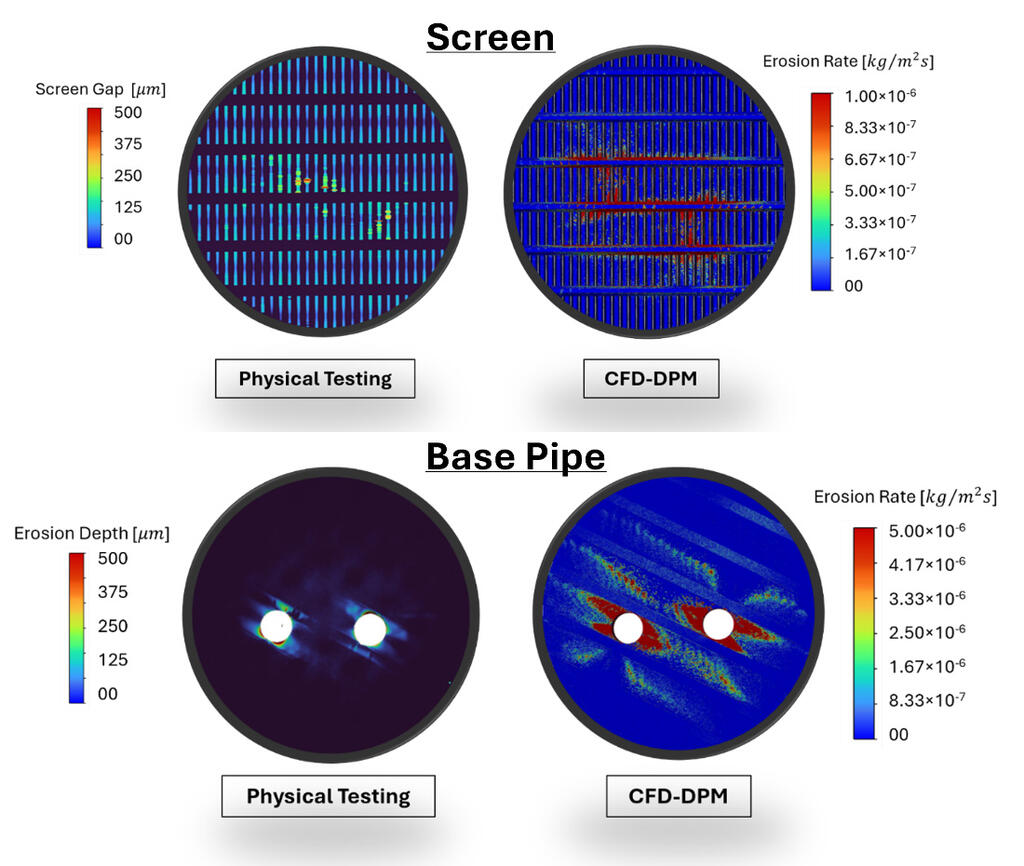
Case Study: Sand Screen Coupon Erosion Analysis – SwRI conducted a series of CFD simulations using ANSYS Fluent’s Discrete Phase Model (DPM) to predict erosion in a sand screen coupon. The computational fluid particle dynamics study demonstrated strong qualitative agreement between the CFD-predicted and experimentally observed erosion patterns, validating the simulation approach for use in erosion risk assessment and design evaluation.
For more information about computational fluid particle dynamics and CFD-DEM coupling, please contact Dr. Raouf Tajik or call +1 210 522 4524.