
Algorithms enhance weld sequence optimization to minimize distortion and residual stress
Accuracy and efficiency are becoming ever more critical in robotic welding as designers of structures seek to push the limit in design and what the manufacturing processes can deliver. As manufacturers seek to expand robotics automation into shipbuilding and heavy industry, both product design and manufacturing engineers need advanced tools to predict weld distortion and stress, which can affect structural integrity.
Southwest Research Institute (SwRI) recently explored the application of spatio-temporal graph neural networks (STGNNs) as part of a trained machine learning-based architecture combined with physics-based simulations to enhance outcomes for large structural fabrications that deal with real-world variation that is not accounted for in computer-aided design (CAD).
This blog delves into the project’s goals, prior work, updated approach and key results, along with insights that pave the way for future innovations.
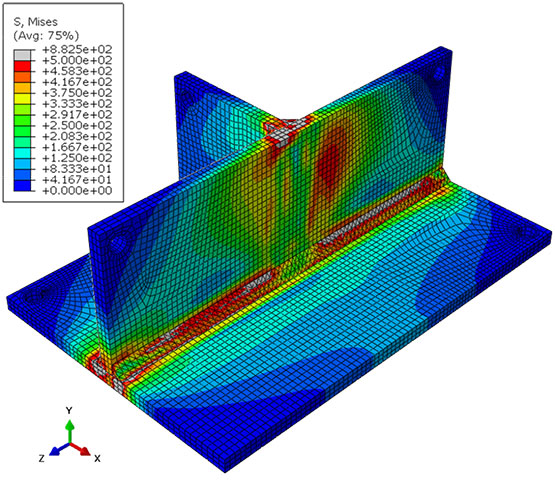
Traditional methods for anticipating distortion and stress in welded structures rely heavily on finite element analysis (FEA) simulations.
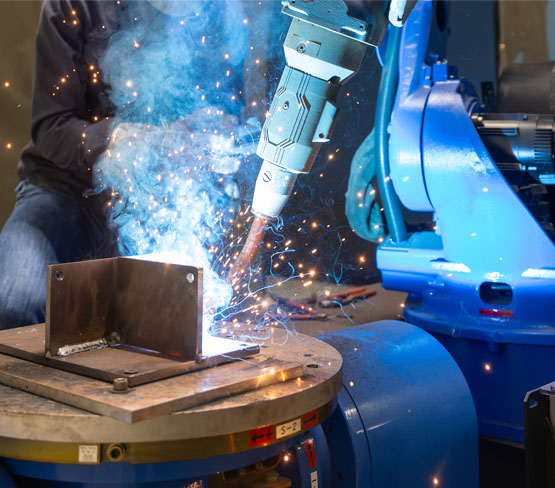
SwRI used real-world welding input and physics-based FEA simulations to train STGN algorithms to predict weld distortion and stress.
The Need: Optimization of Distortion and Residual Stress in Welded Structures
Welding, a critical step in manufacturing, often encounters challenges related to geometric distortions and residual stress caused by heat and material changes during the process. These issues not only affect part quality but can also compromise structural integrity, particularly in dynamically loaded components found in ships, tractor frames or aerospace structures. Traditional physics-based simulations have been valuable for evaluating such factors during the design phase, but they depend on idealized CAD models and struggle to account for real-world variability once manufacturing begins. Thus, there is a growing demand for learning-based approaches capable of adapting to real-world variations in welding processes.
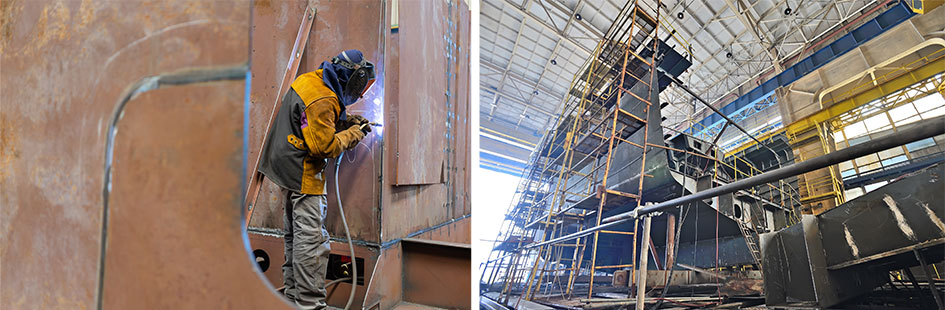
Examples of dry dock ship building. SwRI is developing automation technologies to increase human safety, reduce human exposure and increased process repeatability in naval sustainment and maritime robotics applications.
Prior Work: Establishing the Foundation
Finite element analysis (FEA) simulations have served as solid foundations of traditional methods for anticipating distortion and residual stress in welded structures. While effective for predicting system behavior, these simulations are computationally intensive, often requiring significant time, resources, and expertise. Additionally, when dealing with real-world variability, such as unexpected gaps or deviations in weld joints, physics-based models must be modified to incorporate the variability leading to additional delays. Previous studies have sought to bridge this gap using data-driven models, but challenges remain in scaling these to generalizable frameworks that can both learn from and complement physics-based simulations.
Updated Approach: Leveraging ML Frameworks with Physics-Based Simulations
The novel approach SwRI explored employs a spatio-temporal graph neural network (STGNN) as part of a machine learning (ML) framework, informed by data from physics-based FEA simulations. The developed learning-based model was trained to predict distortion and residual stress outcomes for specific welding configurations through examples of simulated and real- world experiments. These examples included the geometric features of the unwelded part, outcomes from a variety of welding sequences, and supporting data such as thermal histories. By integrating real-world variations into the input dataset, this approach not only leverages the quick inference speeds of ML algorithms but also ensures that the predictions align closely with observed physical behaviors.
The use of STGNNs allows for modeling complex interdependencies in welded structures, enabling the identification of patterns that inform the design of improved weld sequences. Additionally, the iterative feedback loop between FEA simulations and the learning-based model provided new opportunities to validate and continuously refine the model’s predictions—key to achieving a scalable, real-time system.
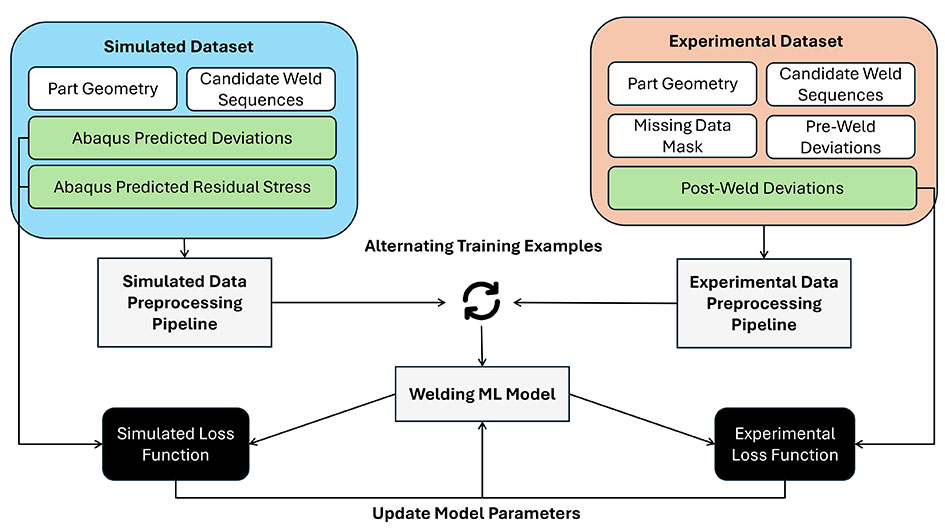
A workflow depicting the machine learning (ML) model training.
Results: Enhanced Predictive Accuracy and Real-World Relevance
The combined learning-based and physics-informed framework demonstrated significant improvements in predictive accuracy compared to traditional modeling approaches. Specific results included:
- Improved Weld Sequence Design: Optimization of welding sequences led to reductions in both distortion and residual stress, aligning with FEA and experimental results.
- Efficiency Gains: The ML model provided rapid insights into sequence alternatives, significantly speeding up decision-making in real-world production timelines.
- Generalized Predictions: The trained model proved effective across a variety of weld configurations, showcasing its generalizability to different manufacturing setups.
Takeaways: Charting the Future of Predictive Manufacturing
This work highlights the power of combining advanced machine learning frameworks containing novel algorithms with traditional FEA simulations to achieve improved manufacturing outcomes. Key lessons include:
- Data Matters: Effective training requires not only simulated data but also real-world input to account for variability and unexpected conditions inherent in manufacturing.
- Interplay Between FEA and ML is Key: The ability to exchange insights between FEA models and the ML framework enables predictive accuracy while reducing dependence on pure simulation.
- Scalable Modeling is Achievable: With proper setup, training, and system integration, generalizable models can be developed and applied to a range of manufacturing contexts.
As industry interest in learning-based approaches continues to grow, SwRI's work underscores the importance of collaborative innovation to untangle complex advanced manufacturing challenges. By bridging the gap between simulations and real-world variability, machine learning offers a promising path forward to enhance efficiency, precision, and reliability in industrial processes. This surrogate modeling approach, learning-based models standing in for traditional physics-based modeling, is extensible to an array of manufacturing use cases, including forging, coating and other processes where complex physics-models are unable to work on real-world parts with real-world variation.
This research highlights how thoughtful integration of ML tools into manufacturing systems can significantly impact product quality while reducing time and resource overhead — a vital step toward building smarter, more adaptive manufacturing ecosystems.
For this project, SwRI leveraged the Institute’s expertise in mechanical engineering, computer science and robotics automation. For more information, visit Naval Sustainment & Maritime Robotics or learn about our FEA solutions at Life, Integrity & Failure Prediction.
For more information, contact Matt Robinson or call +1 210 522 5823.