
Manufacturing & Reliability
About the Header
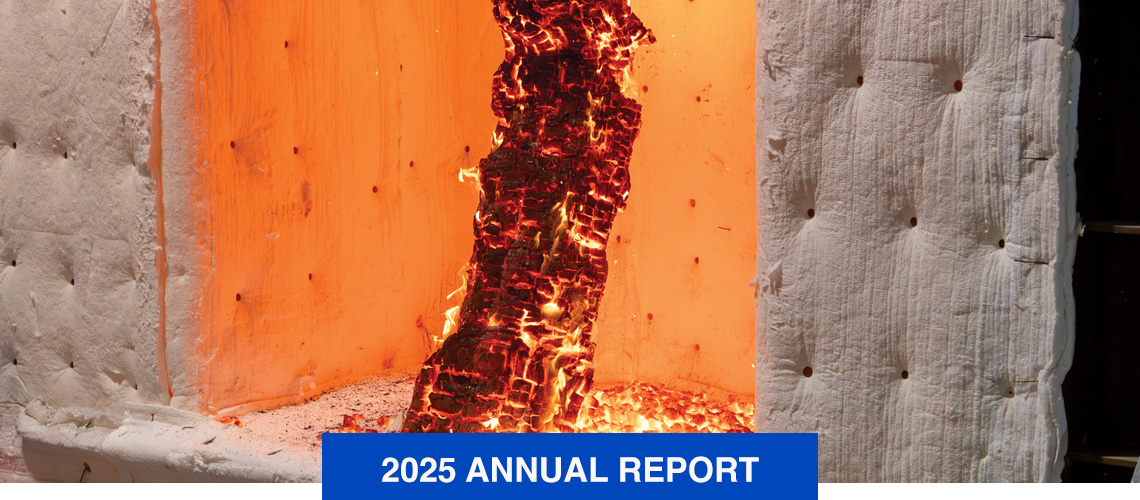
SwRI expanded its fire-testing capacities, developing specialized testing rigs to evaluate the structural integrity of construction materials, such as flooring and columns.
Southwest Research Institute supports the manufacturing industry with advanced automation technology, creating adaptive software tools and robot systems while supporting workforce training. We also help make sure aging infrastructure and new products meet or exceed standards for safety, durability and performance.
Engineers are updating the SwRI-created DARWIN® software to predict the structural integrity of metallic components built by additive manufacturing (AM) processes. Known as OPAL, or “One Part And Life,” the DARPA-funded initiative rethinks how AM parts are now qualified, exploring the possibility of predicting the life of an individual AM part within 12 hours of production to support surge manufacturing at distributed facilities.*
To support automation applications, SwRI developed a novel distributed camera system that provides real-time 3D pose estimation for robot movements using edge processors. This computing strategy processes data locally, near the source where it’s generated. This technique provides faster response times and lower power consumption compared to traditional data-center-based approaches while improving the safety of human-robot interactions.
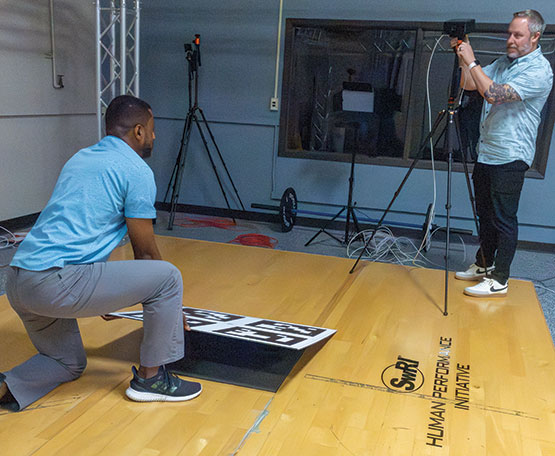
SwRI developed a distributed, camera-based technology to provide real-time 3D pose estimation for robotic applications using edge devices. The system uses ArUco markers, similar to QR codes, to improve the safety of human-robot interactions.
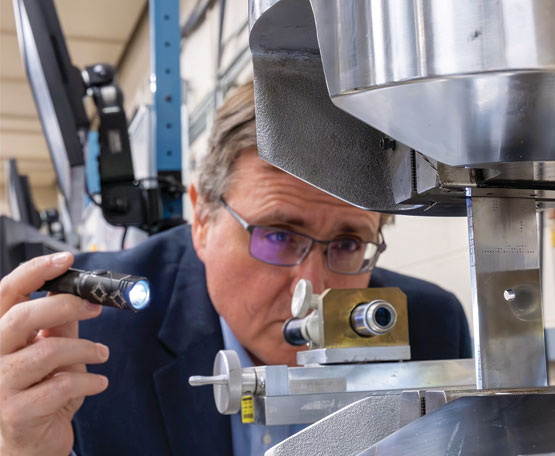
Using innovative fatigue testing methods, SwRI supports efforts to predict the structural life of additive manufacturing components at production.
For 30 years, SwRI has operated the Texas Manufacturing Assistance Center, supporting small and medium manufacturers in South Central Texas with automation and process improvement solutions. Regional demand for manufacturing assistance continues to grow with reshoring trends and growth in the automotive and semiconductor industries as well as with helping defense contractors navigate cybersecurity compliance standards.
SwRI expanded its fire-testing capacities, developing a specialized testing rig to evaluate the structural integrity of construction materials, such as flooring and columns. With maximum design loads of 125,000 and 130,000 pounds, the new capabilities offer the real-world analysis needed to ensure safety and performance of materials in the event of a fire.
* Approved for public release, distribution unlimited.