

ABOUT THE HEADER
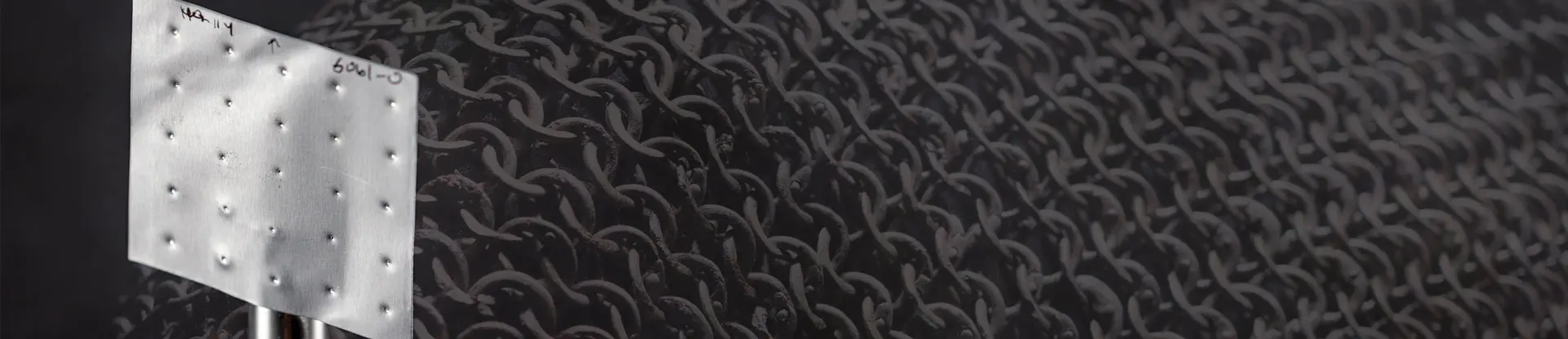
A small square 0.1 mm thick metal target is punctured with 25 holes from 0.3 mm projectiles fired during a novel laser-induced particle impact test (LIPIT).
Warriors have armored themselves against the weaponry of their day for thousands of years. Early Sumerian soldiers used copper helmets while ancient Greeks employed bronze breastplates and shields, and medieval knights wore chainmail, all designed to protect them from their enemies. The rise of gunpowder gradually reduced the effectiveness of traditional armor, as metal shielding strong enough to resist bullets proved too heavy to wear.
Modern armor emerged in the mid-20th century with steel helmets in World War I and eventually composite and ceramic armor to protect individuals and vehicles from increasingly accelerated impacts and innovative projectiles. The focus of modern armor is reducing weight while increasing ballistic protection through nanotechnology, advanced ceramics and smart materials.
The goal is to improve mobility and comfort while providing superior protection. Today, we can imagine a world where materials no thicker than fingernails can protect soldiers as well as spacecraft and even everyday vehicles from high-speed impacts.
But to get there, industry needs the ability to test the protective qualities of these advanced materials rapidly, using small samples of materials and producing relevant data. This vision is rapidly becoming a reality thanks to Laser-Induced Particle Impact Testing (LIPIT), a groundbreaking technique Southwest Research Institute recently improved.
Unlocking Laser Testing
DETAIL
SwRI has decades of experience in ballistics, explosive loading, structural response and scale modeling. Ballistic capabilities range from small arms testing to hypersonics research.
An SwRI team has opened new avenues for faster, cheaper and more effective ballistic testing through innovative uses of lasers and microscale projectiles. This research has astounding implications for a variety of industries. Researchers are tackling the hurdles to fully unlock its potential, essentially bridging the gap between LIPIT and conventional ballistics testing. The technique launches larger projectiles than previous LIPIT processes allowed — and at a higher rate. Previously, LIPIT launched microspheres 0.1 mm in size, and normal conventional ballistics programs conducted 30 to 40 tests a day. SwRI’s technique uses 0.3 mm microspheres and automates the process to conduct 200 tests in an hour.
Protecting soldiers, spacecraft or critical infrastructure relies heavily on materials rigorously tested for their ability to resist high-speed impacts. Traditional ballistic resistance testing is essentially a war zone in miniature: Guns fire bullets into targets, and researchers meticulously measure how materials hold up — or fail — under stress. These tests typically use large pieces of material, such as steel plates. But scaling these tests to evaluate new formulations can quickly devolve into a logistical and resource nightmare.
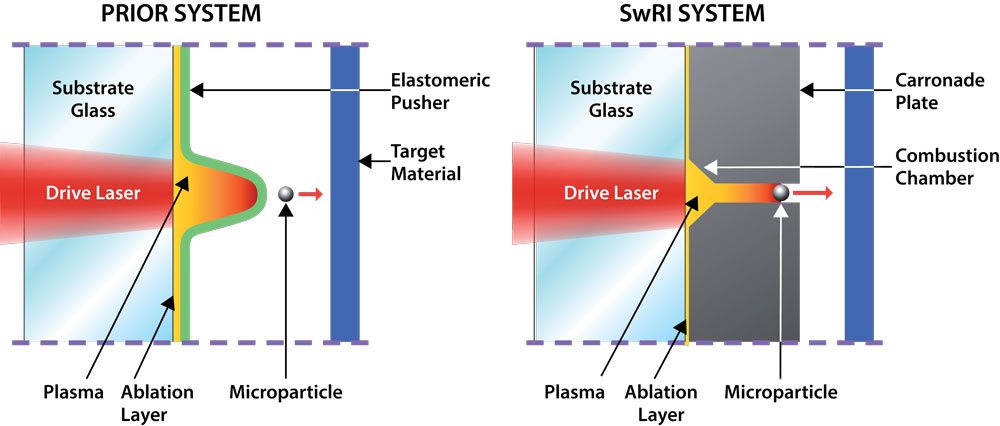
SwRI improved prior LIPIT methodologies, which used a high-intensity laser to blast microprojectiles 0.1 mm in size at velocities close to the speed of sound at a target material. SwRI’s enhancement uses larger 0.3 mm microprojectiles, which can enhance correlation to standard ballistics testing.
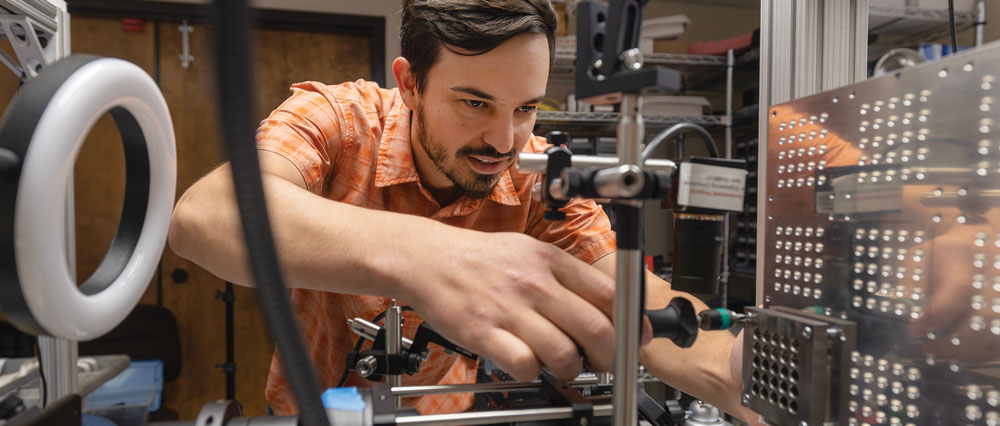
Senior Research Engineer Dr. Daniel Portillo developed facilities to scale up a LIPIT, which generates data that better correlate to conventional ballistics testing. His team then automated the process to allow hundreds of tests an hour.
In many cases, manufacturers have only small quantities of newly developed materials. This limits testing options because firing full-size bullets at very thin or small samples is pointless. The situation becomes even more impractical when rapidly trying to evaluate tens or hundreds of candidate materials.
LIPIT flips the script by scaling everything down, using lasers to launch microscopic particles — think sand grains but shinier and faster — at scaled-down targets. This allows researchers to emulate real-life ballistic impacts without the need for bulky weapons systems, extensive safety precautions or large material samples.
LIPIT Logistics
LIPIT testing is an elegant combination of physics and cutting-edge technology. A high-powered, nanosecond laser provides the punch needed to propel microscopic metallic spheres — 300 micrometers in diameter, roughly the width of a sewing needle — to speeds exceeding 500 meters per second, well beyond the speed of sound. The spheres are loaded into a miniature high-precision barrel system, and when the high-energy laser hits the barrel substrate, an explosion of plasma launches the spheres at a target.
Traditional ballistic testing relies on bullets propelled by the explosive force of ignited gunpowder. LIPIT swaps out chemical energy for photonic energy, using lasers to generate the gas pressure required to accelerate particles. This is where the magic happens. Because the lasers are so precise and repeatable, much of the process can be automated, allowing analyses for batches of test samples in rapid succession.
This time savings is just part of the equation. Testing smaller-scale targets also requires proportionally smaller quantities of material. LIPIT may need only one-tenth of the material normally required for a conventional experiment. This advantage is especially beneficial when working with exotic or experimental materials that are prohibitively expensive to produce.
Small Tests, Big Implications
Despite its advantages, LIPIT has faced skepticism. The research community has questioned whether miniature impacts really predict how full-scale materials perform in life-or-death scenarios. The SwRI team addressed this concern head-on, conducting rigorous scaling studies to validate the reliability of their method.
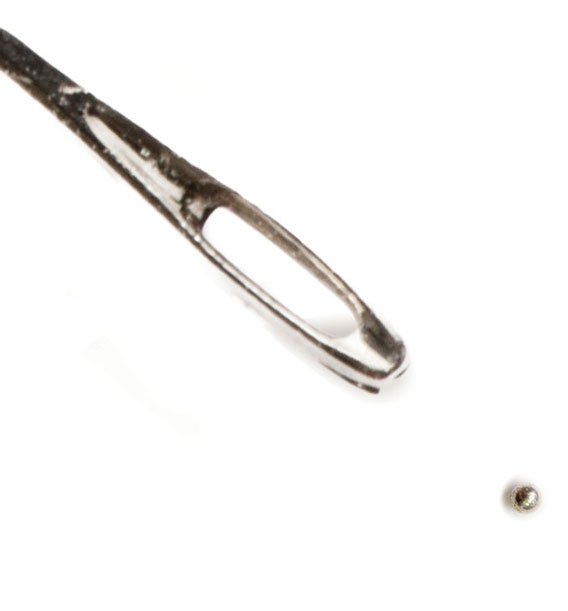
SwRI has expanded and advanced LIPIT testing to make data more applicable to full-scale ballistics testing. The system launches larger projectiles, 0.3 mm verses 0.1 mm in size, shown here with a needle for scale.
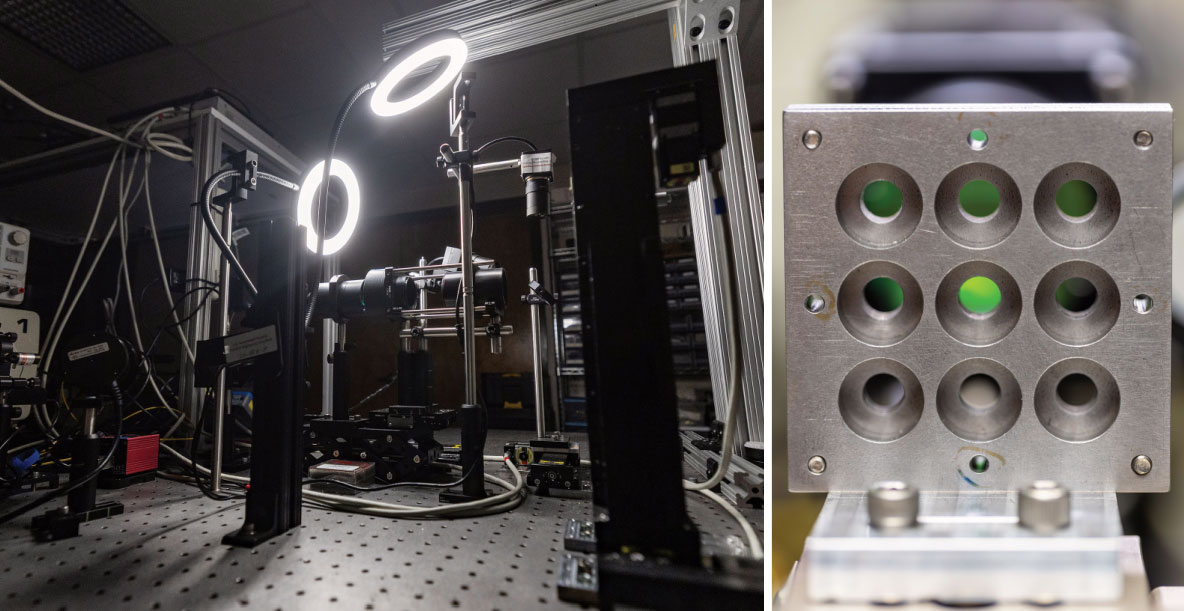
SwRI developed a test system that bounces high-energy laser light around the bench to precisely hit the barrel substrate, causing an explosion of plasma to launch the spheres at a target.
SwRI collaborated with industry consultants to pit different materials against 300-micrometer projectiles. The targets ranged from high-performance aluminum alloys to ultra-high molecular weight polyethylene (UHMWPE) to Kevlar, all common materials for military helmets and aerospace applications.
Interestingly, metals like aluminum demonstrated solid scalability, meaning that their performance in LIPIT tests could reliably predict their performance in real-world scenarios. UHMWPE showed similar promise, but Kevlar and other woven fabrics proved trickier — possibly due to the millimeter-scale structures of their yarns, which couldn’t be scaled down in a way that mimicked the real-life conditions of full-scale impacts. While these challenges remain, the successes with metals and UHMWPE opened the technology to an expansive array of applications.
Faster Path to Better Armor
The potential to accelerate the innovation pipeline for protective materials is among the most exciting implications of the SwRI advancement. Researchers are refining methods to close the gap between miniature modeling and full-scale testing. By using larger projectiles with LIPIT, SwRI researchers have created scaled targets that retain meaningful thicknesses and material properties. The technique has also sparked interest outside the realm of traditional ballistics. For instance, testing could be adapted to understand micrometeoroid impacts on spacecraft hulls or to contribute to the design of impact-resistant consumer products.
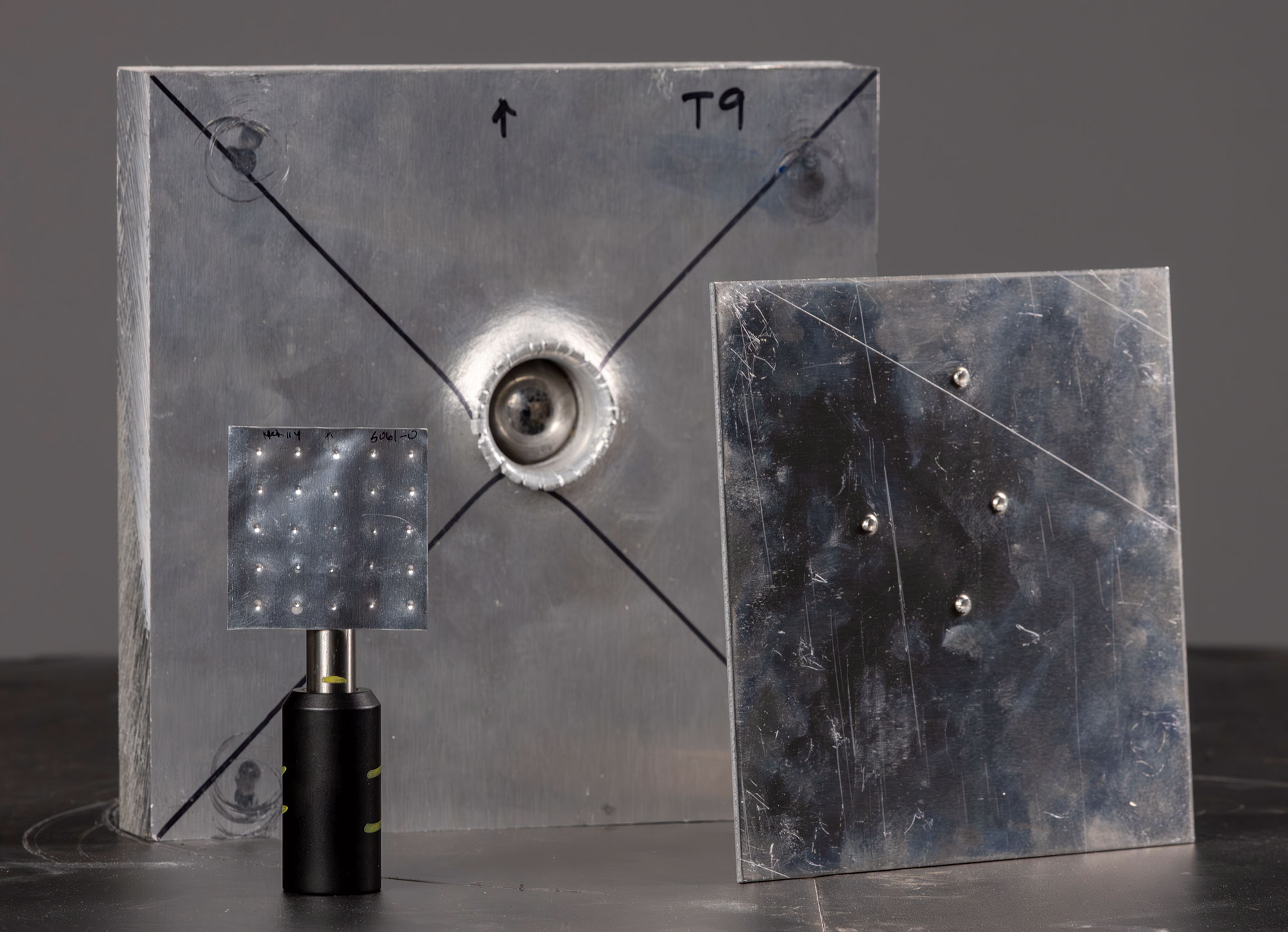
SwRI compared LIPIT experiments (foreground) with conventional ballistics tests (background) to demonstrate correlation. The SwRI technique punctured a small 0.1 mm thick metal target (left) with 25 holes from 0.3 mm projectiles fired using novel LIPIT and a 2 mm thick metal target punctured by 3 mm projectiles (right).
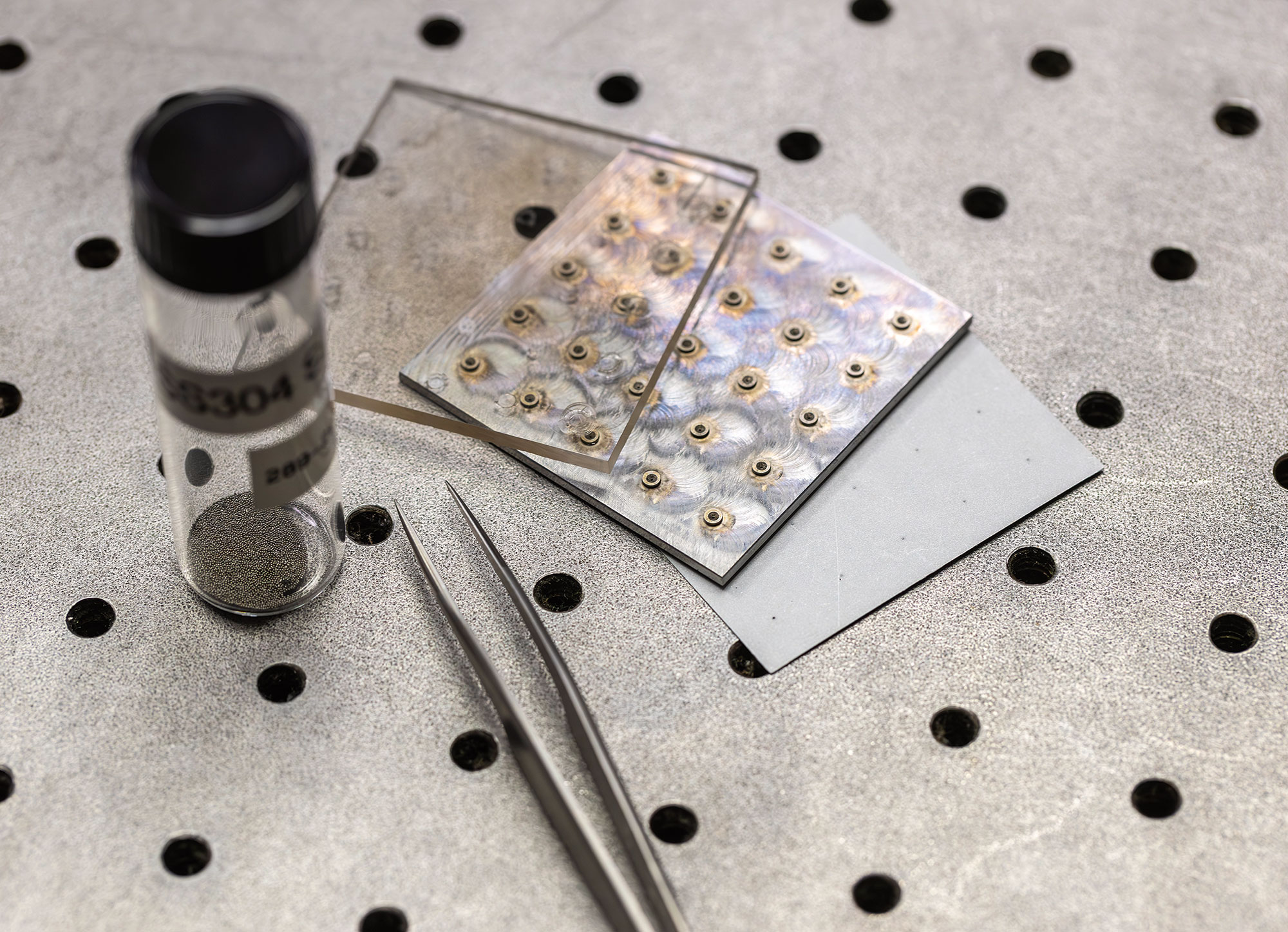
The thousands of microscale impactors in the vial allow SwRI to conduct LIPIT experiments and understand the ballistics response of materials rapidly on a small scale. The goal is to make ballistic testing faster, safer and smarter as well as ultimately expand and improve the innovation pipeline for protective materials.
This method allows us to test materials and scenarios that were previously inaccessible due to time and cost restrictions. This accessibility could be game-changing for industries ranging from automotive engineering — where crash-resistant components are in high demand — to nanotechnology, where researchers are exploring ultra-tough, lightweight materials for energy storage devices. The possibilities are vast.
Challenges, Collaborations Ahead
While LIPIT brings obvious benefits, obstacles remain. The scalability issues with fabrics highlight the need for more nuanced approaches when dealing with complex, multilayered materials. Additionally, researchers are working to push the limits of the system even further, investigating whether even larger projectiles could be launched at higher speeds to more closely mimic the ballistics of real-world scenarios.
These challenges underscore the importance of interdisciplinary collaboration. The U.S. Army’s SBIR/STTR Program has supported the research, which has involved participation from multiple institutions and other private labs. This collaborative ecosystem around LIPIT allows for continuous learning — building on what works and refining what doesn’t.
To encourage knowledge sharing, the team presented their findings at major symposia, including the International Symposium on Ballistics and MACH Conference, where their work has already gained significant recognition.
Brighter, Safer Future
The LIPIT narrative is the story of relentless innovation. It’s about harnessing the precision of lasers and the physics of microscale impacts to solve real, human-sized problems. From saving lives on the battlefield to enabling safer cars and spacecraft, the SwRI team’s work is proving that sometimes smaller really is better.
As laser technology advances and researchers refine their methods, the speed of progress will only accelerate. Materials once thought too delicate to fabricate, let alone test, are now entering the realm of practical application. And despite challenges, one thing is clear: The door to high-throughput ballistic testing is wide open, and it’s propelled by the quiet hum of a high-powered laser.
SwRI’s ultimate goal is simple: making ballistic testing faster, safer and smarter. And with LIPIT, that goal is undoubtedly within reach.
Questions about this story or Ballistics & Explosives? Contact Dr. Daniel Portillo at +1 210 522 4688.
ABOUT THE AUTHOR
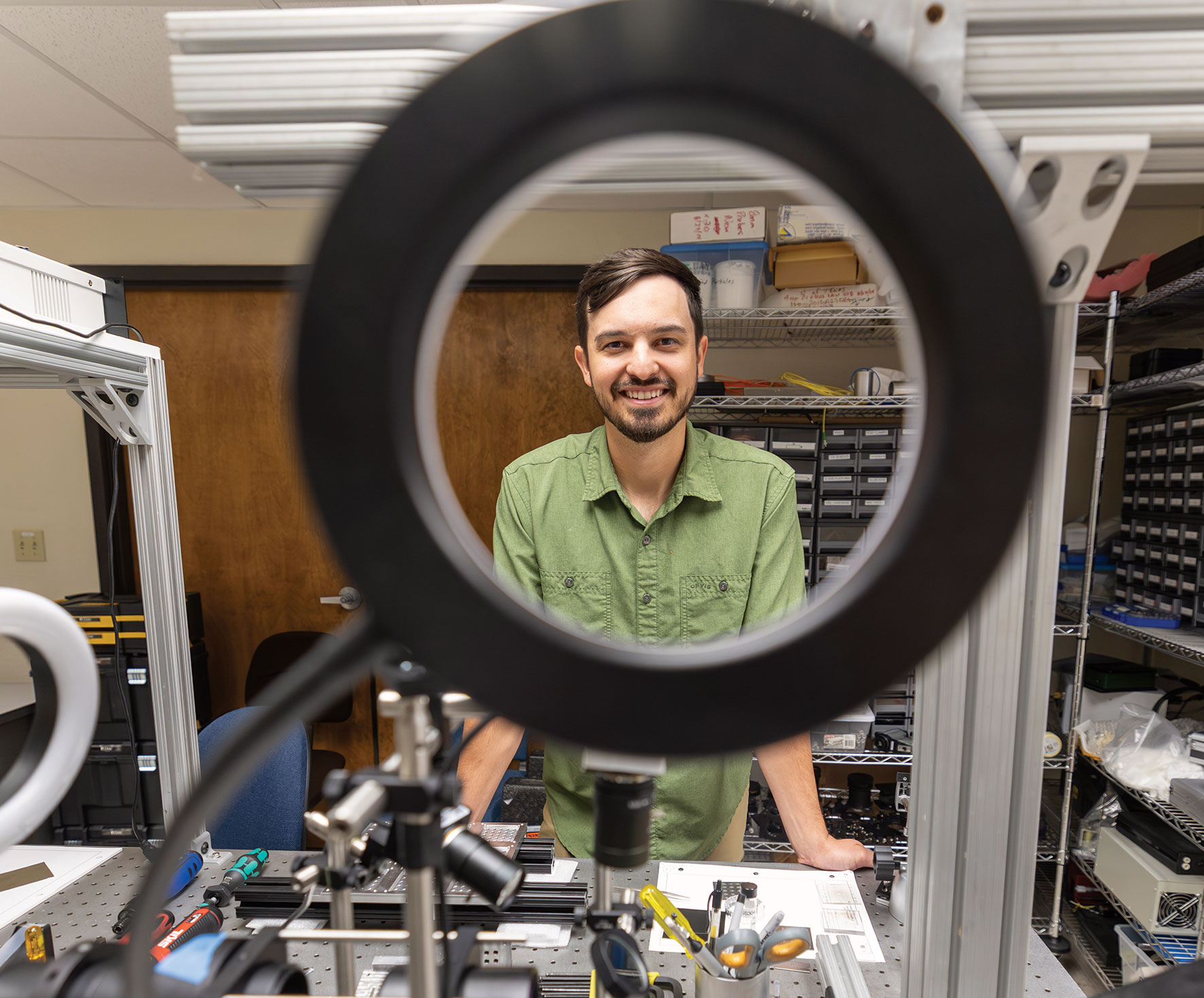
Senior Research Engineer Dr. Daniel Portillo joined SwRI in 2022 as a research engineer after receiving his bachelor’s, master’s and doctorate in mechanical engineering from the University of Texas at San Antonio. Last year, Portillo was lead author of a paper titled “High-Throughput Ballistic Limit Testing Using Laser-Induced Particle Impact Tests,” which earned the Rosalind and Pei Chi Chou Young Author Award at the 34th International Symposium on Ballistics in Jacksonville, Florida.
The author acknowledges the contributions of Institute Engineer Dr. Sidney Chocron and Senior Research Engineer Dr. Michael Heim to the development of SwRI’s improved LIPIT capabilities.