


Southwest Research Institute (SwRI) is entering a transformative era of energy research by aggressively investing in the physical infrastructure necessary to meet the world’s most complex and evolving energy requirements. These strategic expansions across our campus are not merely structural upgrades; they represent a significant capability upgrade and fundamental commitment to our mission of advancing science and technology for the benefit of government, industry and the public. By providing independent and unbiased validation for emerging technologies, SwRI serves as a vital bridge between theoretical innovation and real-world application. Our goal is to ensure that the next generation of energy systems is safe, affordable and reliable and to provide an industry-wide resource to enable these developments.
Recent investments target the critical intersections of traditional energy infrastructure and modern power systems. This transition demands a multidisciplinary approach that leverages decades of expertise to improve mechanical, aerodynamic and thermodynamic performance. By upgrading our labs and test facilities, SwRI is improving its capabilities for large-scale technology development, reducing the costs of innovation for our clients by streamlining test setups and improving workflow repeatability. These facilities allow our engineers to measure and improve the performance of machinery and other power system components to meet specific client requirements and global standards. The following facility developments are central to this modernization strategy:
- The Machinery Innovation Center for High-Energy Fluids provides megawatt-scale testing for machinery operating with hydrogen, natural gas and other flammable fluids.
- Upgrades to the Nitrogen Blowdown Facility streamline subsurface safety valve testing while ensuring tests meet the rigorous demands of new gas storage applications.
- A major expansion to the High-Energy Annex Test (HEAT) facility tripled its airflow and pressure capabilities to better replicate conditions for utility scale combustion systems.
- Infrastructure improvements to the High-Temperature Energy Conversion and Storage (HITECS) facility provide a platform for testing thermal energy storage technologies.
- By repurposing flow loops to handle various gas blends, the Metering Research Facility is helping determine how existing pipeline infrastructure can be modernized to accommodate new fuel types.
- Upgrades to the High-Viscosity Flow Loop (HVFL) meet increased demands associated with processing and transporting heavy oils, including those found in multiphase flows.
ABOUT THE AUTHORS
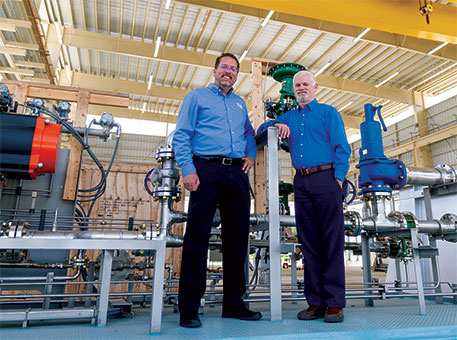
Dr. Tim Allison directs SwRI’s Machinery Department, which performs applied research in machinery and power systems for the oil and gas, propulsion, electric power and other machinery industries. He played a key role in designing the Machinery Innovation Center for High Energy Fluids pictured. Shane Siebenaler is the director of SwRI’s Fluids Engineering Department, which performs applied research addressing leak detection, emissions monitoring, multiphase flow, separation, flow measurement, erosion and other flow-related topics. The department is also involved in air quality and urban heat island mitigation research.
These facilities have already opened doors to significant collaborative research, including Department of Energy (DOE) projects developing machinery and thermal energy storage for energy applications and eight new hydrogen projects supported by the DOE’s ENERGYWERX program (for details, see Hydrogen Energy Research). These initiatives focus on the details of energy modernization, including the development and validation of energy system components, calibration of detection methods, evaluation of ultrasonic meters and analysis of material compatibility. By expanding our capabilities, we can now offer specialized services such as endurance or performance testing, gas analysis, component compatibility testing and leak detection assessment to a broader spectrum of industries and applications. Through these efforts, we continue to fulfill our role as a global resource, providing the technical foundation required to protect the environment and improve the human condition.
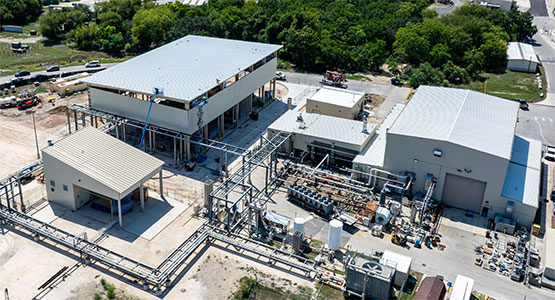
SwRI’s new 90,000-square-foot Machinery Innovation Center for High-Energy Fluids offers megawatt-scale testing of machinery that operates with hydrocarbons and other flammable gases.
Machinery Innovation Center For High-Energy Fluids
A new hydrocarbon research facility significantly expands SwRI’s research and testing capabilities, offering megawatt-scale testing opportunities for machinery and energy systems using hydrocarbons and other flammable gases. The 90,000-square-foot Machinery Innovation Center for High-Energy Fluids evaluates a range of machinery and power system components to enhance efficiency, safety and durability.
The center is designed to safely accommodate and use flammable gases, including hydrogen, hydrocarbons, organic fluids and refrigerants. Hydrocarbons such as natural gas are organic compounds composed of hydrogen and carbon atoms, which serve as a fundamental building block for many fuels, including petrochemicals. Some heat pumps also utilize flammable or otherwise hazardous refrigerants including hydrocarbons, hydrofluorocarbons or ammonia.
Flammable fluids such as hydrocarbons comprise approximately 75% of the U.S. energy supply and are pervasive for energy transport, storage and utilization in power generation and industrial processes. Testing and validation with flammable fluids is crucial to ensure system reliability and performance. These developments also allow SwRI to support emerging technologies and benefit humankind by providing an independent, unbiased and industry-wide resource.
The new facility can evaluate machinery or components such as gas turbines, centrifugal compressors, reciprocating compressors, industrial heat pumps, heaters, coolers, pumps and many other systems that use these fluids in power generation or conversion applications. The new capability accommodates flammable gases at up to 5-MW-electric motor drive (or 80-MW-thermal of natural gas) to facilitate technology development at industry-relevant conditions.
DETAIL
Olefins are vital industrial materials used in plastics, detergents and synthetic fabrics.
The center includes three new buildings, including an open-sided facility for drivetrains and piping systems. A 30-ton bridge crane allows the installation of heavy equipment on four dedicated machinery foundations rated for loads up to 150 tons. The electrical and control building provides up to 5 megawatts of electric power to support testing activities. Its dedicated control room features fiberoptic connections for fast data transfer across the facility. The third building houses a steam plant, and all systems connect to pre-existing infrastructure for compressed air, nitrogen, carbon dioxide and chilled water to facilitate a wide variety of testing scenarios. The facility’s fuel yard safely stores and handles various flammable gases and includes overhead pipe racks to safely and efficiently transport fluids to supply processes or vent gases to the facility’s flare stack.
The facility’s first two projects will focus on validation testing of machinery in two novel applications. The first project focuses on validation testing of a reciprocating compressor loop with natural gas and hydrogen blending up to 20%. The test will demonstrate system and component compatibility as well as performance at blended conditions with these gases. Another project will be a first-of-a-kind demonstration of turbomachinery used in a novel propane cracking process, converting feedstocks of propane and steam to high-value olefins through turbomachinery shaft work rather than in a gas-fired heater.
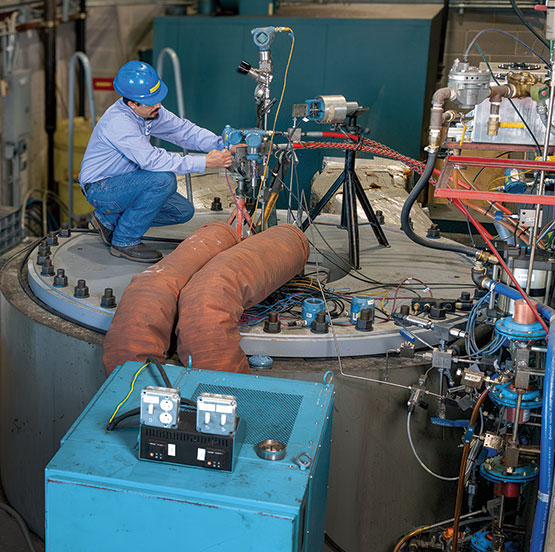
SwRI has made extensive upgrades to its facilities to offer more efficient and cost-effective subsurface safety valve testing to meet the demands of intense carbon capture and storage environments.
Nitrogen Blowdown Facility Upgrades
SwRI’s Nitrogen Blowdown Facility recreates high gas flow rates to test various equipment used in energy production, including subsurface safety valves (SSSV). These critical downhole devices are installed in oil and gas wells to prevent the release of hazardous fluids in the event of damage to surface equipment. These “fail-safe” valves automatically seal the well if control pressure is lost to prevent injury, loss of life and damage to the environment.
The Institute has provided third-party SSSV validation testing since the 1970s to support worldwide efforts to protect the environment from containment loss of wells. Several recent upgrades have significantly improved flow capabilities.
These strenuous tests for SSSVs and other pollution prevention and safety equipment support the energy and oil and gas industries as they transition to cleaner, more sustainable alternatives. One such shift is aimed at capturing and sequestering carbon dioxide (CO2) to reduce greenhouse emissions. Subsurface locations suitable for CO2 storage include caverns, reservoirs or depleted oil wells. SSSVs are prime candidates for safeguarding these storage applications.
SwRI has seen a rise in testing demand for equipment that can handle carbon capture and storage (CCS) applications worldwide to ensure that existing valves and safety measures will meet CO2 storage needs. SwRI has expanded its valve testing capabilities to evaluate existing SSSVs for CCS applications and address related challenges.
For example, very cold CO2 fluids can solidify under certain conditions. These conditions require test parameters substantially different than those required for typical oil and gas production applications, because CO2 properties change dramatically based on temperature and increased pressure, which could lead to a catastrophic leak. Increased safety measures are required for any testing program with CO2.
Recently, SwRI performed testing for companies involved in a joint industry project (JIP) to standardize testing procedures for validating valves for use in CCS environments. The team also participates in international standards development, including new standards for equipment related to CCS.
These efforts, combined with the rising demand for CCS-related testing, prompted SwRI to upgrade its testing capabilities to enhance safety, improve efficiency and reduce costs for clients. SwRI redesigned its facilities, including those complementing the Nitrogen Blowdown Facility, to streamline test setups, reducing labor costs by improving the repeatability of workflows. Modifications include an ergonomically improved enclosure as well as a new plug-and-play design tailored specifically to easily add thermal ducting for the below-ground test enclosure used to test valves at extreme temperatures.
The fully assembled test setup can be dropped into the test pit as a prepackaged unit, eliminating the need for intricate maneuvers over the facility. The result is a safer, higher efficiency, and more consistent testing process. These changes enhance existing benefits, including a high-quality nitrogen source, a highly reliable and time-tested leakage measurement system, and an experienced staff with decades of expertise.
The facility cools the SSSVs using a duct system that flows liquid-nitrogen-cooled air around the test article. This method allows the operator to reliably reach the extreme cold temperatures required to simulate CCS conditions while avoiding challenges such as icing.
SwRI is currently pursuing additional testing opportunities, such as cooled gas slam tests that simulate the worst-case dynamic scenarios in CCS environments.

The SSSV facility cools the test chamber using liquid nitrogen.
HEAT Facility Expansion
SwRI has made significant improvements to its High Energy Annex Test (HEAT) facility to support highly efficient gas turbine combustor testing. An internally funded research project designed new technology that expands HEAT’s capabilities, to better serve evolving industry needs, particularly for alternative fuel applications.
SwRI founded its HEAT facility in 2016 in response to a client request for gas turbine combustion system test support. Gas turbine combustion modeling is an important tool, but real-world testing is a crucial step before deploying any technology to the field. SwRI created a facility with controlled air, fuel and temperature supplies to test how combustors actually perform under realistic conditions. The HEAT facility supports physical combustor testing to validate designs, performance and safety under real conditions.
The facility is designed to run continuous, high-quality tests at high capacity, a rare capability that simulates how turbines operate in the real world. In recent years, SwRI identified improvements to lower the cost of combustion testing, which included designing and testing a new combustion rig concept utilizing additive manufacturing for multiple features, including the combustor liner. This approach can lower costs compared to traditional methods.
SwRI also improved the HEAT facility to address decarbonization challenges and the demand for cleaner, lower-carbon fuels. This entailed expanding HEAT’s fuel supply system to support hydrogen, ammonia and synthetic fuel testing. The upgrade also reduced test consumable costs by integrating a continuous low-cost gas supply, compressing and storing pipeline-transported natural gas from our utility rather than trailer-based methane or liquefied natural gas supplies. The system will be upgraded to accept liquid fuels such as diesel, biodiesel and synthetic aviation fuels.
In 2025, HEAT received a powerful new air compressor that expanded its ability to run higher-pressure tests that more realistically simulate real turbine conditions. This upgrade tripled HEAT’s airflow and pressure capabilities — up to 14 pound-mass per second and 300 pounds per square inch absolute — to support a wider range of combustion system testing at relevant flow rates and pressures. An ejector uses the facility’s air supply and pre-heater to create test conditions for aerospace propulsion applications up to Mach 4.0 and altitude conditions up to 88,000 ft.
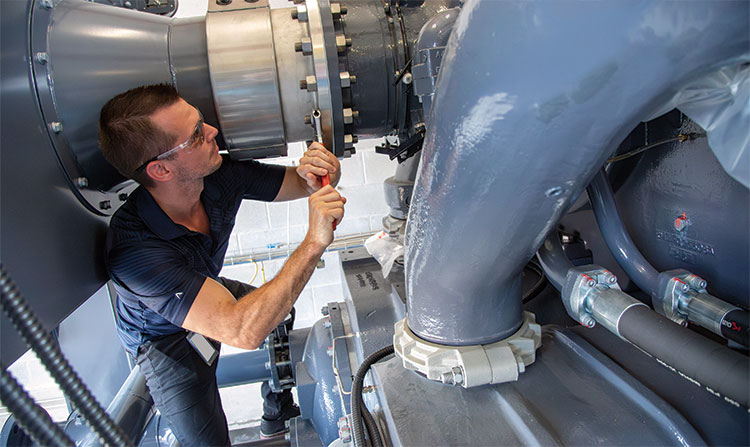
SwRI’s High Energy Annex Test (HEAT) combustion facility includes a new, powerful air compressor to explore how alternative fuels affect the performance of gas turbine combustion systems.
Metering Research Facility Expansion
SwRI's world-class Metering Research Facility (MRF) is a high-accuracy facility for flow meter development, calibration, research and testing. MRF’s high-pressure loop provides highly accurate and repeatable tests under a wide range of actual field conditions.
SwRI has expanded the capabilities of its MRF to ensure existing natural gas infrastructure is compatible with hydrogen fuels. This initiative is supported by internal funding and combines SwRI’s expertise in energy, power and automotive engineering to help several industries evaluate how blending hydrogen with natural gas affects infrastructure and technology.
Blending hydrogen into natural gas pipelines could prove to be a promising, cost-effective pathway to reduce greenhouse gas emissions using existing natural gas infrastructure. The industry is studying using hydrogen-natural gas blends to generate electricity and in home appliances such as heaters and ovens without impacting equipment or performance.
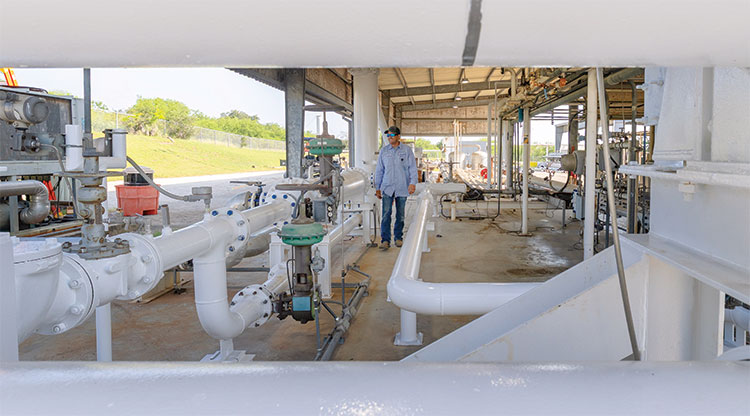
SwRI upgraded its Metering Research Facility to help several industries evaluate how blending hydrogen with natural gas affects infrastructure and technology.
To support this transition, the team repurposed one of two flow loops within the MRF previously used to study flow measurement and compression for low-pressure natural gas applications. Modifications allow the facility to test hydrogen-natural gas blends and explore the effects on pipeline systems, components and flow measurement technologies.
The upgraded facility now features an injection system to introduce hydrogen into the natural gas stream as well as other compatibility upgrades. These include a new safety system to detect both hydrogen and natural gas leaks. The upgraded system can simulate transmission, distribution and end-use scenarios for natural gas-hydrogen blends.
DETAIL
SwRI originally developed the Metering Research Facility for the Gas Research Institute in 1991 as an industry resource to research, develop and test flow meters and to support gas handling machinery and piping system programs. The natural gas flow calibration laboratory has transitioned to become an SwRI-owned facility supporting client research in 2004.
Initial studies are focusing on blends of natural gas with 5-25% hydrogen, pursuing both internal and client funding to understand how introducing hydrogen affects existing energy infrastructure. The enhanced facility now supports flow measurement testing, endurance evaluations, gas analysis, component compatibility analysis, leak detection and general component testing for clients. SwRI continues to dedicate a multidisciplinary team to hydrogen energy research initiatives, supporting efforts to decarbonize a broad spectrum of industries.
High-Temperature Thermal Energy Conversion & Storage
In 2022, SwRI demonstrated a complete pumped thermal energy storage system at the 50 kW scale in its High-Temperature Thermal Energy Conversion and Storage (HITECS) facility. With that expertise, the team pursued additional projects to develop and test thermal energy storage technology, requiring upgrades to handle the size, weight and electrical supply needs at ranges to support industry scale-up. These technologies are long-duration energy storage solutions providing cost-effective alternatives to electrochemical batteries to store energy from renewable resources. Because thermal energy storage technologies discharge heat directly without conversion back into electricity, they are particularly useful for zero-carbon heating applications, functioning as a bridge between variable renewable power sources and 24/7 heat demands.
DETAIL
The Supercritical Transformational Electric Power (STEP) pilot plant is one of the largest demonstration facilities in the world for sCO2 technology, achieving full operational speeds and temperatures. The pilot plant differs greatly from conventional power plants because it uses high-temperature sCO2 instead of water as a thermal medium in its power cycles, increasing efficiency by as much as 10% due to its favorable thermodynamic properties.
Prior to the upgrade, the facility included control and instrumentation rooms and an outdoor 9,500-square-foot concrete slab with a 100-kW power supply. The facility upgrade expands the slab by an additional 12,000 square feet capable of supporting heavy equipment. An expansion of the western portion of SwRI’s electrical grid upgrades site power to approximately 6.5 MW-electric.
The upgraded HITECS tests larger thermal energy storage systems, evaluating modules to support hundreds or thousands of megawatts end-use applications. The HITECS facility neighbors SwRI’s STEP Demo 10-MW-electric pilot plant and chemical engineering pilot plants, to facilitate future potential projects integrating thermal storage with power generation or chemical process applications.
DETAIL
Refractory bricks are specialized ceramic blocks designed to withstand temperatures exceeding 2700°F (1480°C), primarily used to line furnaces, kilns, wood stoves and fireplaces.
The HITECS facility is already engaged in two thermal energy storage projects. The first project is testing client technology incorporating refractory bricks chemically modified to increase their electrical conductivity. These “e-bricks” are effectively scalable high-temperature heating elements, and when combined within a matrix of conventional nonconductive bricks, they can be charged directly with electricity. SwRI is evaluating this first-of-a-kind technology using hot air discharge techniques. The second project is developing and testing molten salt in an actively managed thermocline energy storage tank. This cost-saving technique reduces the number of tanks needed by storing both hot and cold heat-transfer fluids separated by a natural stratification layer, actively managed to improve performance.
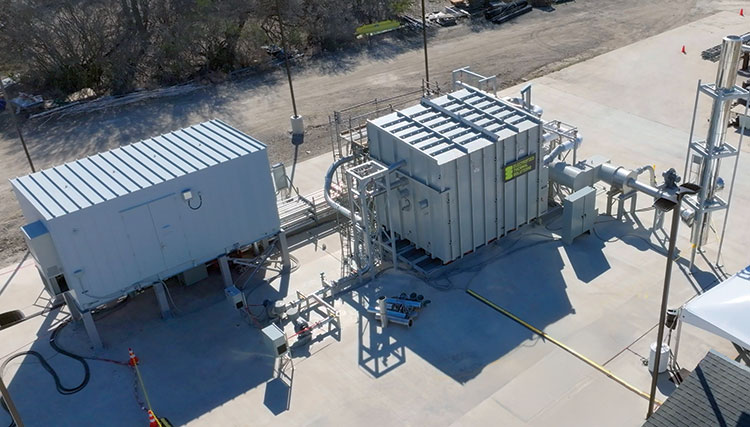
SwRI is testing a client’s 20 MWh, 1,800 degrees Celsius thermal storage system at its upgraded HITECS site.
High-Viscosity Flow Loop
SwRI upgraded its High-Viscosity Flow Loop (HVFL) to meet increased demands associated with transporting and processing heavy oils. The expanded and upgraded facility allows SwRI to offer more comprehensive, efficient and cost-effective heavy oil testing.
Increasing production of heavy oil around the world led SwRI to develop the HVFL in 2015 to gain a better understanding of how flow equipment performs when handling these extremely viscous fluids. Viscosity describes a fluid’s resistance to motion. Heavy crude oil is typically a dense, high-viscosity fluid exhibiting strong bonds between its molecules. The slow-moving substance is incredibly thick and sticky, like molasses or tar. This “thickness” is highly dependent upon the temperature of the fluid.
As industry taps into reservoirs with higher gas volume fractions, conventional pumping systems can struggle to process the volatile mixture of gas and liquid, demanding advanced gas separation technologies. SwRI addresses these challenges, evaluating pump performance with highly viscous fluids while also handling gas mixed into the fluid stream, simulating fluids with multiple phases (e.g., liquid and gas).
In industrial drilling systems, produced oil is rarely single-phase and often has natural gas mixed into the production fluid. The introduction of gas into equipment designed for liquid operations can impact equipment performance. Multiphase testing heavy oils can be costly, as most facilities are not optimized to handle highly viscous fluids.
SwRI modified the HVFL to inject air into liquids to evaluate how pumps designed for single-phase liquid flow will handle multiphase flows. The research is transitioning to handle heavy oils as well, in addition to testing multiphase flows with different viscosities.
The HVFL complements SwRI’s Multiphase Flow Facility, which offers multiphase flow testing at lower viscosities, but over a wide range of flow conditions.
In addition to the new multiphase capability, SwRI redesigned and optimized the HVFL, creating permanent infrastructure to provide cost-effective and efficient testing. The upgrade also improved environmental safety by extending the facility’s oil containment barrier to fully enclose the test setup.
Questions about this story, visit Energy & Environment or contact Dr. Tim Allison at +1 210 522 3561 or Shane Siebenaler at +1 210 522 5758.
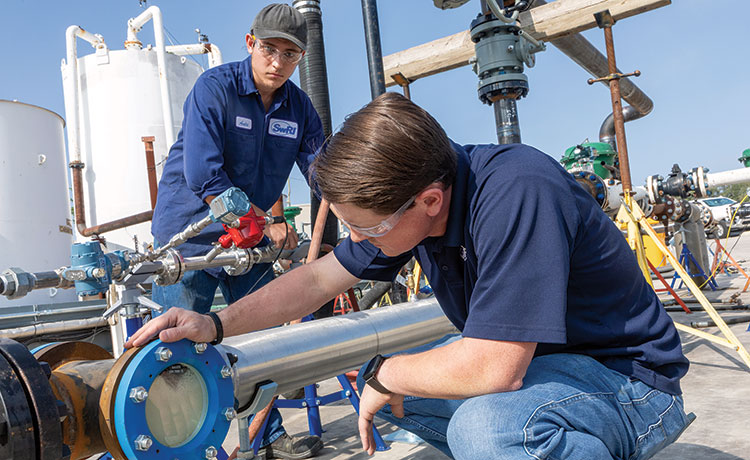
SwRI redesigned and optimized its HVFL, creating more permanent infrastructure to enable efficient cost-effective testing with heavy oils, including high-viscosity multiphase flows.