


On April 20, the SwRI-led Lucy mission got a close-up of the main belt asteroid (52246) Donaldjohanson en route to the never-before-visited Trojan asteroids, located in two swarms leading and trailing Jupiter along its orbit.
“Lucy came within about 600 miles of this curiously shaped object, revealing a strikingly complicated geology,” said SwRI’s Dr. Hal Levison, who is the principal investigator (PI) of the mission. “The first images showed an elongated contact binary, which probably formed during a slow-motion collision. A narrow neck connects the two lobes, which looks like two nested ice cream cones.”
In advance of the encounter, SwRI-led modeling indicated that the space rock may have formed 150 million years ago when a larger parent asteroid broke apart; and Donaldjohanson’s orbit and spin properties have undergone significant evolution since.
“The encounter confirmed the team’s expectations of a relatively young asteroid with a complex history,” said SwRI’s Dr. Simone Marchi, deputy PI of the Lucy mission. “We are studying its surface details and what they reveal about the collisional process that formed Donaldjohanson and countless other asteroids in our solar system.”
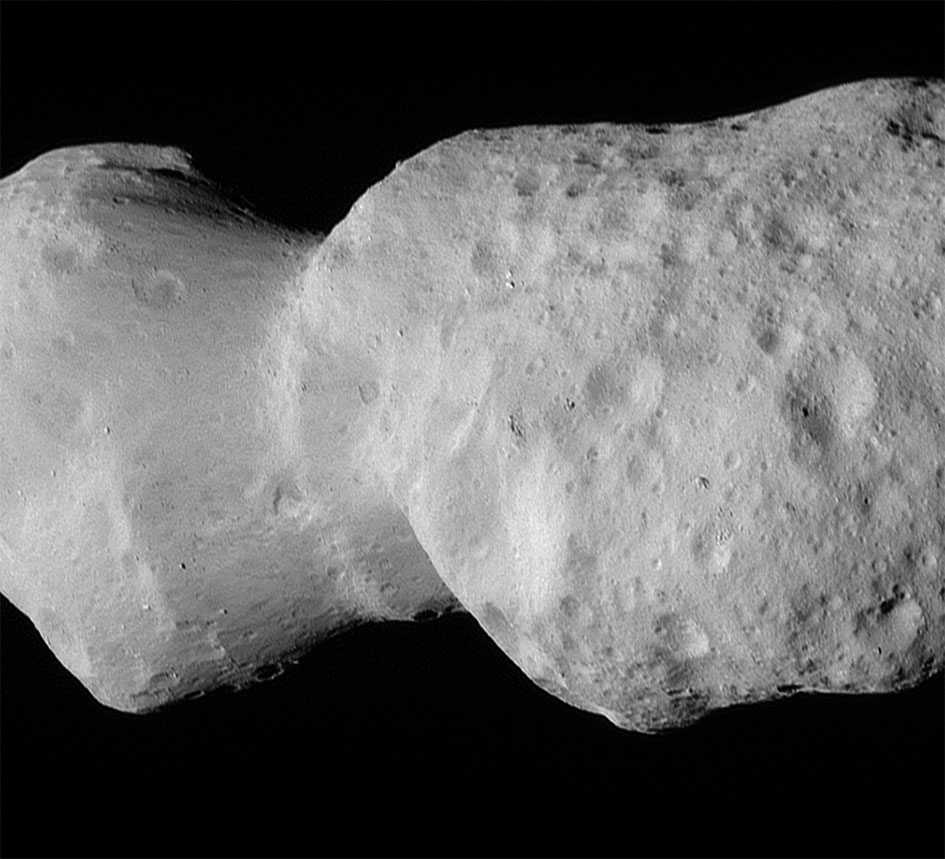
Courtesy of NASA/Goddard/SwRI/Johns Hopkins APL/NOIRLab
NASA’s Lucy spacecraft imaged the asteroid Donaldjohanson with its Long-Range Reconnaissance Imager (L’LORRI) near closest approach, from a range of approximately 660 miles (1,100 km). Sharpening and processing enhanced the image’s contrast.
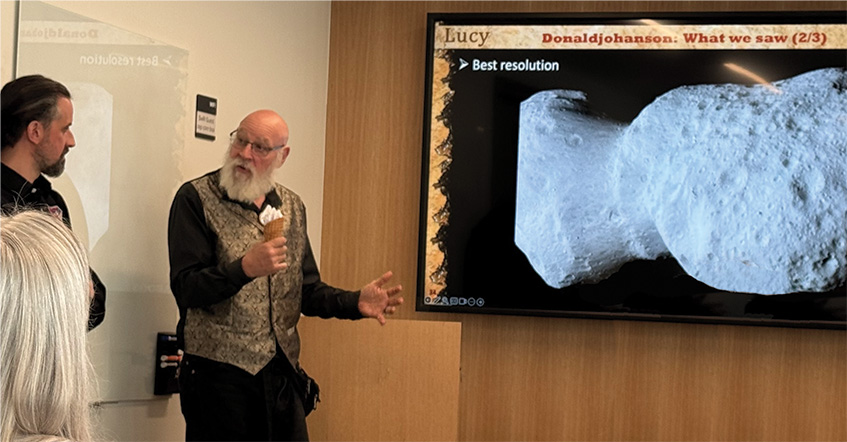
Lucy Deputy PI Dr. Simone Marchi and PI Dr. Hal Levison brief Boulder, Colorado, media about asteroid Donaldjohanson’s curious shape. Levison demonstrates how it looks a little like two nesting ice cream cones.

Donald Johanson, the asteroid’s namesake, was an invited guest at the flyby event.
After preliminary analysis of the images collected by the spacecraft’s L’LORRI imager, the asteroid appears to be larger than originally estimated, about five miles (eight kilometers) long and two miles (3 km) wide at the widest point. The asteroid has a common composition, made of silicate rocks and perhaps containing clays and organic matter.
Research indicates that Donaldjohanson is likely a member of the Erigone collisional asteroid family, a group of asteroids on similar orbits that was created when a larger parent asteroid broke apart. The family originated in the inner main belt not very far from the source regions of near-Earth asteroids (101955) Bennu and (162173) Ryugu, recently visited respectively by NASA’s OSIRIS-REx and JAXA’s Hayabusa2 missions.
“These early images of Donaldjohanson are again showing the tremendous capabilities of the Lucy spacecraft as an engine of discovery,” said Tom Statler, program scientist for the Lucy mission at NASA Headquarters in Washington. “The potential to really open a new window into the history of our solar system when Lucy gets to the Trojan asteroids is immense.”
Like Lucy’s first asteroid flyby target, Dinkinesh, Donaldjohanson is not a primary science target of the Lucy mission. The Lucy spacecraft will spend most of the remainder of 2025 travelling through the main asteroid belt. Lucy will encounter the mission’s first main target, the Jupiter Trojan asteroid Eurybates, in August 2027.
“Lucy is an ambitious NASA mission, with plans to visit 11 asteroids in its 12-year mission to tour the Trojan asteroids that are located in two swarms leading and trailing Jupiter,” Levison said. “Encounters with main belt asteroids not only provide a close-up view of those bodies but also allow us to perform engineering tests of the spacecraft’s innovative navigation system before the main event to study the Trojans. These relics are effectively fossils of the planet formation process, holding vital clues to deciphering the history of our solar system.”
Donaldjohanson is named for the paleontologist who discovered Lucy, the fossilized skeleton of an early hominin found in Ethiopia in 1974, which is how the Lucy mission got its name. Just as the Lucy fossil provided unique insights into the origin of humanity, the Lucy mission promises to revolutionize our knowledge of the origin of humanity’s home world. Donaldjohanson is the only named asteroid yet to be visited while its namesake is still living.
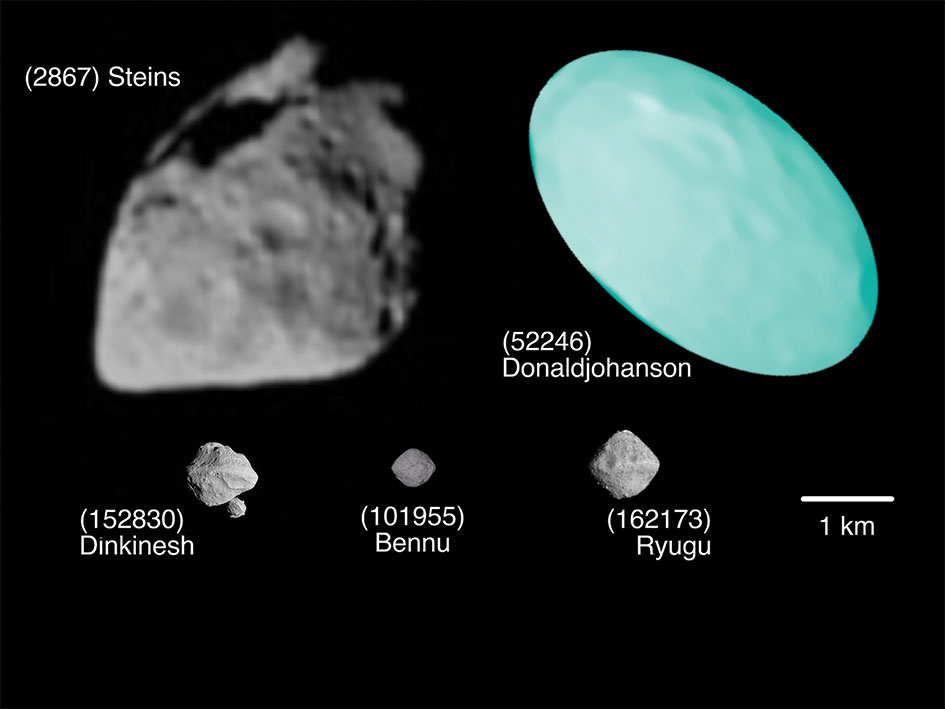
Image courtesy of SwRI/ESA/OSIRIS/NASA/Goddard/Johns Hopkins APL/ NOIRLab/University of Arizona/JAXA/University of Tokyo & Collaborators
This artist’s concept compares the approximate size of asteroid Donaldjohanson, to the smallest main belt asteroids previously visited by spacecraft — Dinkinesh, visited by Lucy in November 2023, and Steins — as well as two recently explored near-Earth asteroids, Bennu and Ryugu. Lucy, an SwRI-led NASA mission, plans to visit 11 asteroids in 12 years, culminating in the first encounters with Jupiter’s Trojan asteroids.
For more information, visit Planetary Science.