


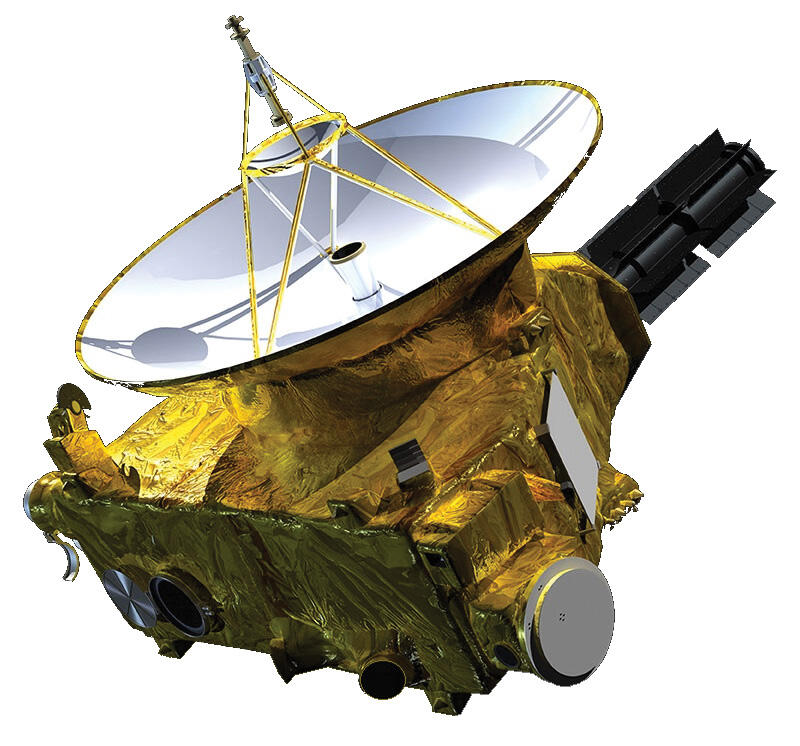
NASA’s New Horizons mission made history with its 2015 encounter with the Pluto-Charon system, followed by its flyby of the Kuiper Belt Object Arrokoth in 2019. More recently, the SwRI-led mission has segued to include heliospheric and solar wind studies as it approaches the edge of the solar system. New research has highlighted recent findings as New Horizons hurtles toward this mysterious region of space in anticipation of becoming just the third spacecraft to reach interstellar space, following Voyager 1 and 2.
The Slowing Solar Wind
The first study used data from NASA’s New Horizons spacecraft to uncover fascinating insights into why the solar wind gradually slows as it approaches the boundary of our heliosphere.
New Horizons is currently roughly 66 AU from the Sun. One AU, the distance from the Earth to the Sun, is roughly 93 million miles. The researchers, led by SwRI’s Dr. Heather Elliott, studied how the solar wind’s speed, measured by the Solar Wind Around Pluto (SWAP) instrument aboard New Horizons, changed between 21 and 58 AU compared to measurements taken nearer the Sun.
“As the solar wind travels away from the Sun at supersonic speeds, roughly 1 million miles per hour, eventually it encounters incoming interstellar neutral gas particles entering the heliosphere,” Elliott said. “These neutral interstellar atoms become ionized via charge exchange with solar wind ions.” The solar wind assimilates these interstellar materials, adding mass that causes it to slow down.
Previously, New Horizons and Voyager 2 measurements between 30 and 43 AU indicated the solar wind was 5-10% slower than at 1 AU near Earth. Now, New Horizons researchers found that at 58 AU the solar wind is 13-15% slower than the wind at 1 AU. This gradual slowdown aligns with previous models of how interstellar material enters the heliosphere and affects the solar wind. It also demonstrates how the Sun’s influence decreases over long distances.
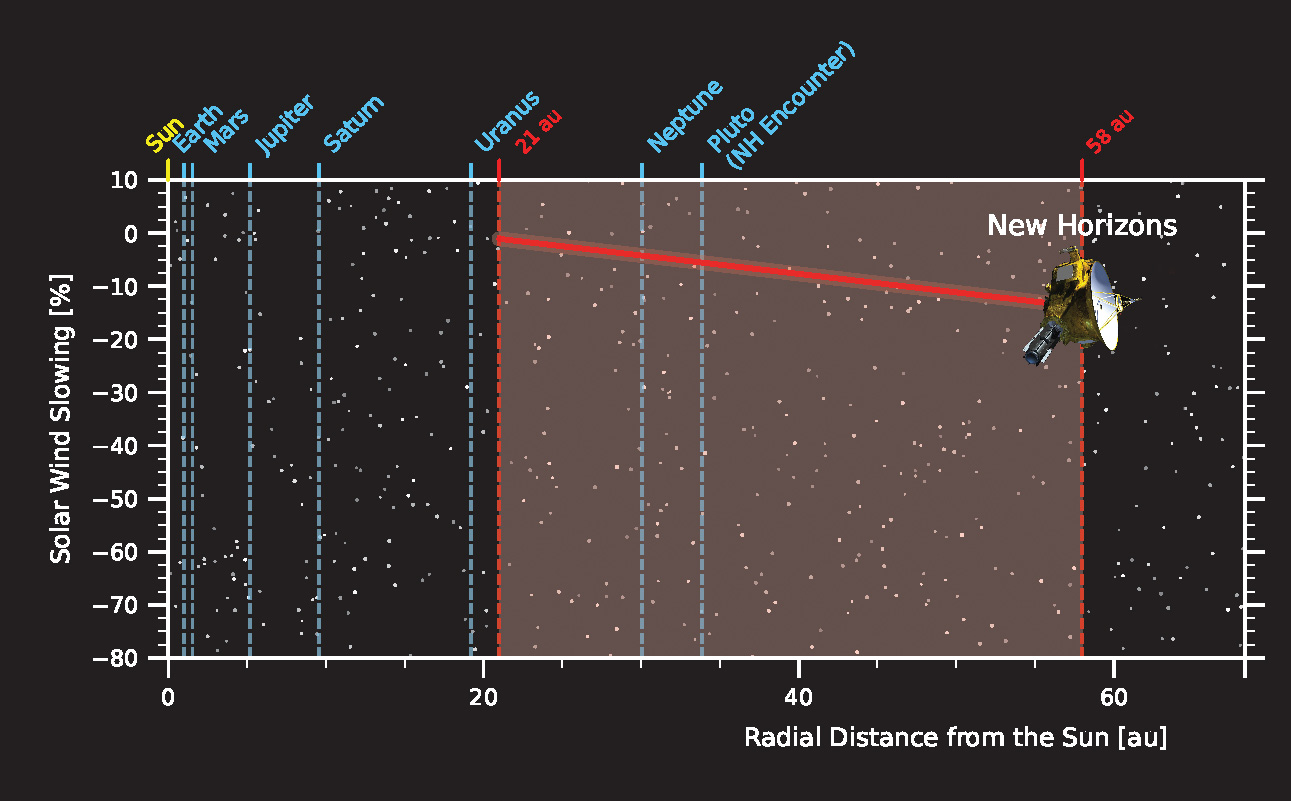
NASA’s New Horizons spacecraft measured the solar wind as it traveled from just beyond Uranus’ orbit into the outer Kuiper Belt (shaded region), detailing the gradual slowdown caused by interactions with interstellar materials (red line).
Defining Heliospheric Boundaries
SwRI scientists are using a solar wind forecasting method combined with analytic and numerical heliosphere models to define the boundaries of the outer heliosphere and predict when New Horizons will reach the edge of our solar system.
SwRI researchers are studying the heliosphere’s dynamic outer boundaries, including the termination shock and the heliopause, where the solar wind slows and then abruptly stops when interacting with interstellar material. These boundaries constantly expand and contract in response to changing solar conditions. During solar maximum, the “turbocharged” solar wind expands the heliosphere. During solar minimum, the waning solar wind allows the heliosphere to contract.
“When the spacecraft reaches the boundary of the heliosphere, we will be prepared to take measurements and download data about this region,” said SwRI’s Dr. Jonathan Gasser, lead author of two papers. “We predict that New Horizons will encounter the termination shock between 2029 and 2040. And it is possible that it could cross the boundary more than once as the heliosphere continues to expand and contract.”
For more information, visit Planetary Science.