

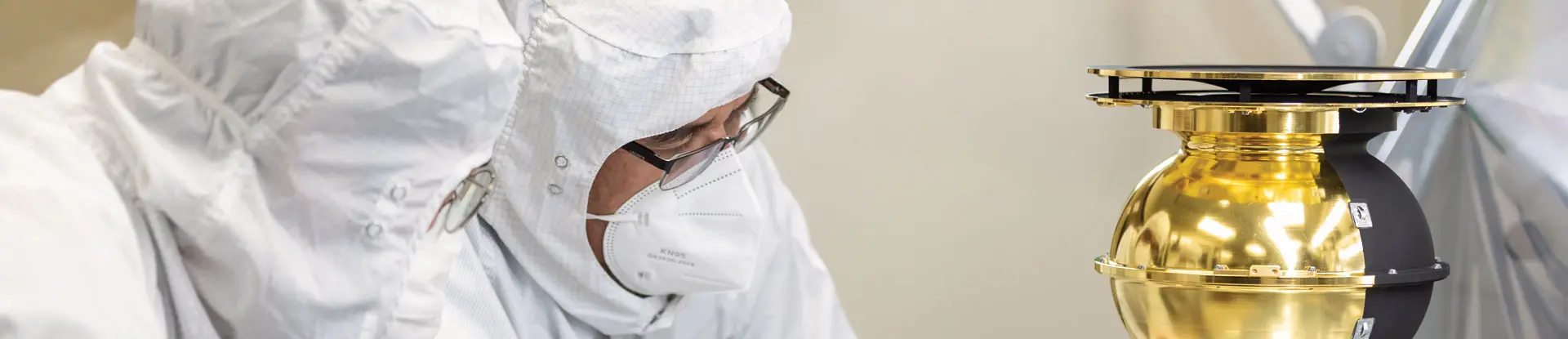
ABOUT THE HEADER
SwRI’s novel CoDICE instrument maintains operational reliability and longevity with its unique design. The half of CoDICE that will always face the Sun has a shiny gold surface to deflect heat energy, while the opposite side has a matte black surface to absorb as much heat as possible.
SwRI’s novel Compact Dual Ion Composition Experiment (CoDICE) instrument aboard NASA’s Interstellar Mapping and Acceleration Probe (IMAP) spacecraft has successfully collected first-light data. IMAP launched in September 2025 to help researchers better understand the boundary of the heliosphere, the magnetic bubble that surrounds and protects our solar system.
As a modern-day celestial cartographer, IMAP will chart the boundaries of the heliosphere encapsulating our entire solar system to understand how it interacts with the local galactic neighborhood beyond.
In addition to providing CoDICE, SwRI also managed IMAP’s mission payload, overseeing the development and delivery of all 10 IMAP instruments from multiple institutions. All have successfully recorded their first-light observations as the spacecraft journeys to its final observational post.
“IMAP features the next generation of instruments designed to give us a more complete picture of the interaction between the interstellar medium and the solar wind,” said SwRI’s Susan Pope, the mission’s payload manager. “This will provide a better understanding of our place in the universe.”
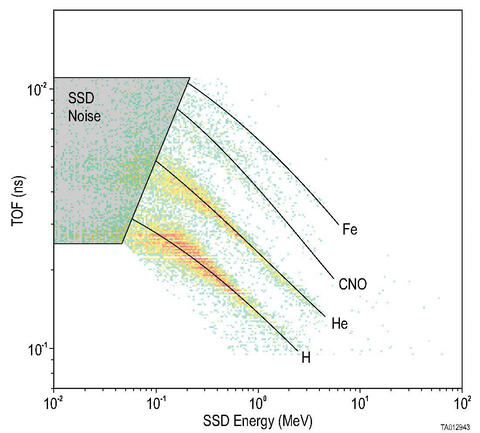
The SwRI-developed CoDICE instrument aboard IMAP collected first-light data that included these higher-energy measurements of hydrogen, helium, carbon, nitrogen, oxygen and iron. At least two separate instruments are typically required to make these types of measurements. CoDICE makes them on its own.
CoDICE measures the distribution and composition of interstellar pickup ions, particles that make it through the “heliospheric” filter. The instrument will also characterize solar wind ions as well as the mass and composition of highly energized solar particles associated with flares and coronal mass ejections.
“The CoDICE instrument performed as expected, identifying particles from different origins by measuring protons as well as rarer ion species, such as interstellar helium ions, and solar wind oxygen and iron ions,” said Dr. Mihir Desai, an IMAP co-investigator and part of the CoDICE leadership team.
The heliosphere is created by the constant flow of particles from the Sun known as the solar wind, which separates our solar system from the interstellar medium, the ancient cast-off winds of other stars. IMAP instruments will collect and analyze particles that make it through the barrier. The mission will also examine the fundamental processes that accelerate particles throughout the heliosphere and beyond. These energetic particles and cosmic rays can harm astronauts and space-based technologies.
“Initially developed through the Institute’s internal research and development program and then matured through the IMAP mission, CoDICE combines the capabilities of multiple instruments into one patented sensor,” said SwRI’s Dr. Stefano Livi, who led its development. “The 22-pound instrument is about the size of a 5-gallon paint bucket and has a unique and beautiful thermal management design.”
With all of IMAP’s instruments up and running, the mission has completed its commissioning stage and moved into the science demonstration phase.
Questions about this story or Heliophysics?