


A series of experiments conducted at SwRI’s Center for Laboratory Astrophysics and Space Science Experiments (CLASSE) facility supports observations of Jupiter’s icy moon Europa by the James Webb Space Telescope (JWST).
One study showed that Europa’s surface is constantly changing, as ice crystallizes at different rates in different places, resulting from a complex interplay of thermal and radiation-driven processes. Another study provided insights into the origin of elevated hydrogen peroxide (H2O2) near the moon’s equatorial chaos regions.
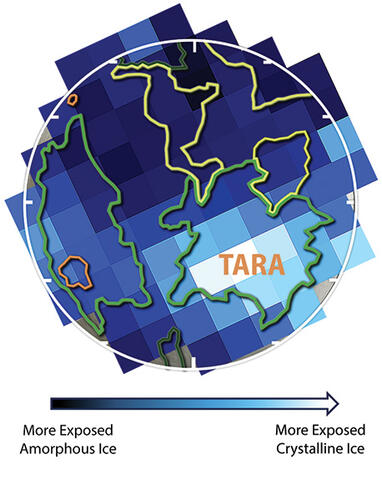
SwRI experiments produced evidence to support spectral data recently collected by JWST showing that the icy surface of Jupiter’s moon Europa is constantly changing. Ice on Europa is developing at different rates in different places, such as Tara Regio, where crystalline ice (lighter colors) is found both on and below the surface.
Crystalline Chaos Ice
In one study, the team conducted extensive laboratory experiments to assess time scales for the amorphization and recrystallization of ice on Europa, particularly in chaos terrains where features such as ridges, cracks and plains are jumbled together. A new paper co-authored by SwRI’s Dr. Ujjwal Raut weaves the JWST spectral data and SwRI experiments to understand crystallization dynamics of chaos ice.
For the past couple of decades, scientists have thought that Europa’s surface was covered by a very thin layer of amorphous ice protecting crystalline ice beneath this upper veneer (~ 0.5 mm depths). This new study found crystalline ice on the surface as well as at depth, especially at Tara Regio, a prominent chaos region in Europa’s leading hemisphere.
“We think that the surface is fairly porous and warm enough in some areas to allow the ice to recrystallize rapidly, outpacing radiation-induced amorphization,” said Dr. Richard Cartwright of Johns Hopkins University’s Applied Physics Laboratory, lead author of the paper.
Puzzling Peroxides
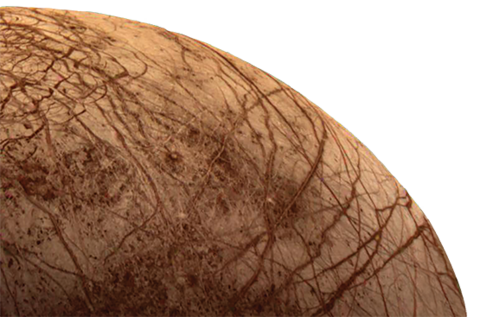
Image Courtesy NASA/JPL-Caltech
SwRI experiments offer insight into a hydrogen peroxide chemical cycle on Europa. Carbon-bearing species rising to Europa’s icy surface from a subsurface ocean are irradiated by Jupiter’s energetic plasma, synthesizing peroxide that may be cycled back down to the ocean, releasing chemical energy that may contribute to the ocean’s habitability
In a separate study, SwRI scientists conducted lab experiments to address a mystery about the distribution of frozen hydrogen peroxide on Europa. Scientists studying the telescope data noticed elevated levels of hydrogen peroxide on Europa in unexpected areas — the highest peroxide concentrations were found in the warmer equatorial chaos terrains rather than the colder regions toward the poles. Further research revealed that areas with enhanced peroxide also showed elevated levels of CO2, which may be seeping up through cracks in the ice shell from a presumed subsurface ocean.
“We simulated the surface environment of Europa inside a vacuum chamber by depositing water ice mixed with CO2 and irradiated this ice mixture with energetic electrons,” said Bereket Mamo, a graduate student at The University of Texas at San Antonio and an SwRI contractor. He conducted the research through a Future Investigators in NASA Earth and Space Science and Technology grant, with results highlighted in a Planetary Science Journal paper.
“The SwRI experiments demonstrated that trace amounts of CO2 in water ice can significantly enhance hydrogen peroxide production through radiolysis, helping explain the new JWST observations that show CO2 and H2O2 are spatially linked, co-existing in the chaos regions,’’ Raut concluded.
For more information, visit Planetary Science.