


SwRI and Southern Methodist University (SMU) are collaborating on projects using grant funding from the Seed Projects Aligning Research, Knowledge and Skills (SPARKS) joint program, which aims to strengthen and cultivate long-term research alliances between SwRI and SMU.
Advancing Solid-State Battery Technology
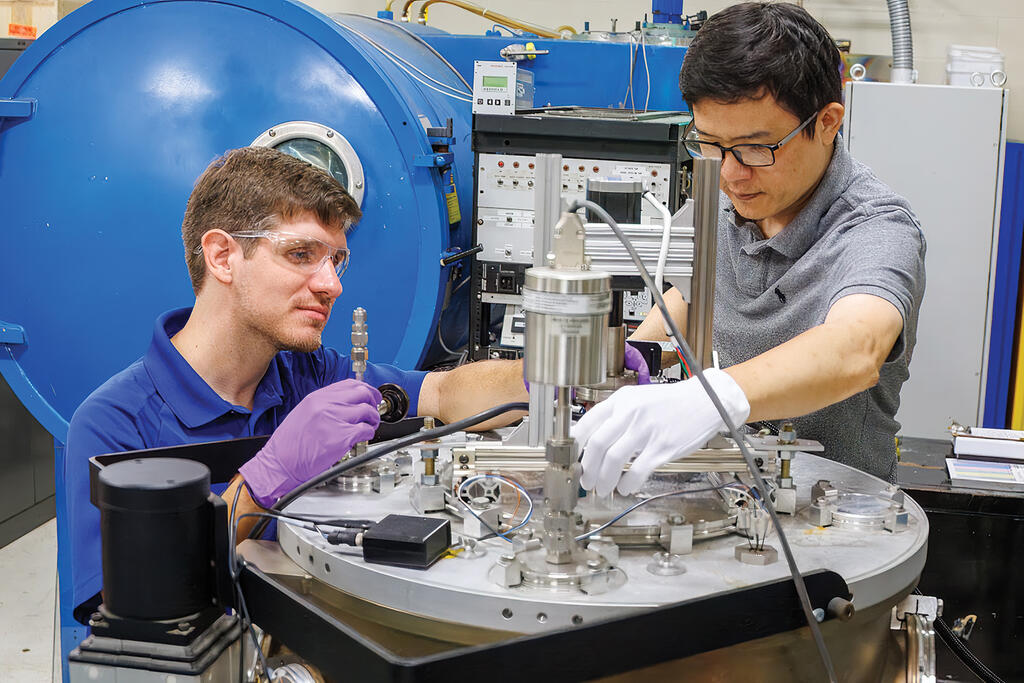
SwRI and SMU are collaborating to advance solid-state battery technology to improve stability and reliability. SwRI Senior Research Engineer Dr. John Hemmerling and Staff Scientist Dr. Jianliang Lin are engineering ultra-thin films to reduce degradation and resistance at the anode-electrolyte interface of a solid-state battery.
Researchers at SwRI and SMU are engineering ultra-thin films for solid-state batteries to reduce degradation and resistance at the anode-electrolyte interface, with the goal of improving their reliability and stability.
Solid-state batteries are safer, longer-lasting and more efficient alternatives to traditional lithium-ion batteries, offering faster charging and greater energy storage potential. They are especially promising for powering electric vehicles, but current designs fall short due to degradation of electrodes and interfaces over time.
“Solid-state batteries are next generation technologies with huge potential for energy storage, particularly for electric vehicles, but they haven’t been widely commercialized because of manufacturing and materials challenges,” said Dr. John Hemmerling, a senior research engineer in SwRI’s Materials Engineering Department. “One of the biggest technical hurdles is the unstable interface between the lithium metal anode and the solid electrolyte.”
The project will leverage SwRI’s expertise in thin-film deposition and SMU’s strengths in solid-state battery development to establish quantitative structure-property-performance relationships linking interfacial chemistry, lithium nucleation behavior and long-term electrochemical performance.
AI Controller for Complex Electric Microgrids
SwRI and SMU are developing an AI-driven controller for hybrid microgrid systems that integrate multiple energy sources and storage systems. Battery systems are effective for short-term energy storage, while hydrogen storage systems can potentially extend energy storage from hours to days. This can potentially enable greater system resilience and efficiency during periods of prolonged outages or renewable energy shortfalls, particularly as energy demands escalate with the proliferation of AI computing and data centers.
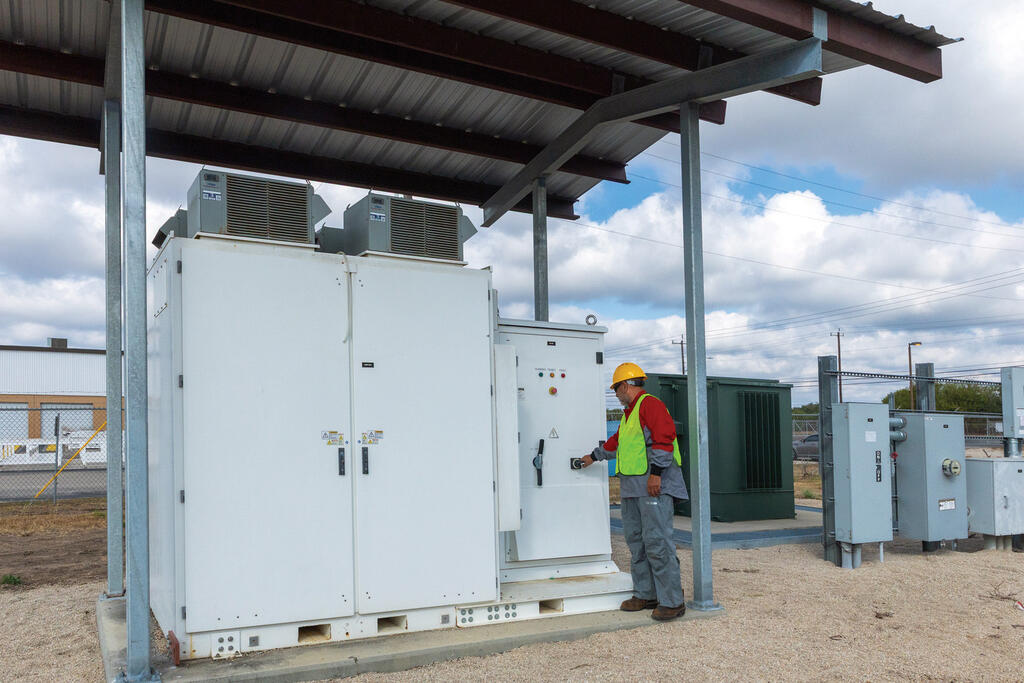
The SwRI-SMU SPARKS program is developing an AI-driven hybrid microgrid controller that coordinates battery and hydrogen energy sources and storage systems to improve the reliability, efficiency and resilience of critical facilities such as data centers. The project leverages real-world testing using SwRI’s on-campus infrastructure, including the grid-connected battery energy storage system shown.
The SwRI and SMU project will develop an AI controller for a microgrid configuration that integrates a battery energy storage system (BESS) with a long-duration hydrogen energy storage system (HESS). The application will integrate fuel cells, advanced solid-state storage technologies, renewable energy generation and the local energy grid. The grid will power electrolyzers to split water into hydrogen and oxygen through electrolysis to store hydrogen as energy.
“The rapid expansion of AI computing is creating unprecedented electricity demand, challenging both utilities and data center operators to find reliable and scalable power solutions,” said Dr. Richard Fu, a research engineer in SwRI’s Powertrain Engineering Division and one of the project’s principal investigators. “We are working to create a control system that integrates short- and long-duration energy storage with renewable power resources — without sacrificing reliability.”
Dr. Jianhui Wang, the Mary and Richard Templeton Centennial Chair of Electrical Engineering and a professor in SMU’s Department of Electrical and Computer Engineering, will develop the AI controller to regulate the microgrid’s performance efficiently.
For more information, visit Energy Storage Systems.