


SwRI and St. Mary’s University (StMU) have launched a new grant program to support collaborative research. The StMU-SwRI Technology & Applied Research (S2TAR) program aims to strengthen the technical ties between the organizations and cultivate long-term collaboration. Seed funding from StMU and SwRI is designed to advance research and position teams to jointly pursue and secure external research funding from government and industry.
Predicting Hydrogen Storage Durability
SwRI and StMU are collaborating to develop a physics-based forecasting tool that can predict the degradation and durability of TiFe-based metal hydride vessels through a chemical and thermomechanical framework.

A joint SwRI–St. Mary’s University project seeks to replace traditional, time-intensive physical hydrogen storage vessel durability testing with a high-fidelity modeling framework to advance metal hydride vessel technology as a reliable solid-state storage solution.
Metal hydrides are chemical compounds, often powders, formed when hydrogen reacts with metals or alloys. Metal hydrides can lock and store hydrogen in the compound’s lattice through a process known as chemisorption, offering one of the safest and most compact solid-state storage options for hydrogen available.
“Metal hydrides absorb hydrogen like a sponge at moderate pressures without the explosion risk of high-pressure tanks or the energy costs associated with liquefied hydrogen,” said Dr. Richard S. Fu, co-principal investigator of the project and a research engineer in SwRI’s Powertrain Engineering Division. “One of the unresolved barriers preventing their wider adoption as a storage vessel is their low durability. After repeated charge and discharge cycles, the alloy powder fractures, the powder-bed densifies and the vessel’s performance quietly degrades.”
Currently, the only methods of predicting degradation in these vessels require expensive, lengthy physical tests. Fu and Dr. Mohamed Shaat, co-principal investigator of the project and an StMU assistant professor of mechanical engineering, aim to replace traditional, time-intensive physical test cycles with a high-fidelity modeling framework.
For more information, visit Hydrogen Energy Research.
Improving Metabolic Cost Prediction
Another SwRI-StMU project seeks to expand and validate a system to estimate metabolic costs of movement to improve performance or rehabilitation. The team will combine the engine for Automatic Biomechanical Evaluation (ENABLE), SwRI’s markerless motion capture technology, with musculoskeletal modeling and machine learning to improve metabolic cost prediction for healthcare.
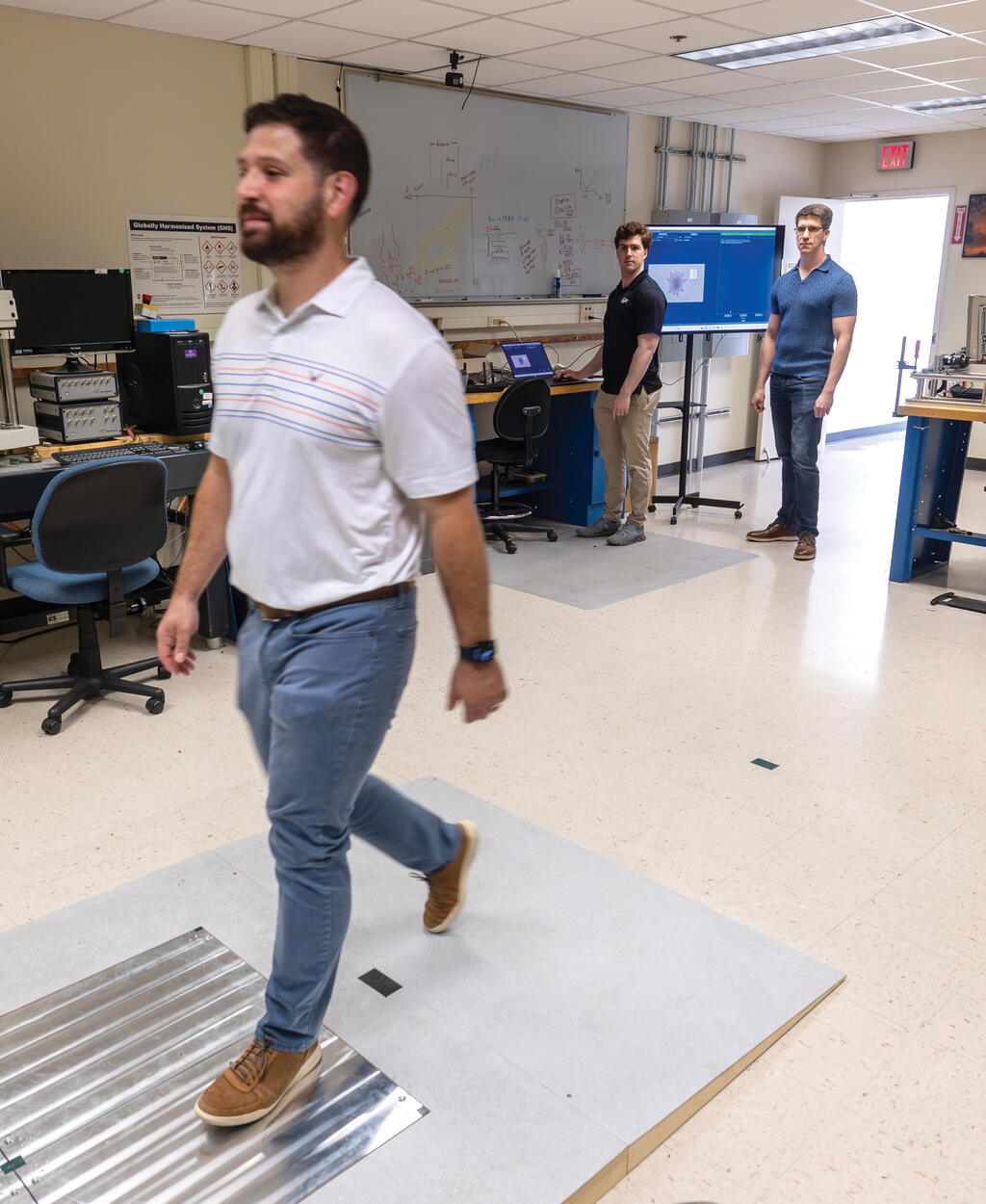
The SwRI and St. Mary’s University research will advance StMU’s machine learning algorithms to predict metabolic costs using ENABLE’s 3D markerless motion capture and musculoskeletal modeling capabilities.
“Metabolic cost is the amount of energy a person’s body uses to do an activity, like walking or running,” said Dr. Nicholas Vandenberg, a research engineer in SwRI’s Mechanical Engineering Division who is working with Dr. Ricardo Ramirez, an assistant professor of electrical engineering at StMU, on the project. The team is building on Ramirez’s work that uses 2D video footage and machine learning algorithms to predict metabolic costs. The team is extending the approach using 3D video captured by SwRI’s ENABLE tool.
The team will use ENABLE to capture movement data for people with below-the-knee amputations and people without limb loss. The researchers will use a metabolic cart to directly measure how much energy their bodies are using to move. Then the team will run the 3D motion data through musculoskeletal models. Comparing model outputs and experimental metabolic measurements to machine learning predictions, the researchers can validate and refine the algorithms.
The team hopes to improve outcomes for patients facing mobility challenges by allowing clinicians to understand movements that make patients work harder than necessary.
For more information, visit ENABLE.