

Southwest Research Institute (SwRI) and Trinity University have launched a new grant program to support collaborative research. Three unique biomedical research projects were funded in 2025, the program’s inaugural year.
“We are proud to launch this new focused grant program to grow Trinity and SwRI collaborations, provide opportunities for Trinity students and advance medical breakthroughs that may one day improve and even save lives,” said Dr. Joe McDonough, vice president of SwRI’s Chemistry and Chemical Engineering Division.
Stability Studies
One project is studying Thermus thermophilus, a bacterium with highly stable proteins, to advance understanding of stability mechanisms that could pave the way for advanced treatments for diseases such as Alzheimer’s, ALS and cancer. The bacterium is extremely heat tolerant and produces thermostable enzymes and proteins. Dr. Jonathan Bohmann, a staff scientist at SwRI, and Dr. Laura Hunsicker-Wang, a chemistry professor at Trinity University, will explore the structure of these stable proteins.
“For SwRI’s part, we’re working to determine a baseline for how mutations or changes in a protein can degrade stability,” Bohmann said. “Nearly any structural change will affect the stability of a protein, but some mutation sites are more relevant than others. We want to understand those changes and if small molecules could bind to those sites to restore stability.”
For more information, visit Medicinal Chemistry Services.
Targeting PTSD
Another project is developing an intranasal drug-device combination to treat post-traumatic stress disorder (PTSD). Researchers are screening formulations and delivery methods for oxytocin, a hormone that plays a critical role in human bonding and stress mitigation. The project expands on prior collaborative research with Trinity University that explored treating alcoholism and relapses with oxytocin. SwRI successfully packaged oxytocin using liposomes, or nanosized protective spheres made of organic compounds, to ensure targeted delivery in the body.
“Intranasal delivery of liposomes can bypass the blood-brain barrier and allow the treatment direct access to the central nervous system. In addition, the intranasal delivery has commercial precedents with other Food and Drug Administration-approved liposome-drug combinations, making future advancements more feasible,” said SwRI Staff Scientist Dr. Mike Rubal.
For more information, visit Materials & Bioengineering.
Prodrug Promise
A third project seeks to improve a prodrug, a compound activated in the body, to mitigate tissue and organ damage associated with heart attacks, strokes and traumatic injuries. It will address both the initial lack of blood and the rush of blood that follows treatment.
“Protein misfolding during cellular stress is a key driver of tissue damage, so the new prodrug will target that,” said SwRI’s Dr. Christopher Dorsey, who will synthesize the new formulation. “Once we figure out the synthesis route, we will train Trinity students to carry out our new technique. That’s the exciting part of this collaboration, the opportunity to give back and pass along what we learn to a team of future scientists.”
For more information, visit Pharmaceutical Development or Microencapsulation.
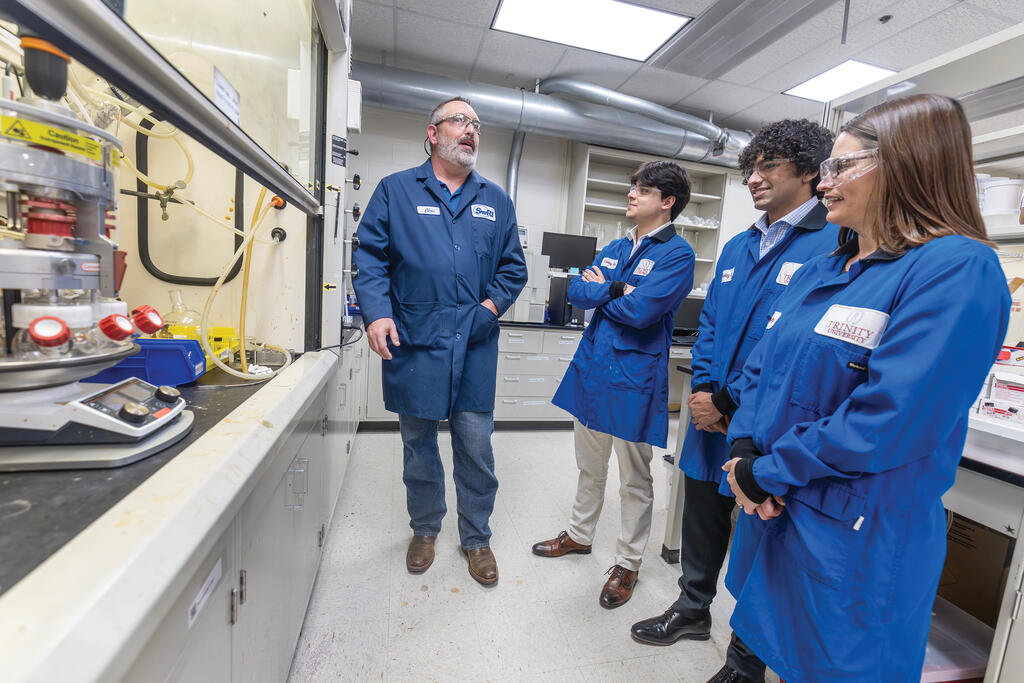
SwRI is collaborating with Trinity University to develop a prodrug to mitigate tissue and organ damage in patients treated for heart attack, stroke and other injuries. The team includes (from left) SwRI Senior Research Scientist Christopher Dorsey, Trinity students Cesar Perozo and Hrithik Patel, and Trinity University Associate Professor Christina Cooley.