

As the 3I/ATLAS comet zipped through the inner solar system in late 2025, SwRI scientists leveraged rare opportunities to study this interstellar interloper.
3I/ATLAS is just the third object scientists have identified as originating outside of our solar system. SwRI took advantage of some exclusive opportunities, with the PUNCH (Polarimeter to Unify the Corona and Heliosphere) mission tracking the comet from its unique perspective, and SwRI’s Ultraviolet Spectrograph aboard NASA’s Europa Clipper studying the comet’s coma and tail.
PUNCH Perspective
“Since its launch in March 2025, PUNCH has achieved major accomplishments with images providing a unique view on the pageantry of the planets and other objects while revealing the grandeur of our Sun in the cosmos,” said SwRI’s Dr. Craig DeForest, PUNCH mission principal investigator. “And we’ve discovered some incredible bonus science that PUNCH performs, tracking comets and other objects. We tracked 3I/ATLAS as it traveled through the inner solar system while bright sunlight rendered it invisible to many other telescopes and space assets.”
PUNCH’s four small suitcase-sized spacecraft have synched to act as a single virtual instrument 8,000 miles across. The mission’s wide-field imagers can track objects for long periods as they move across the inner solar system.
As SwRI’s Dr. Kevin Walsh and Dr. Simon Porter initiated an internal research and development project to use PUNCH data to search the solar system for previously undiscovered asteroids, 3I/ATLAS was discovered.
“We checked its predicted trajectory and realized it would spend almost two full months in the PUNCH field of view,” Walsh said. “For several weeks, the comet was behind the Sun as seen from Earth, where it was basically unobservable for everything except PUNCH. This is the beginning of a whole new field of study. It gives us a chance to study cometary bodies — the building blocks of planets and potentially the building blocks of life in other places across the galaxy.”
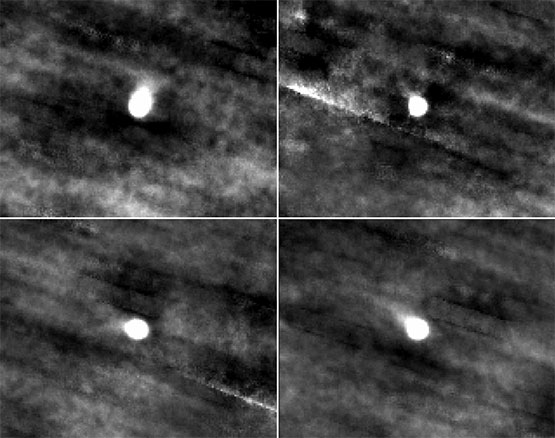
Image Courtesy NASA/JPL-CALTECH/SwRI
An SwRI project used data from NASA’s Polarimeter to Unify the Corona and Heliosphere (PUNCH) spacecraft to track the interstellar comet 3I/ATLAS. PUNCH tracked the comet for many weeks when it was behind the Sun as seen from Earth, making it difficult for other telescopes to follow it. The comet is visible in these images created by PUNCH between Oct. 30, 2025 and Nov. 2, 2025.
Ultraviolet Observations
PUNCH observations were complemented by those made by Europa-UVS.
“This opportunity to view another target on the way to Jupiter was completely unexpected,” said SwRI’s Dr. Kurt Retherford, the principal investigator for Europa-UVS. “Our observations have allowed for a unique and nuanced view of the comet.”
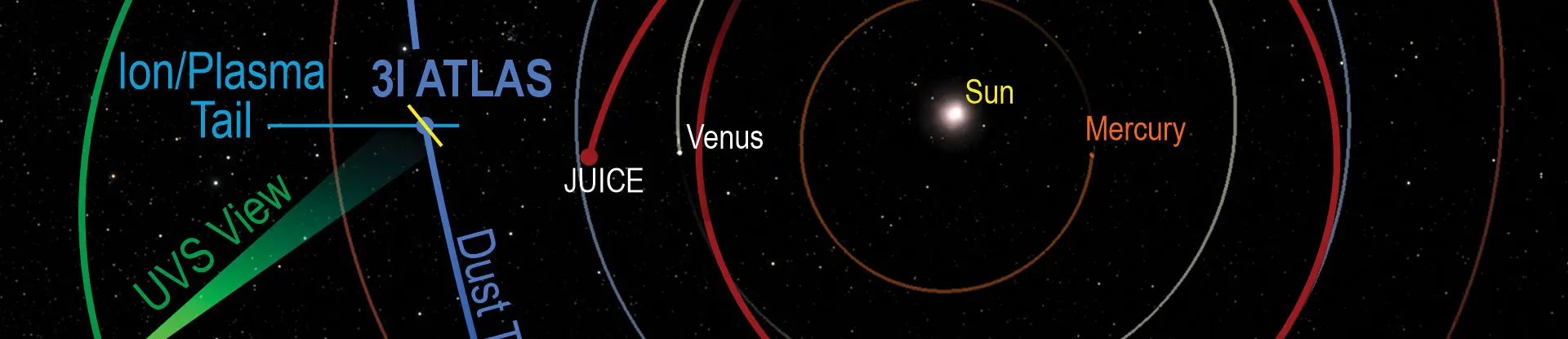
Europa-UVS’s unusual sunward viewpoint obtained a unique downstream view of the comet’s two tails, viewing largely from “behind” the tails and looking back toward the comet nucleus and coma, the cloud of gas surrounding it.
Europa-UVS detected oxygen, hydrogen and dust-related features, supporting the preponderance of data indicating that comet 3I/ATLAS underwent a period of high outgassing activity during the period just after its closest approach to the Sun. The instrument readily measures the fundamental transitions from atoms and molecules, visualizing gases emitted and water molecules breaking down into hydrogen and oxygen atoms.
“Understanding the composition of the comet and how readily these gases are emitted can give us a clearer view of the comet’s origin and how it may have evolved during transit from elsewhere in the galaxy to our solar system,” said SwRI’s Dr. Tracy Becker, co-deputy principal investigator of Europa-UVS. “What are the chemical processes at play, and how can we unravel the comet’s origin in its own star system? Were those processes similar to how we believe our solar system formed? Those are big questions.”
Questions about this story or Planetary Science or Heliophysics? Contact Tracy Becker at +1 210 522 6315 or Craig DeForest at +1 303 546 6020.
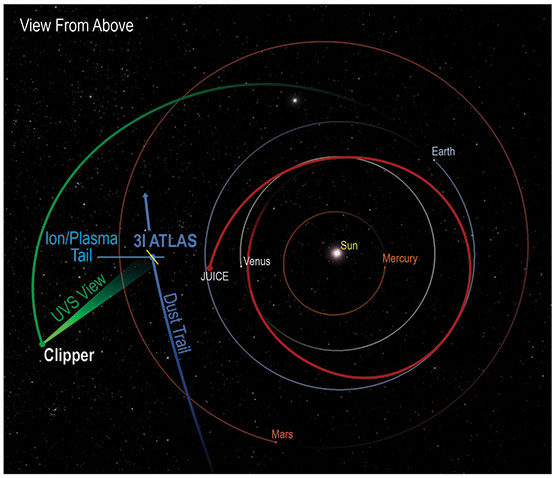
Image Courtesy NASA/JPL-CALTECH/SwRI
At the same time that the PUNCH spacecraft was tracking the comet, the SwRI-led UVS aboard NASA’s Europa Clipper spacecraft made valuable observations of it from a different vantage point. During a period when it was difficult to observe from Earth, Europa Clipper was able to view its two tails from between their downstream directions.
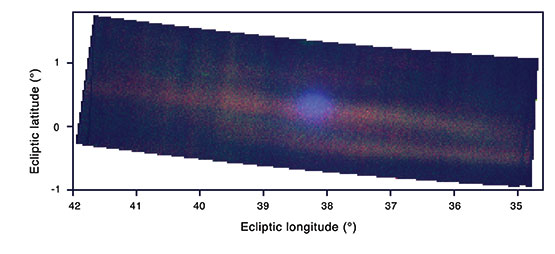
Image Courtesy NASA/JPL-CALTECH/SwRI
The SwRI-led Europa-UVS instrument captured this composite image of Interstellar comet 3I/ATLAS on Nov. 6, 2025, from aboard NASA’s Europa Clipper spacecraft.