
Defense & Security
About the Header
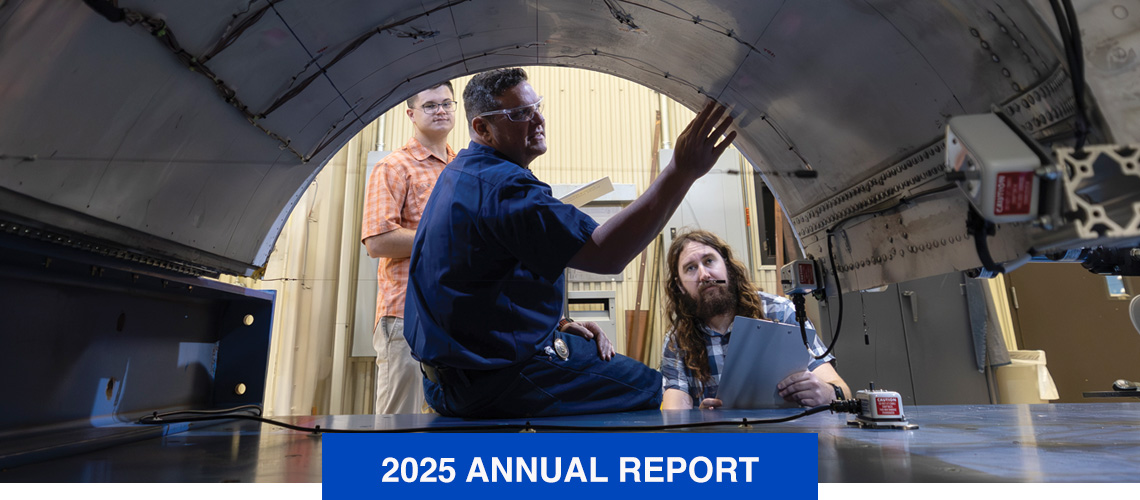
SwRI performs structural integrity assessments, usage monitoring, materials characterization, component and full-scale testing, and stress and damage tolerance analyses to sustain aging aircraft such as the A-10 Thunderbolt II attack airframe shown here.
Southwest Research Institute’s defense and intelligence advancements bring progress and innovation to the front lines with an emphasis on accuracy, efficiency, security and safety. We continue to expand capabilities that produce reliable results for military and defense clients. SwRI-developed technology supports U.S. and allied forces, helping achieve military objectives and advancing solutions to support and protect warfighters. Our defense and intelligence engineers tackle today’s toughest aerospace, antenna, communications, software and signals challenges to advance tomorrow’s technology. SwRI also supports government and industry with cybersecurity services spanning homeland security and commercial enterprises.
SwRI developed specialized sensors and trained algorithms to advance cognitive and neuromorphic capabilities in electronic warfare (EW) systems designed to thwart enemy attacks on military targets. Cognitive EW integrates elements of human perception, using AI algorithms to autonomously sense the environment and determine threats around an aircraft or vehicle. These systems independently decide an appropriate response, making adjustments in real time to improve performance. SwRI systems use spiking neural networks to emulate how the human brain retains memories, making processing faster, more accurate and more efficient.
Through an internal research initiative, SwRI is developing an EW large language model (LLM) to autonomously generate mission data files (MDFs) that optimize stealth flight paths, identify and classify threats, and execute countermeasures. Traditionally, aircraft MDFs required the expertise of a human subject matter expert (SME) familiar with myriad radar modes and specialized EW terms. Leveraging the fine-tuning capabilities of a leading open-source platform, SwRI trains LLMs using synthetic data mirroring current and legacy radar systems while incorporating a range of formats, including text and tables. The data extraction process is context-driven, ensuring alignment across sources, with the goal of generating EW MDFs autonomously. Refining LLM precision and information comprehension streamlines the generation of mission data, reducing reliance on human SMEs and increasing operational efficiency.
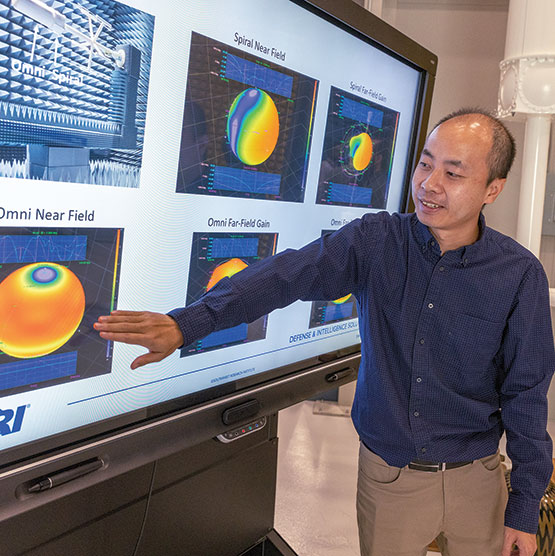
SwRI’s new spherical near-field antenna test chamber accurately samples the near field of an antenna, which engineers can then mathematically transform into far-field data. Analyzing both fields provides more complete performance evaluations.
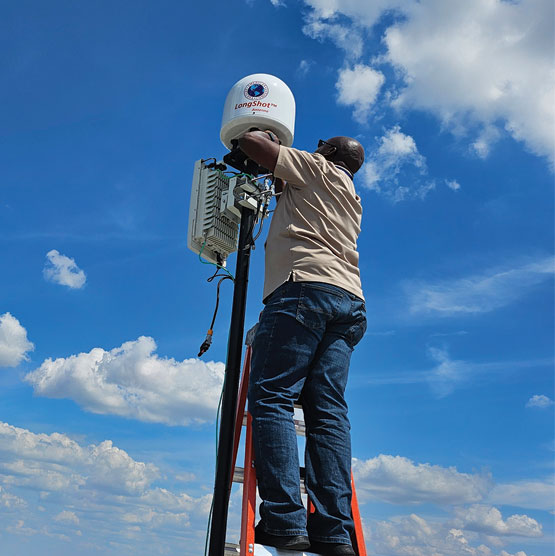
SwRI installed a private, secure, high-velocity 5G network to support a range of research and development projects. This antenna extends the 5G coverage range, which will ultimately support next-generation 6G research.
Using automatic speech recognition models, SwRI computer scientists are developing methods to transcribe collected communications signals for faster, easier analysis. This technique reduces operator workload, increases audio transcription, improves accuracy and enables new features like keyword matches. Researchers are fine-tuning the model using distorted signal data, including fading noise, impulse noise and varying signal-to-noise ratios. The model has been integrated into SwRI’s Frontier system, a signal evaluation tool. SwRI is considering expanding the speech recognition tool by adding language and speaker identification to improve model performance.
SwRI developed and deployed a high-performance, high-frequency direction-finding (DF) system to allow users to discover new or elusive signals of interest using arrival direction as a filtering criterion. The radio frequency spectrum between 3 and 30 megahertz is congested with signals that can propagate for thousands of miles. SwRI’s newly deployed process, Full Spectrum DF, significantly accelerates DF processing to more than 33 million calculations per second. The large volume of calculations allows angle-of-arrival measurements on very short signals and signals in a crowded spectrum, providing more precise information about the location of a signal’s source.
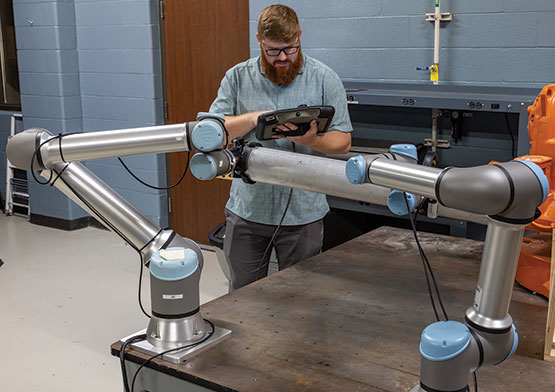
SwRI developed software that allows a robot to use multiple arms working together to meet the challenges associated with intricate, high-stakes, or bulky material handling applications, such as munitions loading.
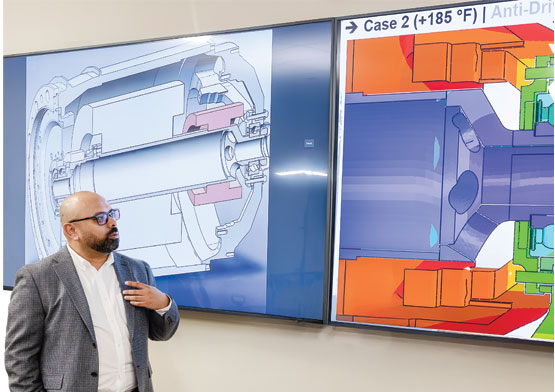
For the Air Force, SwRI created a first-of-its-kind digital twin of the B-52 AC generator to uncover the root cause of catastrophic bearing failures. Multicolored patterns emerging under various temperatures and stressors contributed to the findings.
Turning forensic engineering into mission assurance, SwRI uncovered the root cause of multiple B-52 alternating current generator failures that caused catastrophic outcomes in the field, including near-crashes. Engineers captured 3D scans at micrometer levels to assess the geometry of key generator parts, bearing components and rotor inertial properties. Subtle wear patterns and misalignments emerged under digital scrutiny. Using scanning electron microscopy imaging and X-ray diffraction, SwRI investigators discovered microcracks, pitting and degraded lubrication pathways — previously undetected signs of fatigue and contamination.
For decades, SwRI has worked with the Air Force to extend the life of aging military aircraft. This year, we received new contracts to sustain the A-10 Thunderbolt II attack aircraft, the T-38 Talon supersonic trainer, the C-5 cargo carrier and the B-52 Stratofortress bomber, among others. These fleets were introduced between the 1950s and 1970s. SwRI will also provide technical engineering support for smaller fleets managed by Hill Air Force Base, including the T-41 and T-52 trainers and the E-9 surveillance aircraft.
SwRI invested in the Air Force community of Warner Robins, Georgia, to advance national defense technology, with the first SwRI-owned property outside of Texas. After decades of leasing there, SwRI opened a 33,000-square-foot, $18.5 million building strategically located 3 miles from Robins Air Force Base. The new facility features conference rooms, offices, labs and equipment to support development of EW technologies that detect and intercept enemy radar signals. Engineers use the facility’s server equipment to train highly complex AI algorithms locally, eliminating the lengthy process of copying data sets between our San Antonio headquarters and Warner Robins.
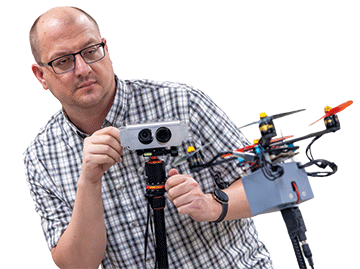
SwRI developed algorithms for event cameras, digital imagers that record pixel changes within a field of view, to track small, fast and agile uncrewed aerial systems (UASs). These counter-UAS technologies support airspace security.
In 2025, SwRI developed software to help the U.S. Department of Defense identify and respond to chemical and biological threats. The tool helps make agile medical decisions about countermeasures and other actions to rapidly address a danger or threat.
In 2025, SwRI expanded the scope of the Laser-Induced Particle Impact Test (LIPIT), dramatically increasing the precision and efficiency of material ballistic resistance testing at scales not possible before. Previously, LIPIT only supported testing using extremely small projectiles. To make LIPIT results more applicable to full-scale ballistics, SwRI engineered a test system to launch larger projectiles of 0.3 millimeters in size. Further, the system was automated to accelerate from a manual test rate of 30 to 40 tests per day to the automated rate of 200 tests per hour.
In 2025, cybersecurity work included penetration testing, risk assessment and secure software development for critical systems. In 2025, SwRI’s team identified cybersecurity vulnerabilities in both 240-volt Level 2 electric vehicle (EV) chargers and direct current fast chargers (DCFC). As a result of the Level 2 work, the EV charger manufacturer published a public advisory for 76 impacted products, and the Cybersecurity and Infrastructure Security Agency issued two common vulnerability and exposure (CVE) reports. The DCFC research uncovered a critical cybersecurity risk with global implications, leading to another CVE report.
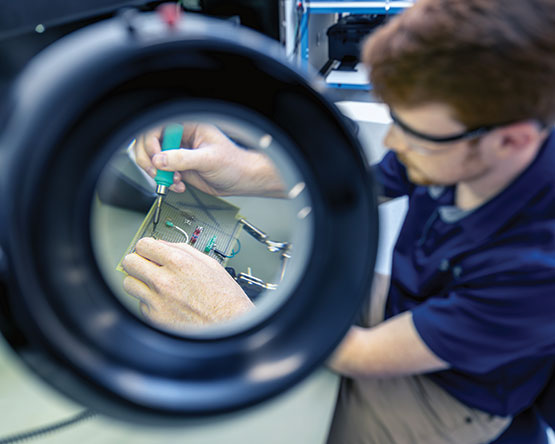
SwRI engineers develop testing technology to evaluate advanced electronic warfare systems designed to thwart enemy attacks on military aircraft.
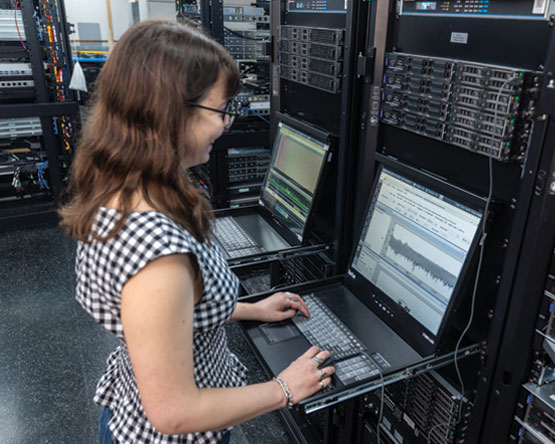
SwRI developed a high-frequency direction-finding system that significantly accelerates calculations for very short signals and signals in a crowded spectrum, providing more precise information about the location of a signal’s source.
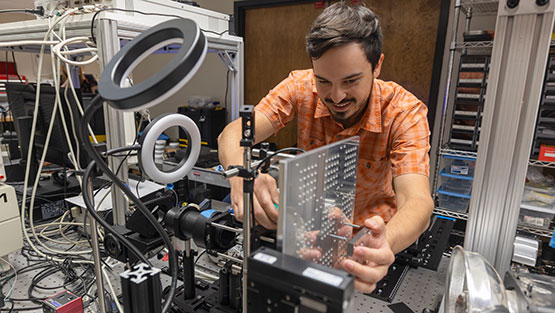
SwRI expanded the scope of LIPIT, dramatically enhancing precision and efficiency by engineering test systems to launch larger projectiles, 0.3 millimeters in size. The new automated system can perform 200 ballistics tests per hour.