


An SwRI-led study has proposed a connection between a specific collision in the main asteroid belt and an inner-solar-system-wide bombardment episode that may have had measurable biological and geological consequences on Earth. The research suggests that the catastrophic breakup of the Eulalia parent body could be linked to an impact shower that struck the terrestrial planets about 800 million years ago.
“The role impacts have played in shaping the origin and evolution of life in our solar system is poorly understood,” said Dr. William Bottke, an executive director in SwRI’s Solar System Science and Exploration Division in Boulder, Colorado, and lead author of a paper describing this research. “The heavily cratered surface of the Moon serves as a reminder of the large impacts in Earth’s past, but so far, only the Chicxulub impact event 66 million years ago has been strongly linked to a specific effect on life, namely the mass extinction of the dinosaurs.”
Finding geological evidence of impacts older than 650 million years ago on Earth is challenging due to the constant renewal of the surface of our home planet. The Earth’s landscape constantly changes as constructive forces such as volcanoes and plate tectonics build it up, while destructive forces such as weathering wear it down. One way researchers have searched for clues about Earth’s past is to study asteroid shower events.
“These rare events, triggered by large, well-positioned collisions in the main asteroid belt, bombard all inner solar system worlds,” Bottke said. “So, evidence preserved on the Moon’s static surface can be used to infer what happened on Earth and Mars in ancient times.”
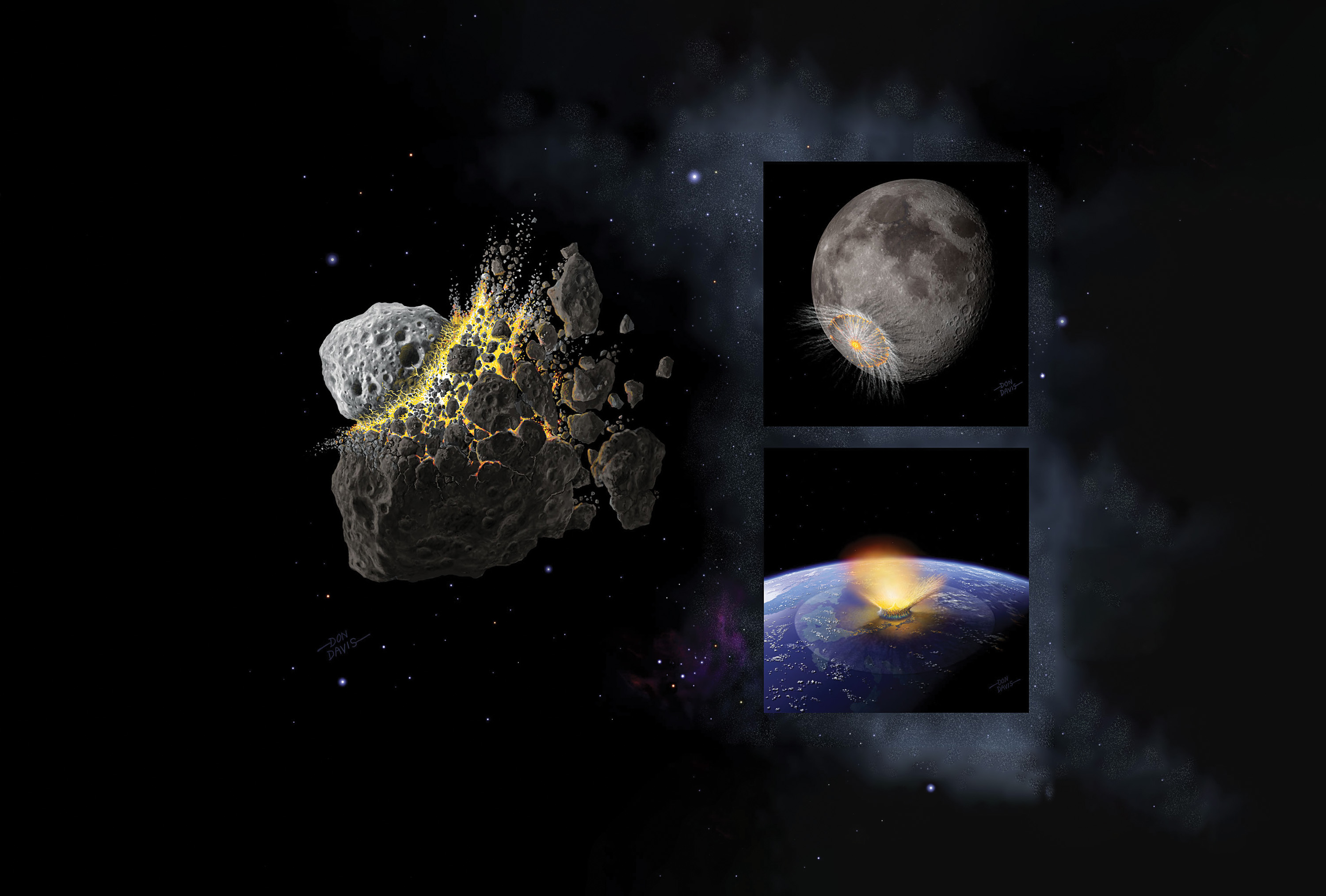
IMAGE COURTESY SwRI/DON DAVIS
An SwRI-led study has connected a specific asteroid collision in the main belt to an inner-solar-system-wide bombardment episode that may have had measurable biological and geological consequences on Earth and Mars.
Scientists have proposed that a substantial surge in large lunar impacts occurred approximately 800 million years ago, based on the ages of large lunar craters and the age distributions of impact glass materials found by the Apollo missions.
“Our cosmic forensics team used collisional and dynamical models to link these to the formation of the Eulalia asteroid family, when a primitive carbonaceous chondrite-like object collided with another object,” Bottke said. “The location of the parent asteroid was key — it broke up on the brink of the gravitational 3:1 mean motion resonance with Jupiter.”
The J3:1 resonance serves as a gravitational escape hatch for the asteroid belt, delivering objects into planet-crossing regions, and the Eulalia breakup would have delivered up to 75% of its fragments to J3:1 within 150 million years. The Eulalia breakup can plausibly account for the observed lunar craters formed around 800 million years ago and may have had widespread repercussions across the inner solar system.
“Given that the peak of this barrage coincides with a period of widespread cooling and major shifts in our biosphere, it is tempting to suggest that the former produced the latter,” Bottke said. “On Mars, these impacts would have triggered substantial episodes of seismic shaking and can be linked in time with a surge in volcanic activity. Together, this showcases how certain catastrophic collisions in the main belt could have had far-reaching consequences for the history of the terrestrial planets.”
For more information, visit Planetary Science.