


Background
New transportation system technologies will produce large quantities of precision data. This data can enable valuable services and improve management of roadway infrastructure. But these new technologies also present new risks to user privacy, revealing sensitive information about the behavior of roadway users. This research investigated techniques for transportation data collection, communication, and processing that preserve the usefulness of data while protecting the privacy of users.
Approach
The project approached the problem with a goal of achieving both usefulness and privacy, not to attempt to balance these two objectives while accepting compromises to both. This objective was achieved through carefully tailoring solutions to the unique characteristics of the problem, designing around specific data sources, analysis objectives, and privacy concerns. Several real-world problems were selected as use cases for new techniques, including applications in intelligent transportation systems, urban planning, and tolling. Solutions were developed employing privacy-preserving system architectures, novel cryptographic protocols, differential privacy, and homomorphic encryption.
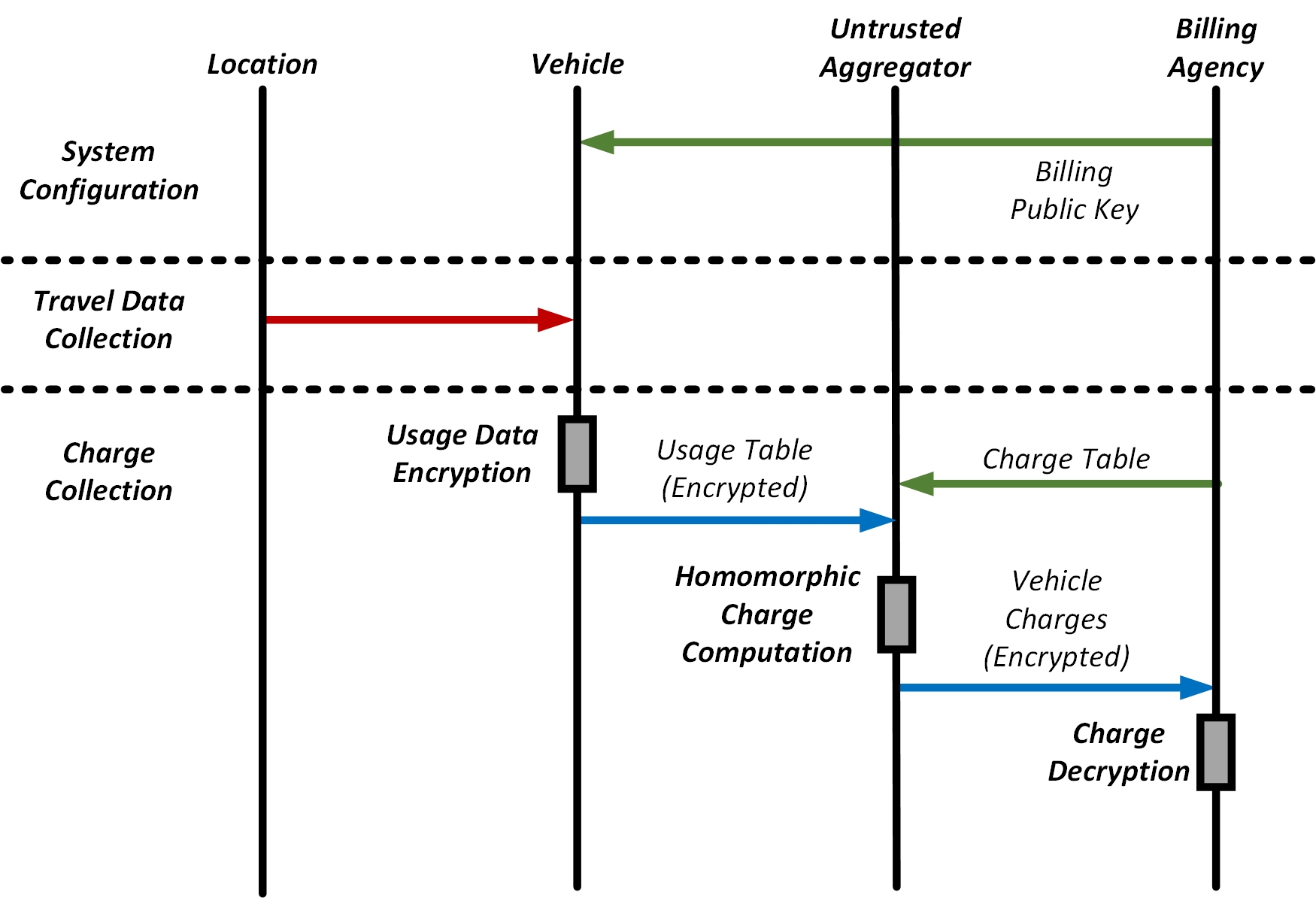
Figure 1: Sequence diagram illustrating the flow of information in a privacy-preserving precision tolling application. Sensitive travel data is encrypted before transmission from vehicles and tolls computed by an untrusted third-part data aggregator using homomorphic encryption. The solution provides strong protection on private user data while generating perfectly accurate tolls.
Accomplishments
Privacy-preserving solutions were formulated for all sample problems. All solutions provided very strong, mathematically provable and quantifiable levels of privacy on personal data. Solutions varied in their system complexity and their impact on the usefulness of analysis results.
On example solution has been applied to a problem of precision tolling, where vehicles are charged for use of specific roadways and specific times. Precision tolling provides an effective mechanism for transportation demand management but employs highly sensitive personal travel information. Our solutions employ homomorphic encryption, which enables computation on encrypted data, and an untrusted third-party data aggregator. Travel data is encrypted before being transmitted from the vehicle and never decrypted. Nonetheless, accurate and complete precision tolling can be computed and attributed to specific vehicles.
While evaluated on specific use cases related to transportation data, the tools and techniques developed under the research can be applied to a variety of data collection and processing applications where privacy of data is a concern.