


Background
Hamstring injuries are a common and significant problem in both sports and military settings, leading to substantial impacts on performance and readiness. Traditional injury prediction models often rely on general anatomical metrics such as muscle volume or simple kinematic measures such as peak hip flexion, which lack sensitivity for accurately predicting risk. This project aimed to create a more precise model that integrates complex muscle morphology with detailed running biomechanics to identify athletes at risk for hamstring injuries. The novel approach, termed Statistical Structure-Function Modeling (SSFM), combines muscle morphology and biomechanics data for an innovative injury risk analysis.
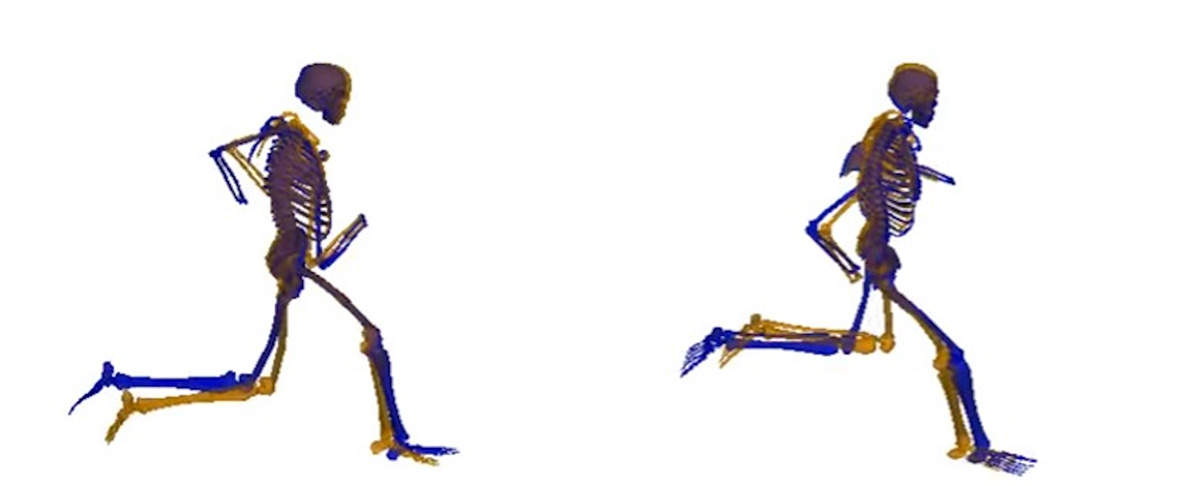
Figure 1: Snapshots of gait cycle at left foot contact (left) and right foot contact (right) for both the no injury group and hamstring injury group (blue).
Approach
The objective of the study was to develop an SSFM model to predict hamstring injuries. Using a combination of Statistical Shape Modeling (SSM) to analyze muscle structure and Statistical Biomechanical Modeling (SBM) for running kinematics, the study examined detailed features of muscle morphology and biomechanics that differ between injured and non-injured athletes. The study involved 84 professional football players, nine of whom sustained hamstring injuries during the season. Prior to the start of the season, MRI scans were acquired to quantify muscle anatomy and running kinematics were quantified using the ENABLE markerless biomechanics. Machine learning techniques, including logistic regression and neural networks, were used to predict future injury risk based on the combined muscle morphological and running kinematic data.
Accomplishments
- Muscle Shape Modeling: SSM identified significant morphological differences in the thigh muscles of injured versus non-injured players. Specific variations in the hamstring and quadriceps muscles correlated with injury risk, providing more detailed indicators than traditional metrics such as muscle volume or cross-sectional area.
- Biomechanics Analysis: SBM revealed distinct differences in running kinematic patterns in injured athletes, notably present in hip extension dynamics and foot placement. These differences, linked to an overstride gait pattern, highlight a running biomechanics factor in hamstring injury risk.
- Predictive Modeling: The SSFM approach, integrating muscle morphology and running kinematics, achieved high predictive accuracy with an area under the Receiver Operating Characteristic Curve (AUC) of 0.84. The neural network model, using combined running kinematics and muscle morphology data, achieved an AUC of 0.844. These findings support the efficacy of the SSFM approach for injury risk prediction, enabling targeted injury prevention strategies.