


Background
Better understanding of the solar corona (the outermost layer of the Sun's atmosphere) requires empirical constraints on 3D coronal plasma properties including density, temperature. During the last decade, the simultaneous operation of missions with different orbits, but similar instruments: NASA's Solar Dynamics Observatory (SDO), the Solar Terrestrial Relations Observatory (STEREO), and ESA's Solar Orbiter, have produced a multi-viewpoint set of observations that potentially enable the reconstruction of the 3D Sun. However, as of today, the estimation of density and temperature of the solar corona remains an open question and a holy grail of coronal physics. This project aims to leverage available multi-viewpoint extreme ultraviolet (EUV) images with a novel artificial intelligence (AI) technique for the reconstruction of 3D objects: Neural Radiance Fields (NeRFs). This project aims to use simulated multi-viewpoint, multi-thermal, EUV images of the solar corona to validate the use of AI in the reconstruction of 3D coronal density and temperature.
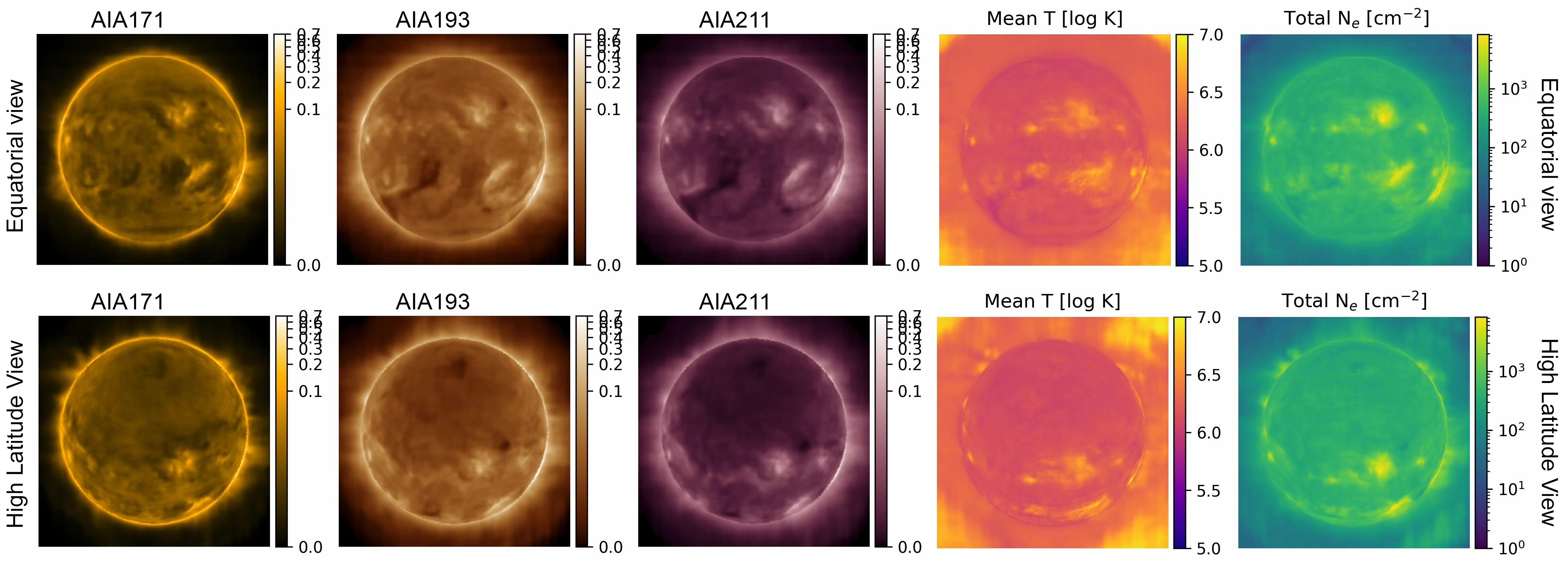
Figure 1: Reconstructed Ultraviolet images and mean temperature and density in the 3D solar corona for two different viewpoints: Equatorial (top row) and high latitude (bottom row). The first three columns show the reconstructed 171Å, 193Å, and 211Å ultraviolet channels. The last two columns show the estimated average density and temperatures.
Approach
There are currently two main observational techniques used to obtain 3D distributions of these parameters: stereoscopy and tomography. Neural networks present us with a potentially disruptive approach to 3D reconstruction. To train a neural network is to optimize its learnable parameters (weights) to minimize a penalization (loss) function. This is accomplished by an optimization process of gradient descent by which the optimization algorithm takes a series of steps in solution space towards the global minimum. One of the properties that makes neural networks so interesting is their ability to work with optimization functions resulting from nested functions, if they are differentiable. This makes it possible for them to estimate indirect quantities (density and temperature), from observable quantities (number of photos observed). In this project we use simulations of the solar corona to render training samples that can be used to assess whether the approach works. We also use real ultra-violet images of the solar corona to see if the model can estimate reasonable values of solar density and temperature.
Accomplishments
In this project we have been successful at implementing a radiative transfer module based on temperature and density and use it to train a Neural Radiance Field network. The preliminary results (See Figure 1) are very promising and hint at the possibility of using AI to finally estimate 3D density and temperature in the solar corona – two quantities that have long been sought after by the heliophysics community.