


Background
Ultraviolet spectroscopy is an invaluable tool for studying the structure and composition of Enceladus’ water vapor plumes, as demonstrated during the Cassini mission at Saturn. SwRI’s Ultraviolet Spectrograph (UVS) is included in the Europa Clipper mission payload as its “plume finder” investigation and for similar reasons is included in the ESA Juice mission to Jupiter. To tailor our previous UVS instrument design to an Enceladus Orbiter mission concept suitable to the New Frontiers class of NASA planetary missions, we need to develop several advanced capabilities compared with designs in our JUICE-UVS and Europa-UVS concepts. Our UVS design is readily adaptable to address questions regarding Enceladus’ habitability and the extent to which plumes are connected to a subsurface ocean, which we investigated in this project.
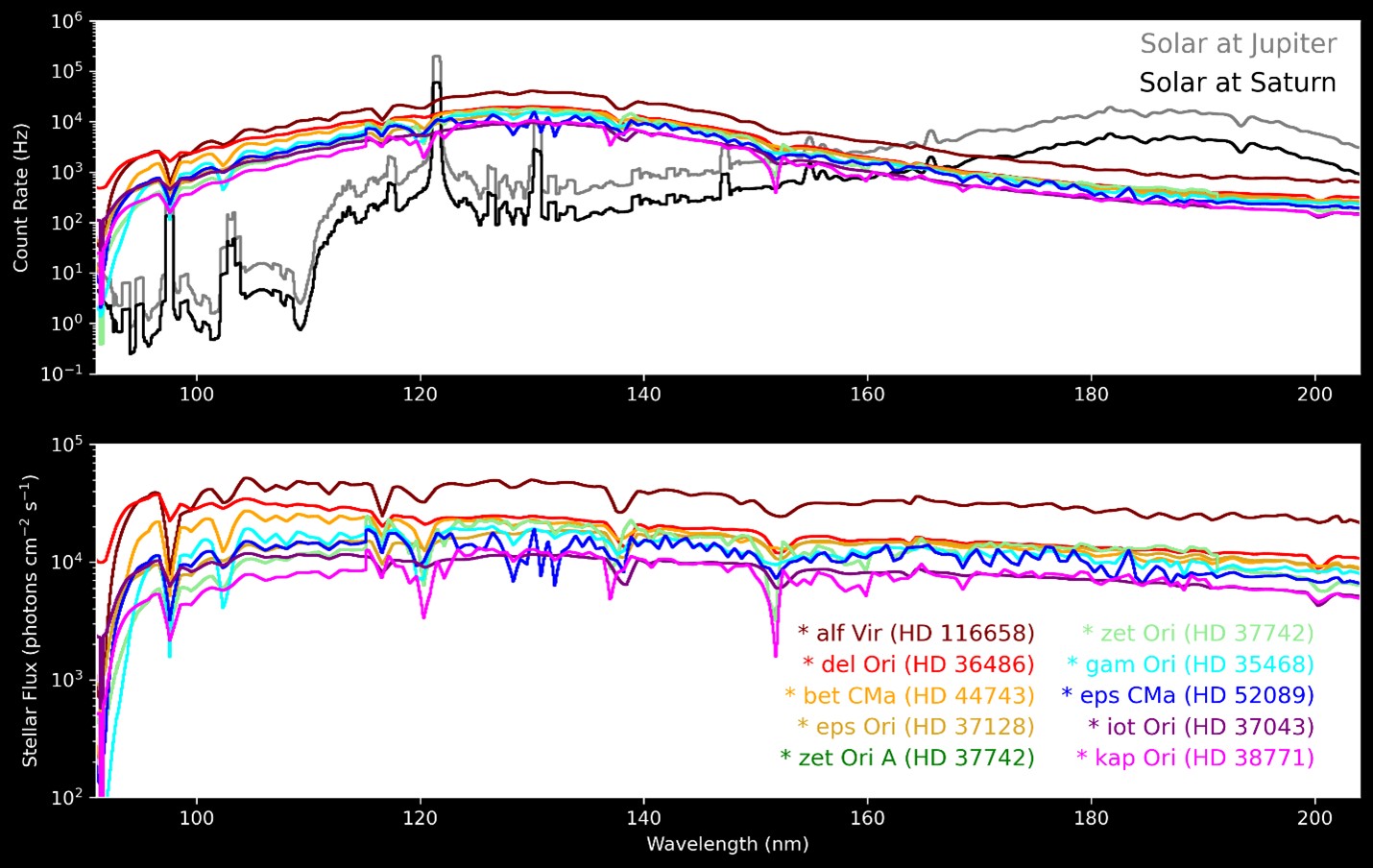
Figure 1. A simulation of expected signals from the Sun (top) at both Jupiter and Saturn’s distance, and several UV-bright stars (bottom) across the key wavelength range of interest for a future UVS instrument tailored for Enceladus habitability investigations.
Approach
Our project defines an achievable science investigation to constrain our understanding of Enceladus’ habitability. Furthermore, we design and develop instrument components suited to an Enceladus Orbiter Habitability mission concept. Development tasks include detailed stellar and solar occultation simulations of sensitivities to species of interest for the habitability of Enceladus (e.g., CO & CH4) in numerous spatially isolated jet or plume components. These simulations inform the definition of free spectral range and sensitivity needed for an advanced UVS instrument tailored to achieve Enceladus-related objectives as reported in a science traceability matrix. Additional webtool, laboratory investigations, and radiation environment assessments inform these objective definitions. Engineering design informed trade studies assess a scan mirror mechanism, radiation shielding-plate requirements, and preliminary optical, mechanical, and electronic design efforts, e.g., to convert our heritage microchannel plate detector approach to a mid-UV-optimized sealed-tube MCP detector design.
Accomplishments
Copious simulations of stellar and solar occultations at Enceladus were performed and demonstrate that an Enceladus-orbiting spacecraft provides an ideal method for obtaining occultation profiles of numerous species of interest for constraining the habitability of this ocean world. Additional progress has been made with web-tools and radiation environment assessments. Much of the detailed engineering design studies are just beginning, having been delayed by ongoing project work by team personnel.