


Background
Since Mars is a dust world, i.e., a world whose climate and geology are driven by dust dynamics, understanding the physical properties of Martian dust is critical. From research on dust in the Earth’s atmosphere, we know that the concentration and size/shape of atmospheric dust has large influences on the climate, and this is likely true at Mars as well. However, there is a dearth of in situ observations of Martian dust. Through both SwRI and NASA funding, we have been developing a laser-based velocimeter/nephelometer designed specifically for the characterization of Martian atmospheric dust. We had not, however, addressed the impact of wind-shadowing by the mechanical structure. This wind shadowing has the potential to affect the dust measurements, skewing our results and any resulting science.
Approach
We used the tools of computational fluid dynamics (CFD) to quantify the wind shadow affects, simulating the particle-laden flow around the instrument in various orientations and conditions. To study how wind shadow may have depended on dust size and the dust size distribution, we injected different dust size distributions into the various simulated environments. To update our mechanical design based on the CFD modeling, we used Ansys-based computer-aided design (CAD) software. The CFD and CAD models were able to import and export representations of the instrument, allowing for smooth transition between the two tools. We simulated the instrument under Mars conditions (Figure 1) and under Icelandic conditions, the latter to compare to actual field measurements.
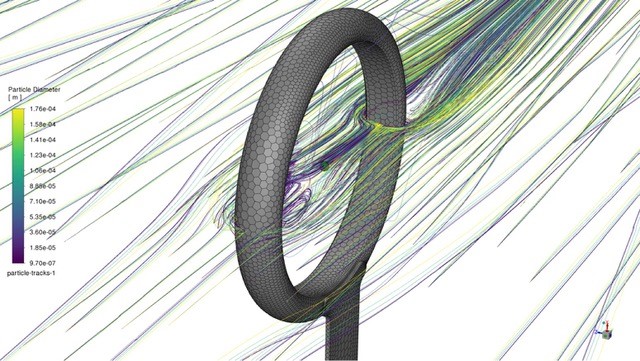
Figure 1: Examples of the particle trajectories in the simulations under Mars condition. The wind is flowing from the bottom left of this image. Dust particles that are heading straight for the ring structure are routed around the ring. Thus, a wake is created by the structure, along with turbulent flow within the ring and further down-flow. Significant recirculation regions are seen in the wake of the left-most inner portion of the ring (“purple cyclones”).
Accomplishments
We have determined that due to the lower Reynolds number and higher Knudsen number in Mars’ near-surface atmosphere, it will be easier to minimize wind-shadowing effects for an instrument for Mars exploration than for an instrument for use here on Earth. The cross-section of the instrument is the dominant design factor, with the smaller scale components having less of an effect on wind-shadowing. Accordingly, design alterations to our instrument are being made for future evaluation including investigating a rectangular shroud of smaller axial height to reduce the apparent cross-section as a function of angle of incidence. Additionally, the shroud provides cover for internal routing of the wiring harnesses to reduce or eliminate irregularities and asymmetries in the interaction of the instrument with the flow.