


Background
Battery modules consist of battery cells electrically joined at the terminals by conductive busbars. Laser welds are the most consistent and controllable process to quickly create these connections in a production environment due to their control over power, speed, and path geometry. Laser weld quality is critical to battery pack performance. This project leveraged existing weld trial results to develop and validate a laser model capable of simulating busbar to battery cell terminal welds.

Figure 1: Top view of the finite element mesh used for the laser welding model.
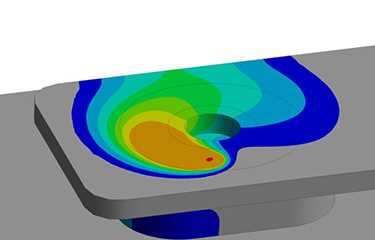
Figure 2: Temperature contour during transient welding analysis. Current laser focal point in the red dot.
Approach
The goal of this project was to develop a validated finite element model that could be used to calibrate laser welding parameters for future battery modules to reduce development time and cost. The model inputs correlate with laser variables used to define a laser weld such as power, laser radius, and speed. The finite element model uses those variables to model a conic heat source that follows the laser path in small, discrete increments, mimicking the movement of a continuous laser. Melting and vaporization of the metal is represented with temperature dependent enthalpy instead of directly modeling phase change. This method allows the use of conventional FEA and avoids the need for computationally expensive multiphase CFD.
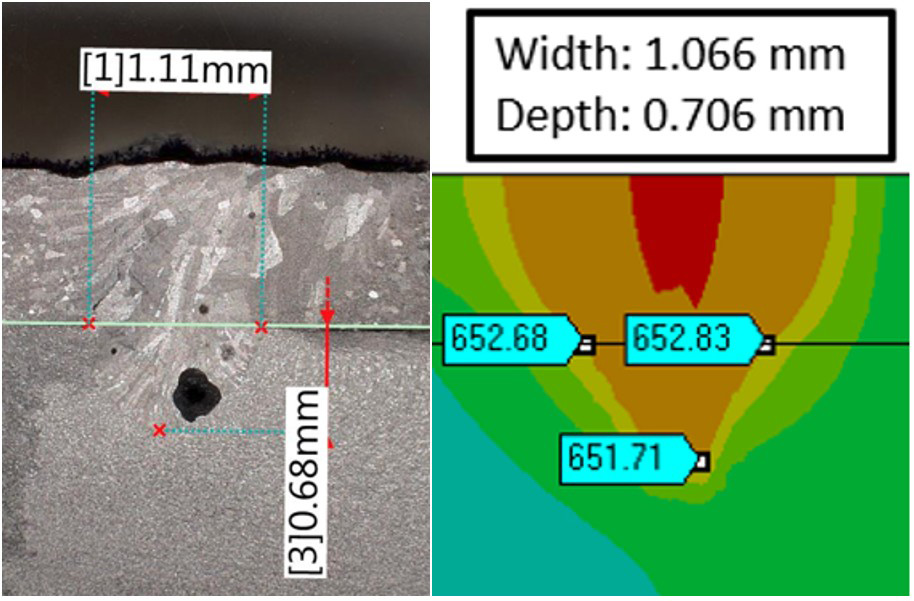
Figure 3: Comparison of laser weld depth and width as measured in sectioned sample with the estimated depth and width in the model estimated from peak temperature.
Accomplishments
The developed finite element model was calibrated to accurately replicate the measured depth and width of previously measured laser welds. This model can be used to guide laser weld development for future battery module designs.