


Background
Lithium-ion (Li-ion) cells form the backbone of energy storage devices in most electric vehicles (EVs) today. An EV battery, comprising hundreds or even thousands of Li-ion cells, undergoes thousands of charge-discharge cycles throughout its lifetime, leading to a decline in health and efficiency. Direct current fast charging (DCFC) is essential for making electric transportation widespread and practical. To reduce charging times and enhance consumer experience, EV manufacturers are seeking ways to increase the charge power transfer during DCFC. However, frequent use of DCFC accelerates the deterioration of EV battery packs. Therefore, it is crucial to periodically and accurately assess a battery pack's health and implement measures to slow performance degradation over its lifespan.
Approach
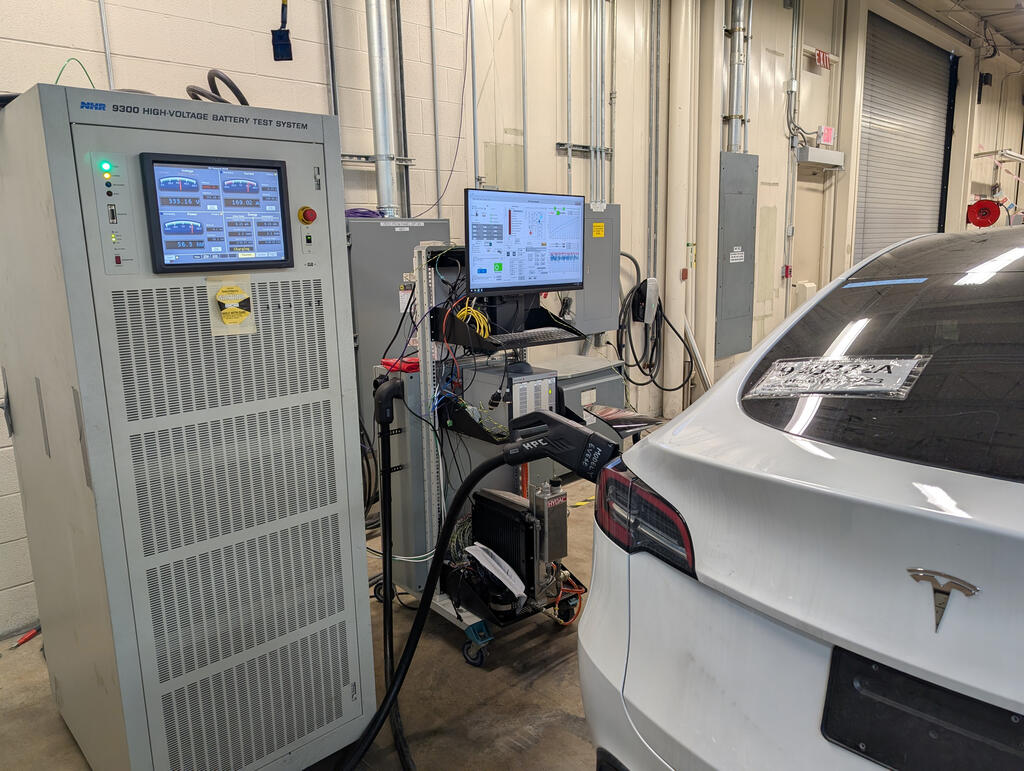
Figure 1: Test vehicle with the DC Power Transfer System during an EIS test while charging.
An electric vehicle from the EVESE-II consortium benchmarking project was chosen, leveraging its self-discharging feature to reset the SoC without moving the vehicle. The DC power transfer system from 03-R6423 was configured with DIN-70121 for communications, and the custom-built control software was modified to introduce electrical perturbations during charging sessions at discrete state-of-charge levels. Both sinusoidal (typically used in Electrochemical Impedance Spectroscopy [EIS] tests) and pulse (synthetic EIS, an outcome of 03-R6156) perturbations were utilized. The battery’s response during these tests was collected and analyzed, which included constructing an equivalent circuit model (ECM) of the battery and determining circuit parameters through a novel system identification approach. Additionally, identical tests were conducted on representative cells from the same vehicle for comparison.
Accomplishments
Parameters of the scaled cell ECM were found to be within 20% of the battery pack, thus meeting the objective metric for success defined in the proposal. The novel method developed enabled the inclusion of additional elements (such as Warburg, constant phase) to the ECM that better explain electrochemical processes within a cell. This creates impedance characteristics like those of a representative cell within the pack and thus has the potential to provide additional insights, given the representative nature of the ECM topology, to accurately depict physics-based phenomena. Through this method, an ECM, and by extension the state-of-health, of any vehicle battery pack can be obtained in situ during charging.
Patents
Title: Method and Apparatus to Provide an Equivalent Circuit Model and State-of-Health of a Battery
SwRI docket number: SWRI 4321
Date: 07/28/2025
Inventors: Jayant V. Sarlashkar, Daniel J. Robles, Andre Swarts, Piyush Bhagdikar, Sandesh S. Rao.