


Background
Southwest Research Institute® has developed a wide range of traffic management solutions for state and local governments across the country. However, these systems require training and experience to operate with maximum efficacy. The recent advent of large language models (LLMs) has provided a means of addressing this issue. Capable of interpreting human language, these systems can provide a new and natural means of interacting with complex programs.
Approach
We sought to determine how LLMs can serve as natural language interfaces to traffic management systems. To do so, we leveraged a commercial cloud LLM offering using the open-source LiteLLM and agents frameworks. Several interacting LLM agents were developed, and a model context protocol (MCP) server was developed to provide the LLM agents with access to tools. These tools were used to collect information or perform actions. Detailed textual descriptions of each tool, along with their expected inputs and outputs, were provided to the model. The LLM was connected to an existing state department of transportation (DOT)’s traffic management system, in which it can collect live data and perform real actions. Modifications were made to this traffic management system to enable this integration and to allow users to interact with the LLM.
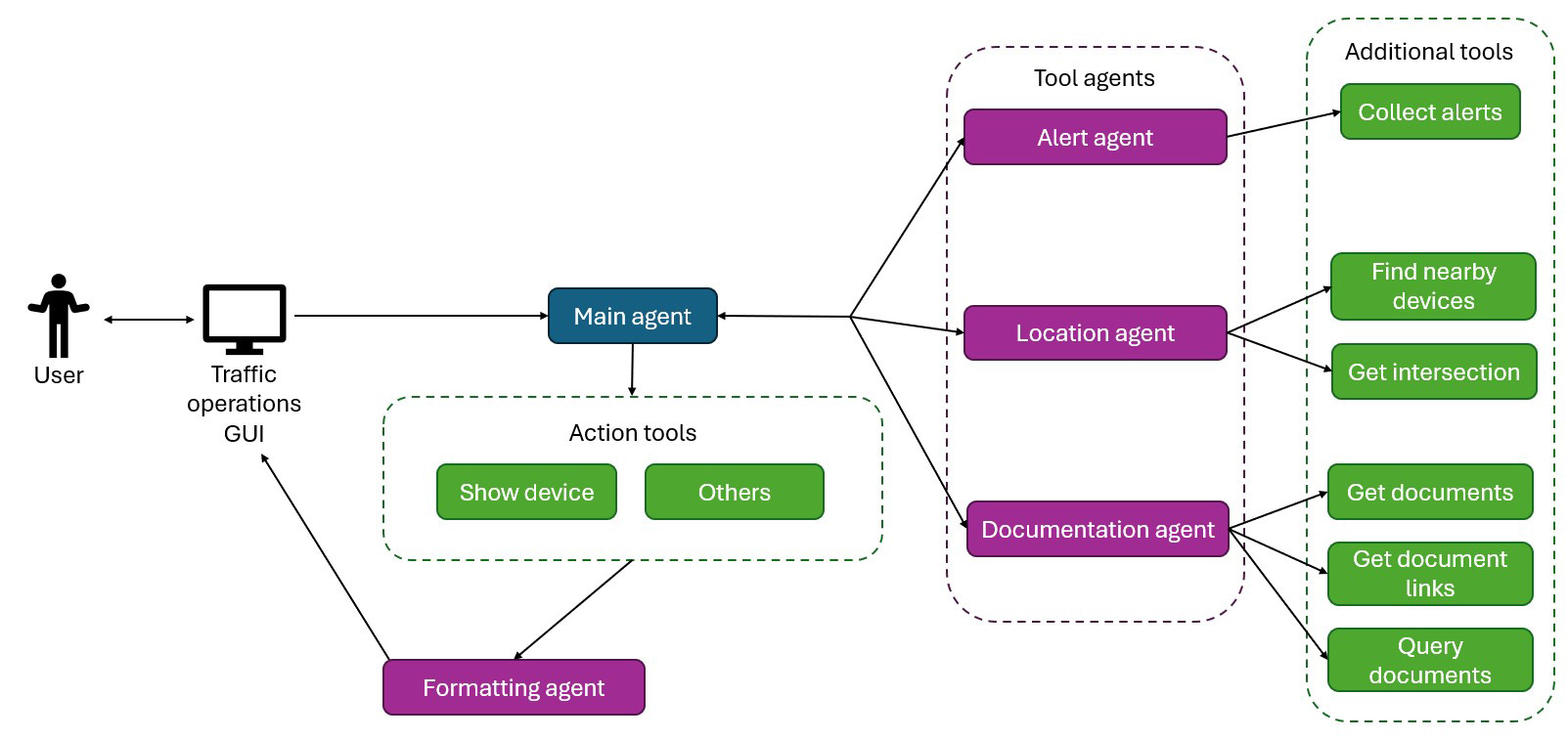
Figure 1: Overall System Architecture.
Accomplishments
A full pipeline was developed and integrated with real-world transportation management software. A simple graphical user interface (GUI) was built into the software to allow access to the LLM. The LLM has access to tools within the software system for data discovery (such as historical incidents and locations), documentation retrieval/help, and actions (such as displaying camera feeds). The system is capable of operating live. Overall, we expect the developed LLM pipeline to be applicable not only to transportation, but to practically any application interaction as well; this promises to enhance efficiency, simply and accelerate complex operations, and, in the case of traffic management, alleviate operator burden.