


Background
Techniques exist to precisely measure the electromechanical efficiency in an electric drive unit (EDU, defined here as the combined motor and geartrain). While total drive unit efficiency is an important metric, it does not quantify the different loss sources in the EDU. Due to the tight packaging in production EDUs, it’s impractical to mount a torque transducer between the electric machine and gearbox to separate the losses from these components. Additionally, this approach does not separate the winding, core, and mechanical losses present in the electric machine, providing little insight into how a drive unit achieves the observed performance and limiting normalized comparisons of the electric machine’s performance across applications and machine architectures.
Approach
The purpose of this research project was to develop a noninvasive approach to distinguish winding, core, and mechanical losses for EDUs containing synchronous electric machines. To separate the effects of these losses, mechanical output power was held constant at several test points while varying the stator’s current amplitude and angle. By maintaining the mechanical power at a constant value and varying the stator current, the core and winding losses were excited independently of the mechanical loss. We combined the resulting data with an equivalent-circuit model (ECM), including separate resistors representing the winding and core losses, as well as a flux-linkage map (providing the voltage for the ECM) to separate and quantify the individual losses. As validation, we implemented this approach on a Ford F-150 Lightning rear EDU, completing a series of tests; static measurements of the electric machine, flux-linkage mapping, maximum-torque per ampere calibration, loss-exciting constant-power mapping, and efficiency benchmarking over a 71 speed/torque point matrix.
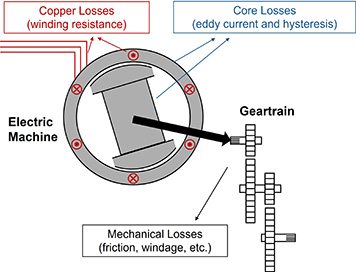
Figure 1: Overview of system losses. Copper and core losses are present in the electric machine while mechanical losses are present in rotating components.
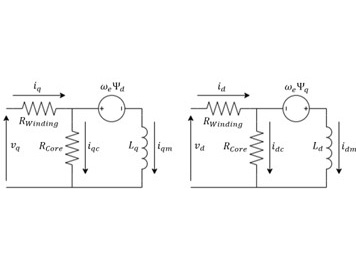
Figure 2: Equivalent D-Q axis circuits with core loss for a synchronous machine.
Accomplishments
This process for evaluating electric drive units provides a breakdown of the losses present in the system. The Lightning EDU showed lower total efficiency during regenerative, rather than tractive, operation, which is unusual, since core losses are typically lower when generating rather than motoring. The loss breakdown revealed that the machine’s core losses exhibited the usual behavior and that its winding losses were symmetric about zero torque, as expected. The EDU’s greater overall loss when generating was solely due to the mechanical loss, perhaps resulting from how this EDU’s planetary gear reduction handled thrust loads.
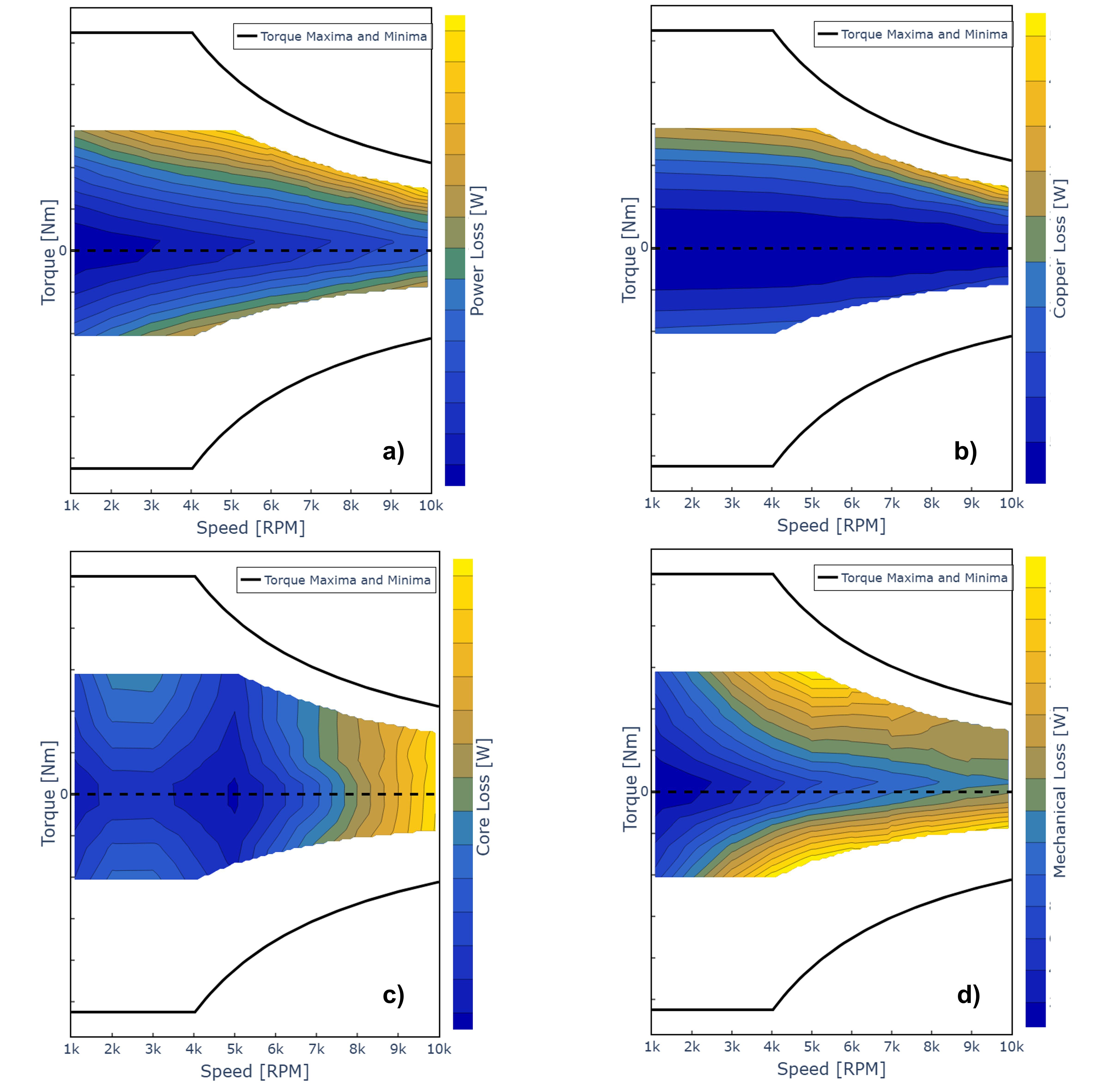
Figure 3: Overview of the (a) total, (b) copper, (c) core, and (d) mechanical losses in the Ford F150 Lightning’s rear drive unit. Overall losses at negative torque operating points are higher than corresponding positive torque points. From the loss breakdown, it is clear the source of this asymmetry is the mechanical losses.