


Background
Advanced Traffic Management Software (ATMS) is a software and expertise offered within Division 10 and aims to improve safety by assisting in disseminating information to the public as well as decreasing response time for life saving assistance in the event of an incident. However, ATMS systems are constrained by how quickly they can react to an incident that has already occurred. This research is attempting to leverage recent advances in machine learning science to predict high risk locations. The results of this research will let the software and operators anticipate incidents, thereby decreasing response times and enabling proactive actions to prevent or mitigate traffic incidents. This IR builds upon the quick look IR 10-R6182.
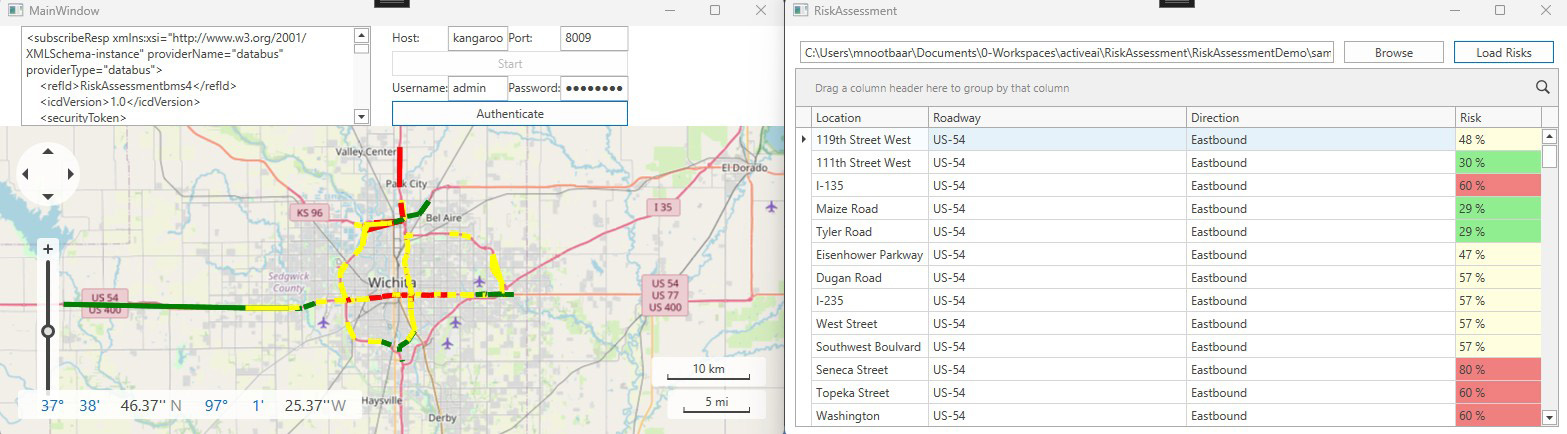
Figure 1: Risk Assessment Visualization: A demo visualization of the risk distribution across the city of Wichita, Kansas.
Approach
The primary goal of this research was to increase the technology readiness level of the machine learning model that resulted from the 10-R6182 quick look. The research also investigated using data sourced from state department of transportation’s ATMS system instead of leveraging third party data such as INRIX as was done in the previous IR. To accomplish this, the project was separated into 3 main phases:
- Data Preparation: Retrieve database backups of State ATMS databases and format the archival data so that a model can be successfully trained on the data
- Baseline Model Adaptation: modify the model from 10-R6182 to train on the formatted ATMS data
- Model Iteration: Iterate through modification and training of the baseline model to improve metrics using preplanned adjustments as well as intuitive adjustments based on the results of previous iterations
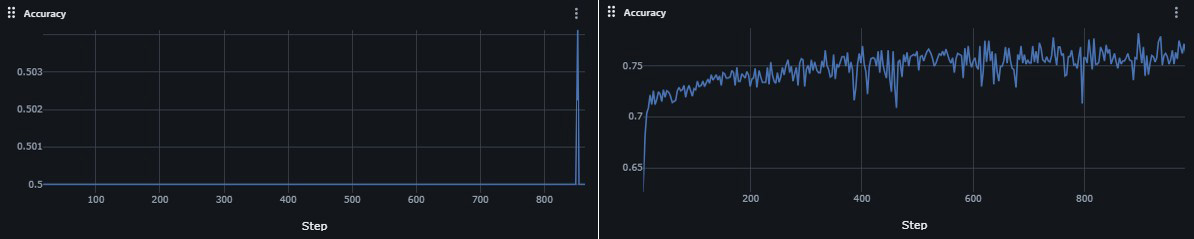
Figure 2: Baseline Model Comparison: Compares the accuracy during training for the baseline model on the left with a new model using attention and Long Short-Term Memory layers on the right.
Accomplishments
The following are our current list of accomplishments:
- Engineer a database agnostic data retrieval structure that allows us to adapt multiple versions of the ATMS database without having to change the structure of the model or model interfacing code to train on the data in the database
- Successfully adapted the baseline model to use ATMS data while showing the significant gaps in accuracy and useability of the baseline
- Engineer 3 competing models using recent techniques in machine learning which outperform the baseline model by over 37%