


Background
Over the past two decades, multiple finite element (FE) human body models (HBMs) have been developed; however, these models are uniformly limited to acute, high-impact scenarios such as automotive crashes, underbody blasts, pilot ejections, pedestrian collisions, and sport-related impacts. A critical gap remains in modeling physiologically accurate, long-duration, quasi-static loading environments that are more representative of conditions leading to chronic injury. These injuries often arise from repetitive overuse, microdamage accumulation, and progressive degeneration and account for over 75% of all military injuries. In the civilian sector, the economic burden is also substantial, with the annual cost of pain management related to chronic injuries is estimated at /$300 billion.
Approach
To address this gap, we are developing a full-body finite element model within the open-source platform FEBio, with an initial emphasis on accurately representing musculature-driven lower limb kinematics. This model is designed to support both military and sports applications by enabling physiologically realistic simulation of musculoskeletal injury mechanisms under chronic loading conditions.
Accomplishments
To date, we have developed a comprehensive skeletal model in FEBio with detailed lower-limb anatomy, including more than 20 muscles, fully articulated knee joints with associated soft tissues, and physiological constitutive models such as contractile stress-driven muscle formulations to simulate active motion. We have also created automated morphing technology that enables personalization of the model from medical imaging data (e.g., MRI), as well as a Digital Twin workflow that integrates markerless motion capture data as target kinematics for the FE model. The musculature is optimized to reproduce observed motions through active contraction, enabling subject-specific, physiologically realistic simulations.
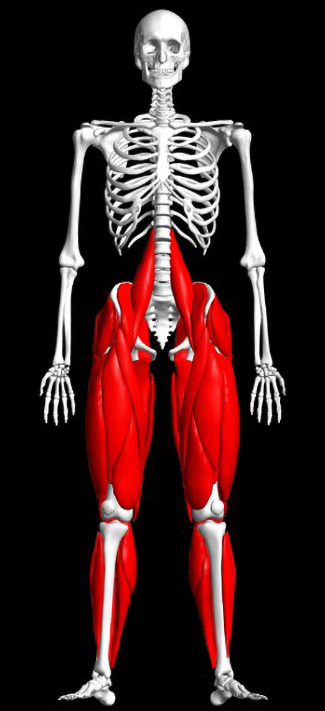
Figure 1: Full human skeleton with detailed lower limb musculature derived from real MRI data.
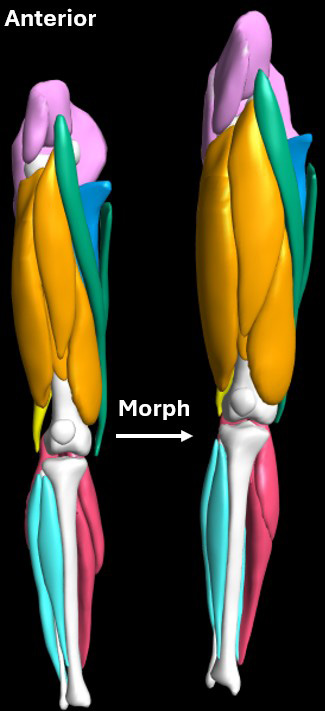
Figure 2: Automated morph of the model from a small female to an average sized male using real MRI data.