


Background
High entropy alloys (HEAs) are multicomponent alloys composed of four or more elements with near-equiatomic ratios that form single-phase solid solutions due to high configurational entropy. HEAs have attracted great attention because they have the potential to exhibit exceptional traits, such as high hardness, corrosion resistance, high strength, exceptional ductility, and good thermal stability. Researchers from SwRI’s Mechanical Engineering Division identified a lightweight high entropy alloy (LHEA) system through a computational-experimental study as part of a Regular IR&D project 18-R6233 in 2022. The team synthesized this LHEA in bulk form by vacuum arc melting and in thin film form (less than 300 nm) by conventional magnetron sputtering. Because thick protective coatings are often required for most industrial applications to fully cover all surface asperities on rough substrate surfaces, there is a need to scale up the LHEA coating process to produce in large batches with increased thicknesses.
Approach
The main objective of this Targeted IR&D project was to develop thick LHEA coatings (above 10 µm) in large batches and study the microstructure and mechanical properties. Thick LHEA coatings in large batches were deposited using various magnetron sputtering techniques, including plasma enhanced magnetron sputtering (PEMS), high power impulse magnetron sputtering (HiPIMS), direct current magnetron sputtering (DCMS), and a hybrid process of HiPIMS and PEMS. Key process parameters (e.g., deposition rate, target power, temperature) were optimized to achieve the necessary adhesion, density, and mechanical performance for LHEA thick coatings. The microstructure and mechanical properties of as-deposited LHEA coatings were characterized to ensure uniformity, adhesion, and mechanical strength.
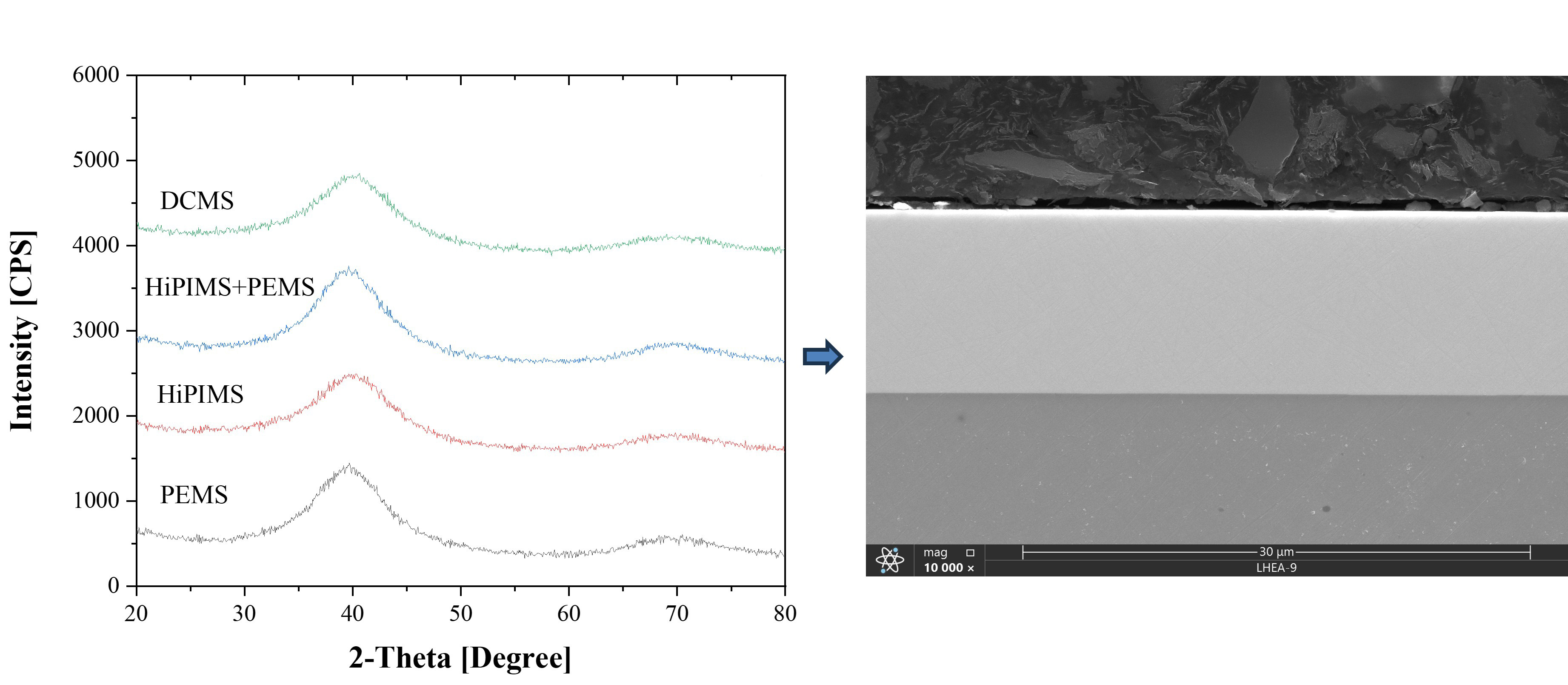
Figure 1: XRD patterns (figure on the left) of LHEA coatings deposited by different sputtering techniques, confirming a single-phase body-centered cubic (bcc) solid solution phase, and a representative SEM micrograph (image on the right) of a LHEA coating deposited by PEMS that exhibits a compact structure with a thickness of 10 µm.
Accomplishments
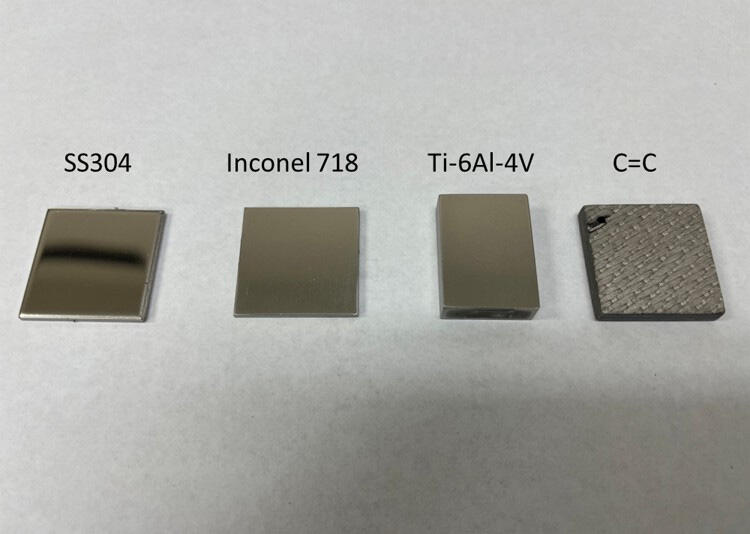
Figure 2: A photo showing a 10 µm LHEA coating deposited by PEMS on various substrate materials, including AISI SS304 stainless steel, Inconel 718 alloy, Ti-6Al-4V alloy, and graphitic carbon.
Thick LHEA coatings up to 12 µm were successfully deposited on various substrate materials (SS304, Inconel 718, Ti-6Al-4V, graphitic carbon) using different magnetron sputtering techniques. The PEMS technique was identified as the best method for depositing LHEA coatings with excellent adhesion, dense microstructure, and outstanding mechanical properties. The LHEA coatings with a novel composition exhibited a single-phase body-centered cubic (bcc) solid solution phase and a dense microstructure. High hardness values in the range of 20 to 24 GPa were measured, which are higher than the predicted hardness value (10 GPa) of LHEA with equiatomic ratios obtained from the rule of mixtures.
Patents
An invention disclosure based on LHEA research was submitted to the patent office on 9/16/2025.