


Background
Southwest Research Institute has a long history in studying and providing services related to protection from underbelly blast. During the mid-2000’s we supported a number of Mine-Resistant Ambush Protected (MRAP) vehicle tests as they were being designed and built to support U.S. forces in Afghanistan and Iraq. Recent years have shown a decline in interest in such survivability until recently, where now there is an upswing in requests related to underbelly blast. Many requests are from U.S. suppliers who are trying to sell their vehicles to non-U.S. countries. Most of these countries are interested in the vehicles meeting a NATO standard, AEP-55 (Volume 2, “Procedures for Evaluating the Protection Level of Armoured Vehicles – Mine Threat”).
The soil in which a landmine (or any explosive) is buried has a large effect on the resulting load delivered to the vehicle. For AEP-55 vehicular landmine exploitation tests, a large pit is excavated from the ground and backfilled with a standard-compliant soil. In fact, the AEP-55 procedure specifically states, “A constant soil quality over the entire test bed should be given. Testing in soil can be subjected to some level of loading variation. It is therefore recommended that test organizations develop and validate their test procedures.” As such, the AEP-55 standard calls out very specific requirements for the soil such as particle size distribution (granularity), wet density (amount of compaction), and moisture content (hydration). These specific parameters must be characterized during construction of the soil pit for the landmine exploitation test to be considered valid. The overall objective of this project was to develop a process for procuring and preparing soil compliant with the AEP-55 standard and determine load and load variation when used in buried landmine tests.
Approach
The project objective was accomplished using a three-step approach. First, the Engineering Dynamic Department explored different road base materials from both local and national quarries to determine their properties in context of the AEP-55 granularity, hydration, and compaction requirements. These properties are measurable quantities determined from sieve and proctor analysis performed by a local geological firm. Second, specific procedures were developed to uniformly hydrate and compact the soil such that it would be compliant with the AEP-55 standard. In the interest of cost, procedures were developed and tested at small scale by filling and compacting several 30-inch-diameter by 16-inch-tall forms, but the methods employed are scalable to a full-sized AEP-55 soil pit. Finally, small scale blast tests were conducted where landmine surrogates were buried in the soil forms and detonated beneath SwRI’s landmine test fixture. Soil loading and load variation were assessed by measuring impulse delivered to the fixture using a suite of on-board instrumentation.
Accomplishments
- A soil material was sourced from a local quarry that met AEP-55 granulation, hydration, and compaction requirements. A local geological firm conducted a sieve analysis to verify that the material met the granulation requirements, as well as a proctor analysis to confirm that the hydrated soil would reach the wet density tolerance specified in AEP-55 during compaction.
- 23 tons of the candidate soil material were delivered to SwRI’s Hondo Remote Test Site. Over the course of three days, soil hydration and compaction methods were developed and tested by constructing nine “soil pedestal” samples. A local mobile mixing truck service was contracted to assist in hydrating the soil. This unique capability allowed precise volumes of water to be metered into known amounts of soil and then mixed uniformly. As a result, moisture content of the soil could be controlled to within 2%, which was critical to reducing variability in the final compacted wet density. The mobile mixing truck is capable of processing large quantities of soil, which makes it ideal for constructing a full-sized AEP-55 soil pit.
- A high-frequency vibratory compactor was utilized to successfully compact the hydrated soil to wet density levels within the AEP-55 tolerance and variability of less than +/-2%.
- Six small-scale blast tests were conducted with the AEP-55 compliant soil pedestals where impulse delivered to the landmine fixture was measured. A nominally 15% variation in delivered impulse was observed, which is considerably lower than SwRI has observed historically for buried landmine testing.
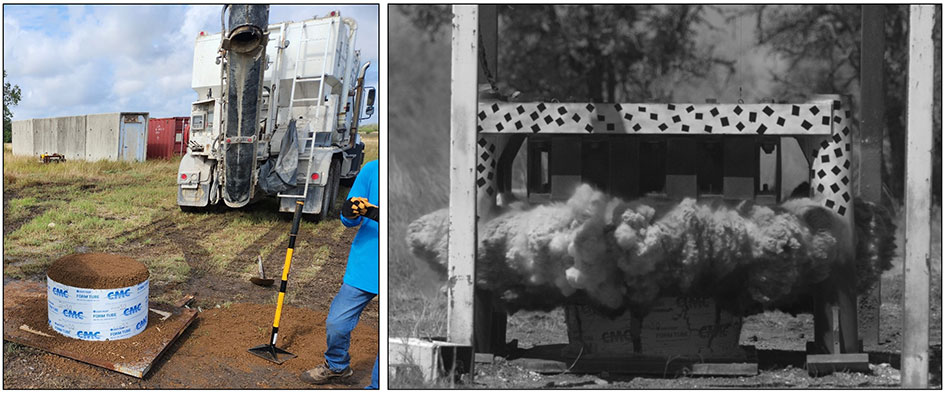
Figure 1: Mobile mixing truck (left) and high-speed video image from small-scale landmine detonation test (right).
Resulting Project Work
The Engineering Dynamics Department has responded to two separate requests for proposals that were provided to SwRI as a direct result of our ability to procure and prepare AEP-55 and similarly compliant soil. Contracts are still being negotiated for these proposals and testing is expected to occur in the early 2026 calendar year:
- Oshkosh Defense: 18-101445C Vehicle Underbody Blast – $397,000
- Integris Composites: 18-102510 Non-STANAG Anti-Vehicular Landmine Exploitation Testing – $360,000