


Background
Impact flash is a physical phenomenon resulting from conventional and hypervelocity impact. The emission of the flash is related to the composition of the target; thus, spectrographic measurements provide spectral data that could be used to identify the materials involved in the collision. In many instances, impact flash is the sole source of information that can be recorded following these events. For this reason, it is necessary to develop diagnostic techniques that can enhance current understanding of the complex physical phenomena underlying hypervelocity impact.
Approach
The objective of this project is to develop and demonstrate the ability to characterize the materials involved in hypervelocity impacts through high-speed spectrographic measurements at temperatures and pressures of interest. In this program both the small and large two-stage light gas guns (LGGs) will be used. During the first part of the program, the smaller LGG will be used to demonstrate the ability to record and process impact flash spectra. For the second part of the program, the large two-stage LGG will be used since this facility can launch larger projectiles that are of interest in meteorite and missile defense applications. These data sets will provide time-resolved data that can be analyzed to extract additional information about the process generating the impact flash.
Accomplishments
To date the program has met the following objectives and metrics:
- A laser-based triggering scheme was developed and tested. Accurate timing within 100 ns of the impact was demonstrated. This achievement meets metric #1 of the program.
- Strong lines of the emission spectra of aluminum and copper have been measured and characterized within ±2 nm of their published values. The doublet near 396 nm, for aluminum, and the triple near 515 nm, for copper, have been selected as the best lines to continue with the experimental test matrix. This achievement meets metric #2 of the program.
- The effects of projectile flight speed, atmospheric pressure, and atmospheric composition have been documented. These results are fulfilled in part metric #3 of the program. The results show these parameters affect the amplitude and width of the emission lines.
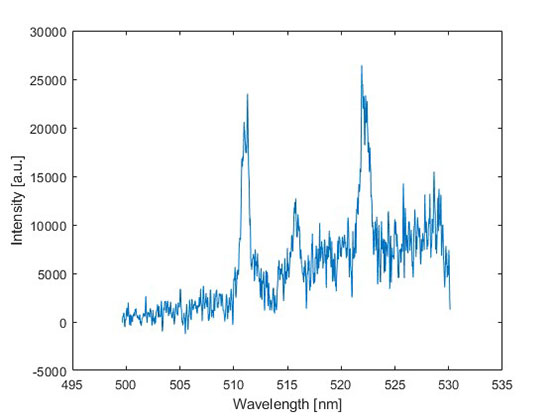
Figure 1: Emission spectrum of copper after the impact of a 3-mm spherical projectile on a 3-mm thick square target at 2.3 km/s. The spectrum shows the triple peak of copper at 510.5 nm, 515.3 nm, and 521.8 nm.
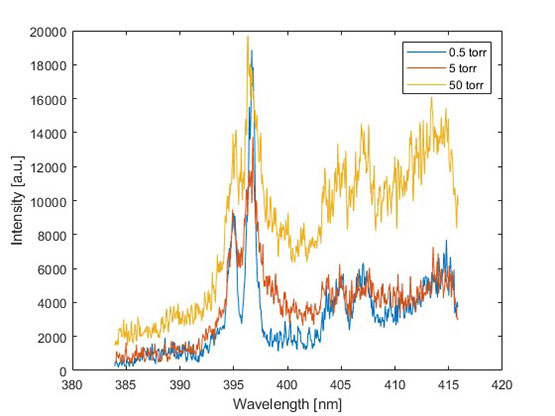
Figure 2: Effect of atmospheric pressure on the emission spectra of aluminum after the impact of a 3-mm spherical projectile on a 3-mm thick square target at 5 km/s. The spectra show that the intensity and width of the peaks increase with increasing pressure.