


Background
Microchannel Plates (MCPs) are widely used as amplification stages in particle and photon detectors. They are comprised of millions of micron-scale pores that generate cascades of secondary electrons when struck by an incoming particle or photon. MCP detectors enable single-event imaging and can be used to characterize gain, resistance, uniformity, and background response. Such measurements are critical for life testing, burn-in, and performance validation.
SwRI has traditionally relied on externally procured commercial detectors for MCP testing, which is costly and inflexible. To reduce dependence on outside systems, this project developed a compact 50 mm MCP detector with selectable bias polarity. The system provides an in-house capability to support calibration and testing for multiple ongoing IR&D programs, ensuring immediate business value and continuity of detector characterization across SwRI’s Space Systems and Space Science Divisions.
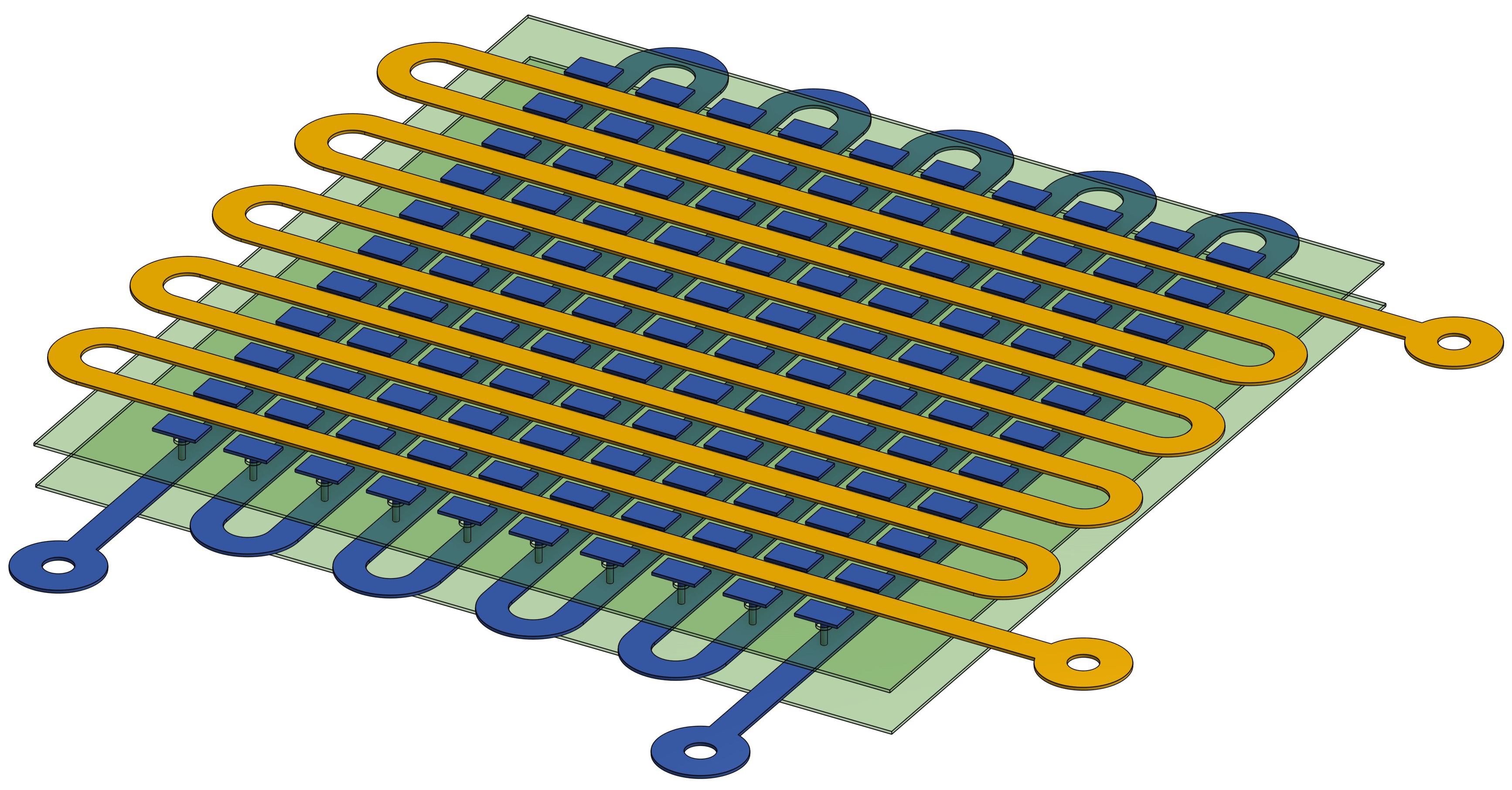
Figure 1: 3D rendering of the 50 mm cross delay line anode design showing orthogonal serpentines (yellow and blue) separated by ground layers (green).
Approach
The detector was built around a 50 mm cross delay line (XDL) anode, which determines event position by measuring the relative timing of signals along orthogonal serpentine traces. A custom high voltage decoupling board was added to allow the anode to float at positive bias while preserving fast signal transmission. The detector housing was designed as a standalone package with shielded HV and signal cabling, enabling modular MCP replacement and integration with existing SwRI calibration chambers.
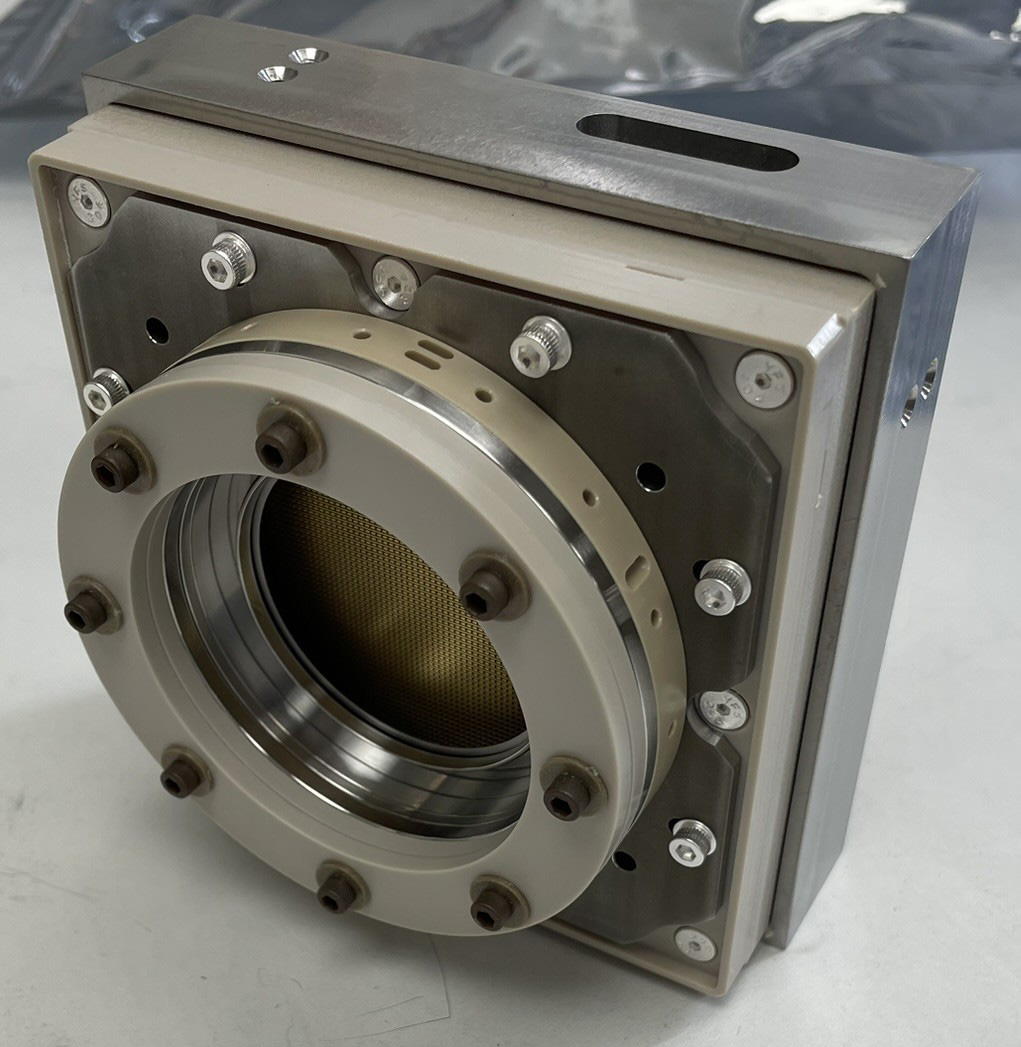
Figure 2: Assembled 50 mm MCP detector with cross delay line anode and HV decoupling board. The system provides a flexible, in-house platform for detector calibration and testing.
Accomplishments
The XDL anode was fabricated and tested, showing expected resistance, capacitance, and timing delays. The high voltage decoupling board operated as designed, isolating downstream electronics from transients while preserving fast timing signals. The completed detector was assembled and demonstrated successful imaging with a 53 mm MCP stack under UV illumination.
The detector is now available for immediate use in multiple ongoing IR&D programs in Divisions 5 and 15. By reducing dependence on commercial systems, this platform provides a reliable, cost-effective capability for MCP testing and calibration, strengthening SwRI’s ability to support current and future detector development efforts.