


Background
Top-hat Electrostatic Analyzers (ESAs) play a critical role in space missions. ESAs measure charged particles by applying a bias voltage (thousands of volts) across the analyzer’s curved outer and inner walls. Achieving tight tolerances, such as uniform concentricity (< 0.1 mm deviation) and voltage settling (< 0.5 ms stabilization), is essential to ensure the instrument's effectiveness in measuring plasma velocity distributions within Earth's magnetosphere. Concentricity ensures a uniform gap between two domes with a common center, which is necessary to reliably filter a small energy range of charge particles with the correct energy per charge through the arc between the domes. Voltage settling refers to the speed and reliability of the ESA reaching the desired voltage, which is crucial to maximizing the data collection window with only 6.5 milliseconds between voltage steps.
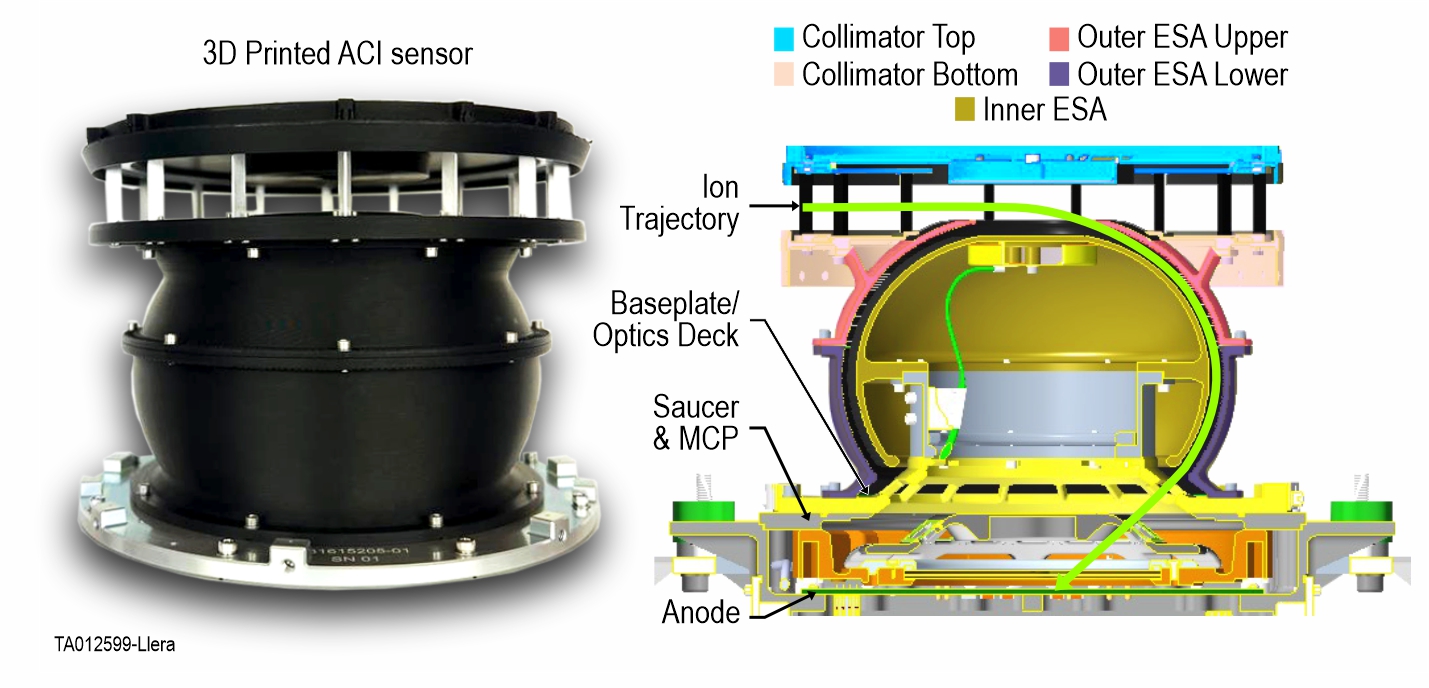
Figure 1: (Left) Assembled ACI ESA sensor out of five 3D-printed pieces; (Right) Color-coded cutaway of the ESA sensor and the five pieces that direct the ion’s path: two collimator pieces, two outer ESA wall pieces, and one inner ESA piece. The outer ESA wall is maintained at ground potential, while the inner ESA is charged up to 3.7 kV. The existing insulated cylinder within the inner ESA secures the high-voltage connection and isolates the inner ESA from the baseplate/optics deck, saucer, microchannel plate (MCP), and anode below.
Ion beam calibration is the only method to measure an ESA’s performance accurately and apply correction factors to meet science-driven tolerances during data processing. Instrument calibration involves characterizing the ESA's response through a known charged ion beam and the voltage applied across the ESA. Fabricating ESAs with additive materials (AM; 3D printing) introduces new challenges, such as (1) the large trade-off between thermal and conductive properties between materials, and (2) the lack of data on how these materials perform in the space environment. Heat-resistant thermoplastics require additional post-processing coating to achieve surface conductivity and electrostatic dissipation properties. The ESA’s large arc inner wall is not optimal for these line-of-sight coating applications. Conversely, infusing conductive properties into additive materials increases their susceptibility to heat. Preliminary tests confirm that our selected conductive 3D-printing material meets thermal and environmental constraints. Further testing in a high vacuum environment was needed to determine the instrument response and confirm operational requirements.
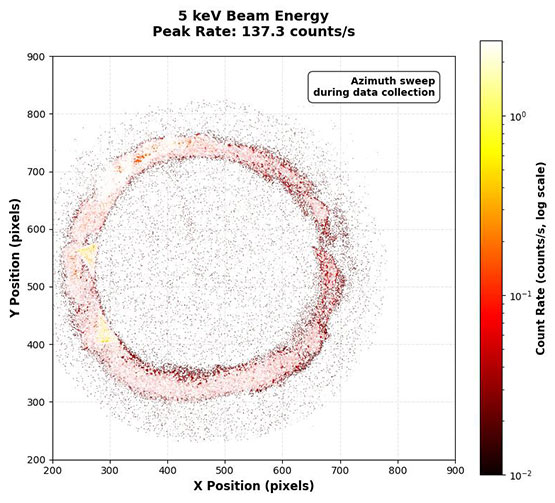
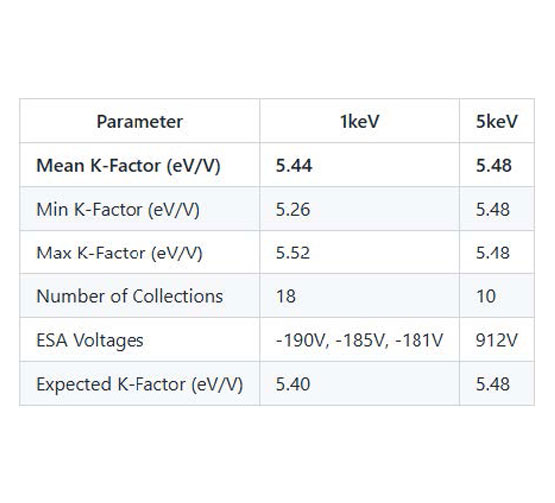
Figure 2: Location impact detections on a delay anode imager mapping the azimuthal response of ions through the 3D-Printed ACI. The K-factor was determined at two energies (1keV and 5 keV). Three locations across azimuth (apparent max, min, and mean) were taken at 1 keV, resulting in K-factor ranging from 5.26 - 5.52, consistent within 5 percent of the machined k-factor of 5.4.
Approach
The goal of this project was to demonstrate the viability of a 3D-printed ACI (Analyzer Constant Instrument) sensor, achieving Technology Readiness Level (TRL) 6, and comparing the performance of the 3D-printed instrument with a conventionally machined ACI sensor. Given the advantages of 3D printing, such as reduced labor, increased design flexibility, and lower resource requirements, this project aimed to validate a transformative approach to fabricating space instruments.
The main challenge is to ensure that the selected additive manufacturing (AM) material can be reliably printed, handle the rapid voltage stepping required, and withstand the thermal and vibrational extremes of a sounding rocket launch. To address these concerns, we selected a robust AM material and initially test-printed two concentric hemispheres separated by 4 mm gap to evaluate structural, thermal, and electrical tolerances. The 3D-printed domes were subjected to a series of tests, including heat exposure, bench-top voltage stepping, and high-vacuum outgassing monitoring. This process helped refine our methodology and develop a systematic, streamlined process for printing, baking, and assembling the ACI sensor.
The performance of the 3D-printed ACI sensor was validated and compared to the conventional machined ACI sensor by replicating the calibration tests used for the TRACERS ACI in the Energetic Plasma Instrument Calibration (EPIC) Lab. These tests included determining k-factors at different energy levels and measuring the consistency of ion impacts on the sensor's delay anode imager, ensuring the reliability and functionality of the 3D-printed components under mission conditions.
Accomplishments
Advanced the TRL of the 3D-printed ACI to 6, indicating successful prototype demonstration in a relevant space environment.
Achieved near-instantaneous voltage settling across the ESA, spanning a few volts up to a few kilovolts, limited only by the slew rate of the applied power supply.
Validated the sensor response through "first light" calibration with a delay anode imager capturing impact detections and mapping the azimuthal response of ions through the 3D-printed ACI.
Conducted successful preliminary tests with a delay anode imager to map the azimuthal response of ions through our 3D-printed ACI, determining k-factors at 1 keV and 5 keV. The k-factors were within 5 percent of the machined ACI k-factor of 5.4, confirming the functionality of our 3D-printed ACI and science-driven requirements.
Passed environmental testing, including thermal cycling and vibrational tests, in accordance with the NASA General Environmental Verification Standard (GEVS) and NASA Sounding Rocket Handbook.
Met NASA Collected Volatile Condensable Materials (CVCM) outgassing requirements for the 3D-printed materials, confirming their robustness and reliability for space missions.
Developed a streamlined process for printing, baking, and assembling the ACI sensor, ensuring reliability and reproducibility of the 3D-printed components.
Publications
We are preparing a manuscript for peer-reviewed publication, with the goal of submission by January 2026.
Presentations
Abstract submitted for the American Geophysical Union (AGU) 2025 in December.