


Background
The first stages of planetary formation involve the growth of dust grains within circumstellar disks produced as gas and dust grains infall to the star from a collapsing molecular cloud core. The disks are composed mainly of hydrogen and helium gas, with a minor component (few percents) of condensable materials like ices and silicates. The disk's temperature generally decreases with distance from the star, and the disk cools with time as infall slows and the gas component of the disk spreads and disperses. For a given disk temperature profile, ice and silicates condense to form small solid grains at and beyond the distance at which the temperature equals the relevant condensation temperature. Although these grains are the initial building blocks of planets, the processes that govern their subsequent growth and eventual assembly into large, > km-sized gravitationally bound bodies (planetesimals) remain poorly understood. This gap in understanding is due in large part to challenges in modeling the complex, coupled evolution of the dust and gas, a long-standing obstacle for planet formation theories.
Approach
We will use the publicly available DustPy package, a Python code developed for studying circumplanetary disks. DustPy combines a code that tracks the time evolution of the disk's radial gas distribution with a code that tracks the orbital and collisional evolution of the dust. DustPy is state-of-the-art, thanks to its numerous technical advances and high computational speed. However, a key limitation of the current code is the absence of grain condensation and evaporation, processes that we will incorporate as part of the development here.
Accomplishments
The project was only recently initiated. We were able to compile the code and the run a few test simulations that show silicate grain growth with different fragmentation velocities.
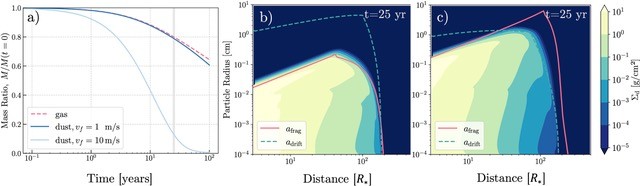
Figure 1: Example of two DustPy simulations. a) The total remaining fraction of silicate grains (blue curves) for a low (dark blue) and high (light blue) fragmentation velocity compared to gas (pink dashed curve). b) Rock size distribution at 25 yr in the low velocity simulation. c) Rock size distribution at 25 yr in the high velocity simulation. The maximum particle size is limited by inward drift (green dashed line) and fragmentation barrier (pink line). In these simulations, which do not include grain evaporation, the silicate grains are quickly lost, without producing favorable regions where planetesimals can form.