


Background
Research applications for new generation suborbital vehicles include but are extensive, including microgravity sciences, space life sciences, the Earth and space sciences, surveillance, education and public outreach (EPO), technology development and demonstration/space systems development and Technology Readiness Level [TRL] raising. The primary research advantages of these vehicles include more frequent access to the space environment, lower launch cost compared to conventional sounding rockets, capability for human operator presence to reduce the risks and costs of experiment automation, better experiment affordability, gentler ascent and entry compared to sounding rockets, longer periods of turbulence-free microgravity, and increased time in the 250,000–400,000 ft (80–120 km) region of the atmosphere (the “Ignorosphere”).
Approach
Our long-term business interests in these vehicles are:
- To exploit them for planetary, astronomical, microgravity, aeronomical, Earth science, and auroral research.
- To provide research-related common systems (flight computers, data recording racks, etc.) and payload integration services to NASA and/or vehicle providers.
- And to provide instrumentation, payload specialists, and flight project expertise to research groups, both domestic and overseas, working in this area.
The overarching objective for this IR is to put SwRI in the lead of the burgeoning suborbital research field using next-generation, crewed vehicles by becoming one of the first organizations to fly payloads with research payload specialists on these vehicles. This will open up to SwRI a series of new business opportunities including new funded research projects, new hardware development projects, ground and flight system task order contracts associated with next-generation suborbital work, and the provision of payload specialists for next-generation suborbital work.
Accomplishments
- Selected our flight experiments (SWUIS-A [Southwest Ultraviolet Imaging System-Airborne] for remote sensing; biomed harnesses for life science work; BORE [Box-Of-Rocks Experiment] for microgravity research).
- Secured personnel for SWUIS-A refurbishment, checkout, and calibration.
- Began the refurbishment of SWUIS-A.
- Completed the design and initiated construction of the BORE microgravity experiment.
- Received and test fit a commercial biomed hardness that forms the basis of one of our three suborbital flight investigations.
- Constructed a flight requirements matrix to determine which flight providers are suitable for which of our experiments.
- Completed a second set of F-104 training flights, with focused, in-flight investigations to (1) evaluate the wearability and function of the biomedical harness with standard crew flight suits and life support equipment during typical g-loads, and (2) test the design concept for our BORE microgravity experiment during zero-g parabolas.
- Completed a zero-g training flight that included initial zero-g training for Co-I Olkin, and team exercises to refamiliarize/practice personal mobility and experiment handling operations in zero-g conditions.
- Made presentations on the SwRI Suborbital Program and our three suborbital experiments at Next-Generation Suborbital Researchers Conferences.
- Completed construction and testing of the BORE microgravity experiment.
- Continued refurbishment and testing of SWUIS-A.
- Gave invited oral presentation on the SwRI Suborbital Program at Spacefest III (Tucson, AZ).
- Completed FAA Class II and Class I medicals for each SwRI Payload Specialist in order to maintain expected suborbital flight medical qualification standards.
- Designed and press released the SwRI Payload Specialist Team mission patch.
- Initiated discussions with David Clark Company and NASTAR (National Aerospace Training and Research Center) on a collaborative effort to test/evaluate the CHAPS (Contingency Hypobaric Astronaut Protective Suit) pressure suit under launch g-loads.
- PI Stern completed pressure suit familiarization training at the David Clark Company and both PI Stern and Co-I Durda undertook centrifuge training at NASTAR to test/evaluate the David Clark CHAPS pressure suit under launch g-loads.
- Completed an upgrade and re-calibration of SWUIS experiment for flight.
- Initiated planning for high altitude (75,000 ft) flight training in F-104 and F-18 aircraft.
- Continued aerobatic jet aircraft training for PI Stern and Co-I Durda; first introduction to aerobatic training for Co-I Olkin.
- Completed flight data requirements and collection plans for each suborbital experiment.
- Gave invited oral presentation on the SwRI Suborbital Program at AIAA (American Institute of Aeronautics and Astronautics) annual meeting (Nashville, TN).
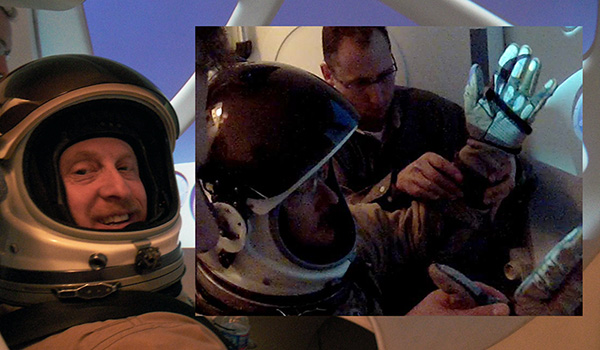
Figure 1: PI Stern and Co-I Durda completed pressure suit testing and centrifuge evaluation.

Figure 2: The SWUIS experiment was upgraded and re-calibrated during laboratory and field ops.
- Requested and received VG flight integration requirements documents and initiated work to complete these documents.
- Checked out all three of our flight experiments after over a year in storage.
- Presented three public talks on the SwRI Suborbital Program at local clubs/organizations.
- PI Stern and Co-Is Durda and Olkin participated in a workshop on planetary science applications in suborbital science at the annual Division for Planetary Sciences meeting.
- Built BORE and SWUIS experiment flight boxes and developed flight checklists, conducted a successful test of both experiments and validated checklists in zero-gravity parabolic aircraft flights flown by PI Stern, and CoIs Olkin and Durda.
- Our BORE payload was prepared for flight aboard the Blue Origin New Shepard suborbital vehicle.
- BORE then successfully flew its first suborbital spaceflight aboard Blue Origin’s New Shepard rocket. The payload performed flawlessly and recorded high-quality video data of the settling behavior of two different asteroid regolith simulants in microgravity. This was the first flight of science payloads on New Shepard, and Blue Origin marked the event by broadcasting pre-recorded video ‘tours’ of the experiments; SwRI’s contribution is archived online at https://www.youtube.com/watch?v=dugpPEp2y78 .

Figure 3: Closeout photo of the BORE payload, delivered to Blue Origin’s west Texas launch site in preparation for suborbital spaceflight.
- Co-I Durda participated in a panel discussion on “Why we want to fly in space” with other astronauts and future astronauts at an International Astronautical Congress in Washington, DC.
- Co-I Durda proposed and was awarded a NASA Tech Flights program grant to conduct a second suborbital spaceflight of our BORE asteroid regolith microgravity experiment on Blue Origin’s New Shepard rocket. Launch occurred in October 2020 with a 100% successful BORE II mission.

Figure 4: Postflight image of one of the two BORE II starfish collectors showing very efficient regolith sample collection, nearly filling the entire collecting volume of the starfish with almost 50% of the mechanism’s own mass in collected sample.
- Proposed to and won NASA a $350K in support of SwRI IRAD experiments to be flown on Virgin Galactic’s SpaceShipTwo. PI Stern was awarded the first NASA human-tended flight mission and flight details are being negotiated with Virgin Galactic for flight in 2026.
- PI Stern participated in two Zero-G Corp. parabolic flights maintaining zero-g proficiency in the run-up to his NASA human-tended research flight.
- Agreed to terms and conditions for a two-flight sequence with Virgin Galactic.
- Completed and delivered the Virgin Galactic Payload Information Form (VIF) for our first payload specialist space flight, Galactic 05.
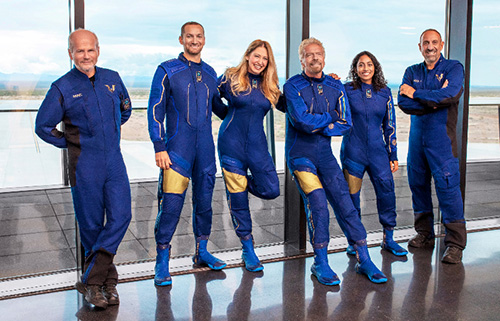
Figure 5: Virgin Galactic’s first commercial spaceflight cockpit and cabin crew, including company founder Sir Richard Branson; this crew flew to space.
- Worked with the Virgin galactic team to complete our Payload Information Package (PIP) for our first flight. PI Stern also began a number of in-depth familiarization and ‘meet your crew’ meetings with Virgin Galactic.
- In August 2023, PI Stern attended the Virgin Galactic G02 launch and met with the payload team for his upcoming flight.
- In September 2023, Co-I Durda completed turn-on validation of the bioharness and fabrication of a number of foam mockups for the Xybion camera that PI Stern will use during his first flight.
- In September 2023, PI Stern and Co-I Durda underwent centrifuge training, flying the Virgin Galactic flight profile, during suborbital spaceflight refresher training at the NASTAR Center in Philadelphia.
- PI Stern undertook and completed all flight operations planning and training for flight aboard the Virgin Galactic mission G05.
- On November 2, 2023, Virgin Galactic G05 launched, with PI Alan Stern aboard as Astronaut 020! The mission was 100% successful – PI Stern accomplished all objectives for the flight, plus some additional ‘get ahead’ evaluation tasks for the upcoming NASA flight.
- Preparations for flight 2, which will conduct the NASA astronomical demonstration flight with SWUIS-A and bioharness experiments are beginning.

Figure 6: PI Stern in space aboard the Virgin Galactic spaceship Unity during his first spaceflight on November 2, 2023.
Our remaining IR task list for flight 2 is short, and is summarized as follows:
Task | Lead |
ID SWUIS-A Targets and Filters by Flight | Stern |
Finalize Virgin Galactic Flight Paperwork | Stern |
Finalize BioMed Checklists | Durda |
Finalize SWUIS Checklists | Durda |
Create Press Kits | Stern |
Create and Execute Training Plan | Stern |
Analytical Integration—Virgin Galactic (VG) | Stern |
Physical Integration--VG | Durda |
Conduct NASA-funded VG Flight | Stern |
Reduce Data, Publish Results | Stern |
Schedule and Budget Status
This IR has been extended to 1 January 2027, and a modest budget increase was granted to the project to allow completion of the preparations and travel for the NASA research flight.
Resulting Project Work
NASA ESMD grant, $350K for human-tended Virgin Galactic flight experiments.