


Background
Several Divisions of SwRI are developing numerous Lunar instruments through multiple NASA and SwRI internal research (IR) projects, however we currently have no stand-alone platform on which they can be deployed. This forces us to rely on other institutions to provide the bulk of the hardware for this type of science mission, and thus receive the bulk of the funding. The solution to this lack of a platform is the creation of the SwRI Lunar Surface Observatory (SwRI LSO).
This presidential discretion (PD) internal research project was initiated to create new devices, associated skills and systems that make the SwRI Lunar Surface Observatory (SwRI LSO) “proposal ready” for the upcoming Artemis IV opportunity and beyond. The LSO and/or subsections of it will be proposed for three current NASA proposals associated with the Artemis IV, Artemis V, and the SALSA CLPS program. This PDIR addresses nine key aspects of the SwRI LSO including power, thermal control, physical design, and communications. The highest priority of these are the three research-objectives related to thermal control. We have divided the project into two phases, Phase One addresses a review of the PDIR scope including supported payloads, materials selection, power options, and thermal approach including survive-the-night or operate-thru-the-night options. It also addresses a Top-Level Design and three critical research activities for thermal control. Phase Two will address additional developmental objectives including raising the SwRI LSO to TRL 6. Through this two-phase implementation of technical objectives, this PDIR will create the critical technologies required to propose the SwRI LSO for stand-alone ADI’s, CLPS Landers, and Luner Terrain Vehicles. Having the SwRI LSO will position the SwRI Space Sector to answer fast turn-around calls for stand-alone ADI’s as well as support calls for lander and vehicle mounted instruments.
Approach
Phase one research objectives:
- Using expertise across the Institute, phase one was expanded to include a ‘scoping’ task consisting of reviews, discussion, and trades of available technologies and capabilities applicable to the LSO concept.
- Generate a Top-Level Design and documents for the SwRI LSO.
- Create an electrically controllable Thermal Isolation Switch (TIS). This is expected to be a patentable device. Prototypes will be built and tested.
- Create a cryogenic Thermal Isolation Enclosure (TIE) needed to survive a Lunar night. A full-scale mock-up will be built.
- Create a Thermal and Battery Management (TBM) approach and system also needed to survive a Lunar night. System design will be validated via simulation.
Phase two development objectives:
- Generate a Top-Level Design and documents for the SwRI LSO.
- Design a Direct to Earth (DTE) communications system.
- Design Solar Panels for use in modular arrays and identify potential vendors.
- Design Astronaut Accommodations meeting NASA carry requirements.
- Update SwRI Spacecraft Avionics Core to survive the Lunar environment.
Accomplishments
Phase 1 of this IR is now complete. Work on Phase II is currently in process. Accomplishments to date include:
We abandoned the original concept of a Thermal Switch based on a stack of Nitinol Belville Washers, settling on a custom designed High Output Paraffin (HOP) actuator. This custom design minimizes space while maximizing force against the radiator. A HOP using a single O-ring design (Figure 1) was fabricated but proved to be too difficult to assemble due to the tight fit of the single O-ring. Using the design guidelines of Parker (manufacturer of hydraulic pistons), we determined that a two O-Ring system would provide a cascade seal and reduce the insertion force needed.
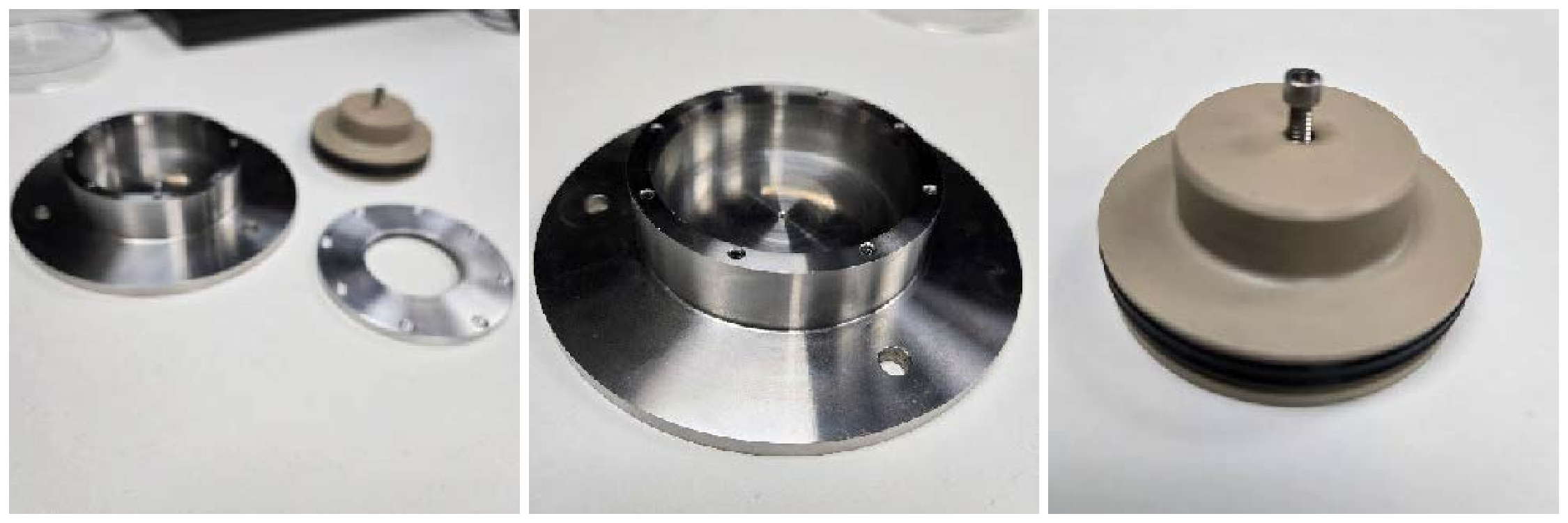
Figure 1: Revision One of the Thermal Switch Prototype. Disassembled Thermal Switch with the Cylinder, Piston, and Upper Alignment Collar (left). Cylinder. A valve through the bottom wall allows wax to be added to the actuator (center). Piston with a single O-Ring on the lower body. Next revision will have two O-Rings (right).
A major new concept was identified as an energy storage medium. The use of a H2 O2 Closed Cycle Fuel Cell or a Thermal Engine was discussed (Figure 2). This method uses solar power, which is plentiful in the SwRI LSO, to electrolyze water and produce H2 and O2 which would be captured in two high pressure tanks. The H2 and O2 would be recombined in a fuel cell during the night to produce 4W thermal and 5W electric. This, along with batteries, would allow the SwRI LSO to not only survive the night but to operate at night. Initial calculations showed that 240g of water would be enough to operate the SwRI LSO. This concept would also be scalable to larger lunar applications or adapted if solar was not available.
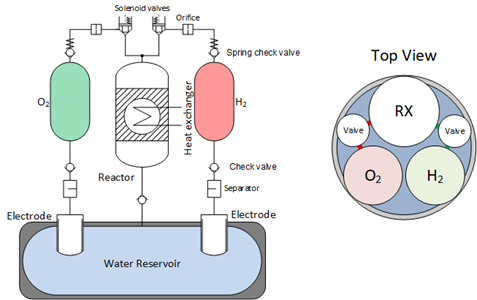
Figure 2: Basic schematic of the Thermal Engine or Closed Cycle Electrolyzing Fuel Cell. This method uses solar power to electrolyze water and produce H2 and O2 which would be captured in two high pressure tanks. The H2 and O2 would be recombined in a fuel cell during the night to produce power and waste heat.
We designed and fabricated a low-fidelity prototype of the Thermal Enclosure. Subsequently, we succeeded in raising the fidelity of several subcomponents of this design (see Figure 3).
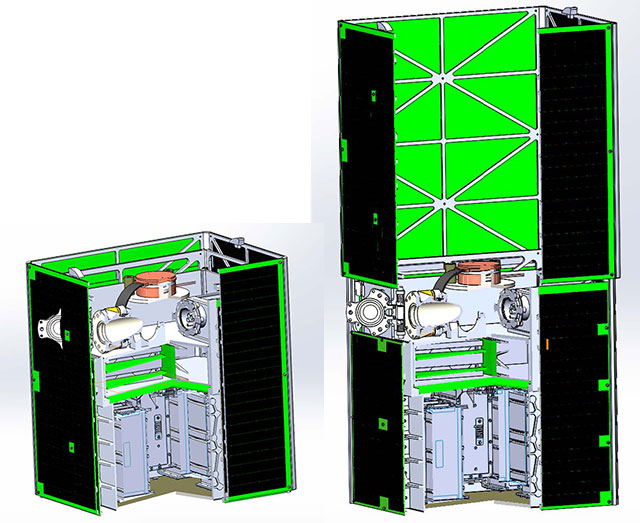
Figure 3: Stowed and deployed view of the SwRI LSO.
We designed the schematics for the thermal management board and completed fabrication and testing of a prototype board (see Figure 4).
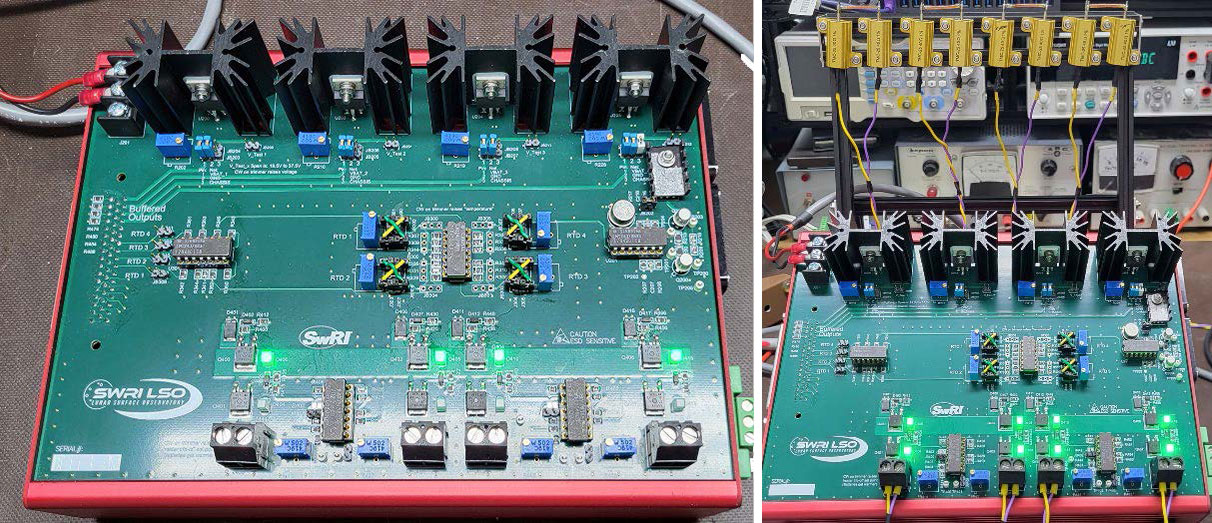
Figure 4: Thermal Board Testing. Each channel monitors a Thermistor and energizes an associated heater when below its given setpoint. For Unit Qualification testing, it has been configured with two channels set to control temperature above the Survival Range Floor temperature of -10C and two of the channels configured to control temperature above the Operational Rang Floor of +10C (left). Test resistors are used during bench testing, in place of the heaters. These resistors (shown across the top) simulate the heaters that will maintain the Inner Box temperatures (right).