


Background
Current space exploration aims to establish permanent structures on the Moon, Mars, and eventually other planetary bodies. The successful design and execution of lunar missions relies heavily on understanding and predicting the behavior of lunar regolith, a fine granular material covering the Moon's surface exhibiting complex physical and mechanical properties due to its environment.
Understanding the regolith’s dynamics under certain circumstances such as granular flow and the interaction between the exhaust plume and the surface are critical for instrument/sensor or mission design. The regolith’s complex flow behavior is due to its distinct characteristics, such as fine particle size, irregular shapes, and low-gravity effects. Lunar exploration and the development of sustainable infrastructure on the Moon demand a detailed understanding of the unique behavior of lunar regolith granular flow under varying relevant conditions. Simulating the granular flow of lunar regolith has been difficult and involves modeling particle-particle interactions, collisions, and surface contact forces.
Discrete Element Method (DEM) is an efficient computational method to simulate particle interactions in simulations of lunar regolith granular flow. The DEM method is based on the use of an explicit numerical scheme in which the interaction of the particles is governed by contacts and the motion of the particles modelled individually. The explicit treatment of particle-particle collisions in DEM makes it one of the most used methods for efficiently simulating granular flow. The study of under expanded compressible flow from the rocket nozzle interacting with lunar regolith is critical for understanding the effects of rocket exhaust on lunar surfaces.
During spacecraft landings and takeoffs, interactions between rocket exhaust plumes and the regolith can result in erosion, particle ejection, and surface damage. The launching of high-speed dust poses risks to equipment, astronauts, and visibility and presents significant challenges for safe landing operations. Research on these behaviors is particularly relevant for space exploration initiatives like the Artemis program, which aims to establish sustainable operations on the Moon through multiple landings using large-scale spacecraft. Plume regolith interaction is a complex, multi-disciplinary multiphysics problem involving high speed compressible flow and flow particle interactions. This completed targeted IR&D project developed a numerical simulation tool that independently addresses these two critical relevant aspects of lunar regolith behavior in two phases: granular flow dynamics using DEM and plume-regolith surface interaction (PSI) using Eulerian-Lagrangian (Discrete Particle Model DPM) approach. The simulation tool leverages the capabilities of two advanced computational platforms: MFiX (Multiphase Flow with Interphase eXchanges) for lunar regolith simulations with DEM and COMSOL Multiphysics® for plume surface interaction without direct coupling between the two computational platforms.
The research established a non-coupled computational framework that allows independent but complementary analysis of granular flow dynamics and lander-regolith interactions on lunar surface. In broader terms, the project investigated the two distinct physics with separate numerical tools.
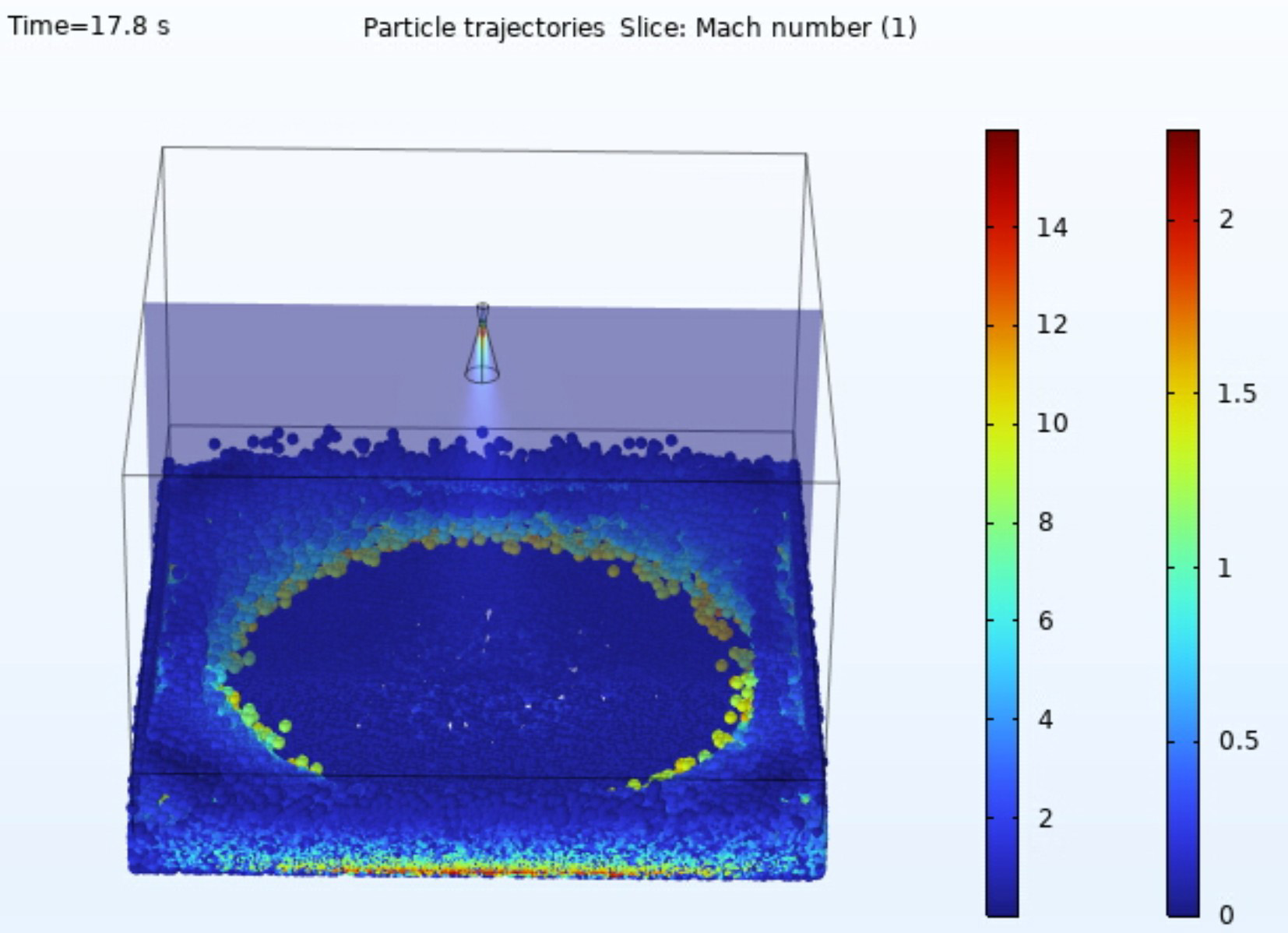
Figure 1: Particle trajectories and regolith particles and plume regolith interaction using COMSOL.
Approach
The technical approach primarily consisted of four tasks.
Task 1: Set up and validation of MFiX-DEM simulations to simulate lunar regolith flow.
Task 2: MFiX-DEM application to lunar regolith funnels and flow.
Task 3: COMSOL Multiphysics simulations of plume surface interactions (PSI).
Task 4: COMSOL simulations of plume surface interactions (PSI) for different nozzle geometries.
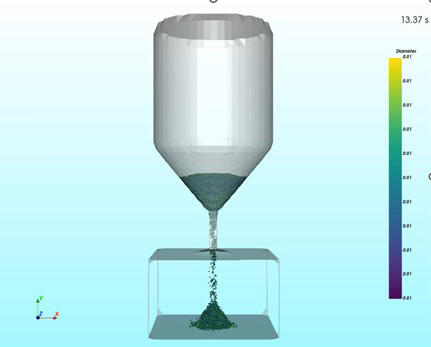
Figure 2: Flow of lunar regolith particles through the funnel geometry using MFiX-DEM.
Two codes were used for the simulations. MFiX-DEM and COMSOL. MFiX-DEM is general purpose CFD code developed by U.S. Department of Energy (DOE) National Energy Technology Laboratory (NETL). For task 1 and task 2, the developed model used the Discrete Element Model (DEM) in MFiX to investigate particle-particle and particle-wall interactions, particle contact forces and collision to understand flow regimes unique to lunar gravity and vacuum conditions. For task 3 and task 4, COMSOL Multiphysics® has been used to simulate the coupled behavior of the under-expanded supersonic nozzle flow and regolith interaction using the Eulerian-Lagrangian approach. A Eulerian-Lagrangian framework was used to simulate the interaction between under-expanded nozzle plume and lunar regolith [22-25]. The Eulerian framework is used to simulate and establish the nozzle flow field and exhaust plume. Once the solution is established, the regolith trajectories are simulated through the Lagrangian approach (Discrete particle modeling DPM) using a one-way coupled approach with the continuous phase flow field.
Accomplishments
This completed targeted IR&D project developed a numerical simulation tool that independently addresses these two critical relevant aspects of lunar regolith behavior in two phases: granular flow dynamics using DEM and plume-regolith surface interaction (PSI) using Eulerian-Lagrangian (Discrete Particle Model DPM) approach. The using the capabilities of two advanced computational platforms: MFiX for lunar regolith simulations with DEM and COMSOL Multiphysics® for plume surface interaction without direct coupling between the two computational platforms. Simulation results from COMSOL indicated that the plume-surface interaction is a complex multiphysics problem. Key simulation outcomes include visualization of Mach number distribution and shock within the plume, identification of primary erosion zones and crater initiation sites and trajectory analysis of lofted regolith particles. Numerical simulations were carried out to study the flow and granular dynamics of lunar regolith using DEM technique to analyze granular flow behavior of lunar regolith while exploring the effects of regolith properties, such as particle diameter, inter-particle friction parameters (rolling friction, Coulomb friction, coefficient of restitution, spring constant), and granular flow behavior. The angle of repose (AOR) was calculated to see the settling and deposition pattern of the regolith particles. The calculated AOR was compared to the values observed in analog studies and open literature. The simulations quantified the effect on particle-wall and particle-particle contact forces on AOR, clogging behaviors unique to reduced gravity granular systems in Regolith particles with small diameters. The predicted AOR values matched well with values in open literatures.
The simulation capability developed through this completed targeted IR&D can be used to demonstrate to clients our unique capabilities to address challenges in modeling lunar regolith for upcoming NASA proposal solicitations. The project is extensible to Martian environments and other planetary surfaces and forms the basis of future SwRI research proposal efforts to NASA space exploration and for future NASA solicitations on plume surface interaction and regolith plume research. In summary, this completed project enables a new avenue of space research to enhance existing instrument development and research & analysis proposals that will give SwRI a competitive edge in future NASA solicitations.
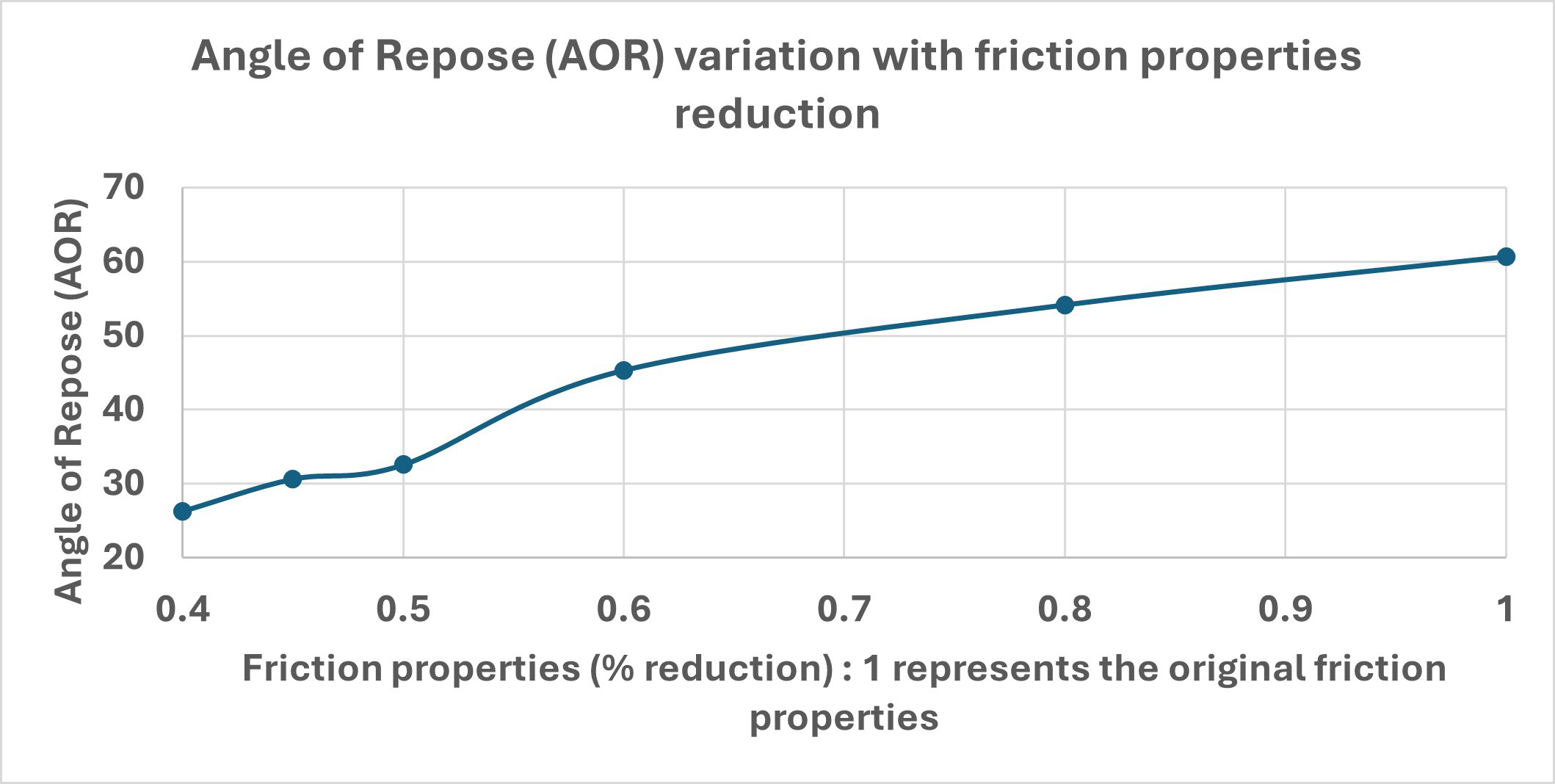
Figure 3: Variation of Angle of Repose (AOR) with friction properties reduction for lunar regolith.