
Background
Recent mission concepts, white papers, workshop proceedings, and decadal surveys have argued the merits of further exploring the magnetospheric systems of the gas and ice giants (Jupiter, Saturn, Uranus, and Neptune). The high-priority science observations and instrumentation for future planetary missions are under consideration.Energetic Neutral Atom (ENA) imaging is being considered. With respect to the upcoming JUICE mission at Jupiter, the science community is actively refining their investigation plan to optimize mission science return, including observations from the JENI (Jovian Energetic Neutrals and Ions) camera. Advanced prediction tools are still needed to assist in the planning and interpretation of observations for future and ongoing missions.
Project R6611 aimed to further expand the worldwide recognition of Southwest Research Institute in developing state-of-the-art prediction tools as a pathway to assist in the science planning of the JUICE mission and future exploration of the ice giant systems (e.g., Uranus and Neptune Odyssey Flagship missions). The outcomes of Project R6611 also provide new opportunities to broaden the use of a new Low to High Energy Neutral Atoms (LHENA) prediction tool to study other planetary systems (e.g., Mercury, Earth, Mars) and objects (e.g., the Moon) of our solar system.
Approach
Project R6611 specifically focused on enhancing the computational capability of an existing in-house model of ENA production to predict and interpret the observation of LHENA, which are here resulting from charge-exchange interactions between charged and neutral particles populating the magnetospheric systems of the outer planets (encapsulated image of Figure 1).
In addition to carrying out code optimization, the key steps to enhance the capability of our in-house tool to predict and analyze the detection of LHENAs were to generalize the theoretical approach to low- and high-energy populations for a moving reference frame (Fig. 1), account for various neutral atoms (hydrogen, oxygen, and sulfur), broaden the energy ranges of neutral atoms to 600 eV – 1 MeV, improve the models of ion distributions from planetary missions, and implement post-processing of synthetic LHENA flux maps to permit meaningful comparisons between modeled images and imager observations.
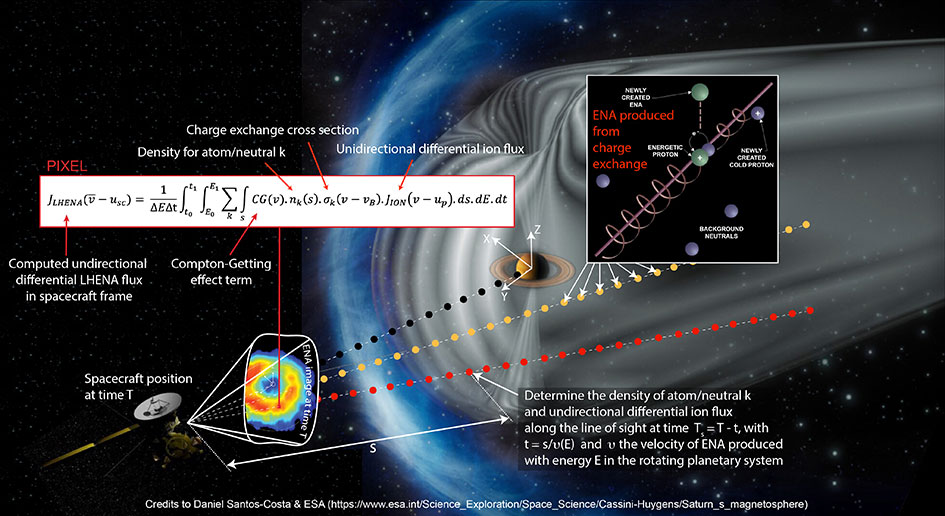
Figure 1: Composite image showing our methodology to predict distribution maps of energetic neutral atoms - which are here originated from charge exchange between singly charged ions and neutral environments present within magnetospheric systems, from a spacecraft viewpoint.
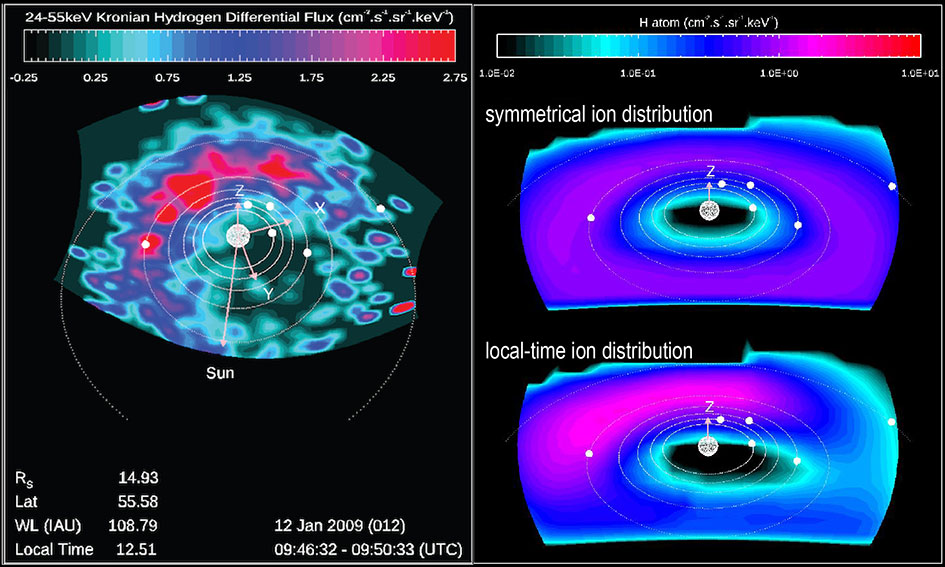
Figure 2: Comparisons between Cassini ENA observations at Saturn (left) and LHENA flux simulations (right) demonstrating our prediction tool’s capability to investigate the local-time distribution of ions in magnetospheric systems.
Figure 3: Time series of LHENA flux maps at Uranus along Voyager 2’s trajectory demonstrating our computational tool’s enhanced capability to predict and analyze magnetospheric systems from ENA imaging for past, ongoing and future planetary missions. (Magnetic field lines are in white, magnetic moment axis in blue, Uranus’ spin axis in red, and the red circle represents the planet.)
Accomplishments
- Time was invested in code optimization. Time computation of a synthetic LHENA map - with tens of thousands of pixels for a resolution of 0.5ox0.5o and a field of view of 120ox90o - takes now a fraction of an hour instead of a day, making our LHENA prediction tool highly efficient to predict and/or analyze observations from ENA imagers.
- Comparisons between our simulator outputs and past ENA observations were carried out to conduct a proof of concept. Results not only validated our improved computational prediction tool but also provided insights into the local time distributions of ENA fluxes observed at Saturn during the Cassini mission in 2004-2017 (Figure 2).
- Simulation results permitted to gauge the detectability of LHENA fluxes at Uranus by simulating what an imager would have observed during Voyager 2 flyby in 1986 (Figure 3). Our predictions provide invaluable information regarding unexplored regions of Uranus and instrument design mitigation for future missions. Similar computations are ongoing for Jupiter and Neptune.
Presentations
- Daniel Santos-Costa, Angèle Pontoni, Cesare Grava, Joey Mukherjee, Nicolas André, Quentin Nénon, Howard Todd Smith, Donald G. Mitchell, Peter Kollmann, George Clark, and Pontus Brandt, “A framework to predict Low- to High-Energy Neutral Atoms (LHENAs) Observations in Support of Planetary Exploration,” https://doi.org/10.5194/epsc-dps2025-170, EPSC-DPS Joint Meeting 2025, Helsinki, Finland 7–12 September 2025.