


Background
Copper oxide blackening, such as Ebonol-C, is commonly used on space instrumentation to mitigate noise generated by stray light. While effective, copper oxide coatings present notable challenges: the complex oxidation process can damage the underlying parent material, and the resulting fragile dendritic surface significantly complicates handling and integration, increasing cost and schedule risk. Alternatives exist with known reflectance properties on flat coupons, however there is a paucity of empirical data comparing the effectiveness of alternative coatings on more complex surfaces, such as Electrostatic Analyzers (ESA).
Approach
To identify viable replacements for copper oxide coatings, a subset of candidate coatings was selected from an initial survey based on cost and performance potential. The UV reflectance of each candidate was measured on sample coupons to further down-select for flight analog testing. These coatings were then applied to flight-like ESAs, which were tested by measuring UV-induced signals on a channel electron multiplier (CEM) housed within the ESA under vacuum to simulate operational conditions. Each coating’s effectiveness was benchmarked against Ebonol-C and bare aluminum to determine viability.
Accomplishments
The results are presented in a comparative matrix showing the relative strengths and weaknesses of each coating option in terms of ultraviolet light (UV) suppression, mechanical robustness, handling requirements, and cost. While Ebonol-C provided the best overall attenuation, certain alternatives demonstrated sufficient performance with significantly improved durability and process reliability to justify their use. Notably, both Acktar Vacuum Black and Aerodag outperformed Ebonol-C under specific lighting conditions. This indicates that in certain contexts these coatings may offer superior suppression performance in addition to greater robustness. These findings support the inclusion of non-copper oxide blackening solutions in future mission architectures where reduced risk and ease of integration are prioritized.
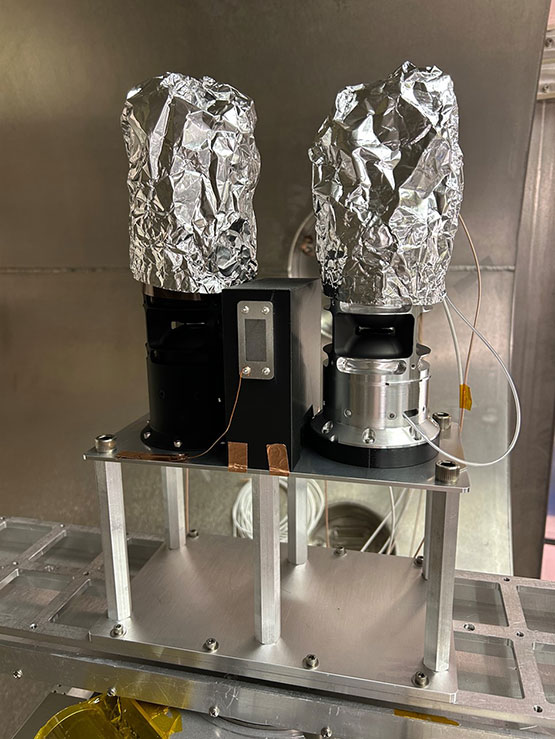
Figure 1: UV Testing of Acktar Vacuum Black and Aerodag Coated ESAs
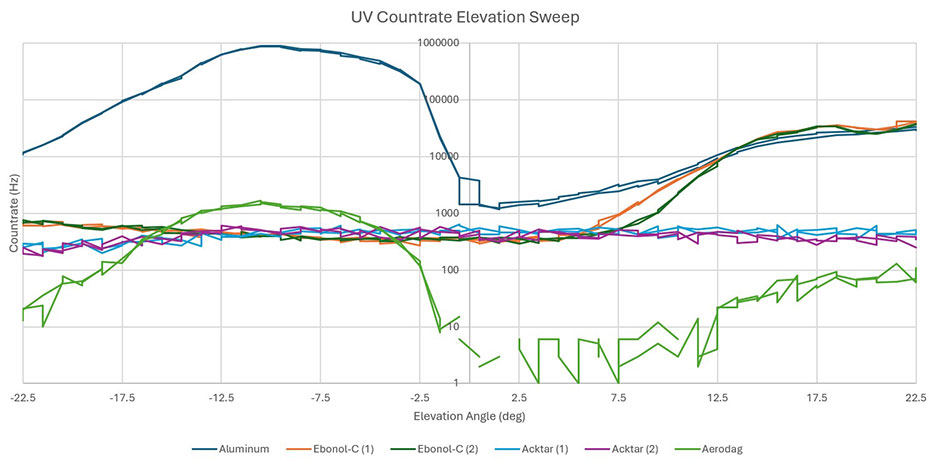
Figure 2: ESA UV Countrates