


Background
Unconventional oil and gas production is successful primarily because of horizontal drilling and hydraulic stimulation. Deformation of wellbore casing – including distributed bending (buckling), zones of ovality, and discrete shearing – leads to problems ranging from difficulties deploying downhole tools to complete well loss. Geological factors (e.g., stress state and rock properties) represent root causes for wellbore casing damage that can result from distributed compaction or shear of weak intervals (e.g., shale) or discrete slip of faults, fractures, or bedding interfaces. Geomechanical simulations have demonstrated that changes in principal stress orientations and magnitudes accompany hydraulic stimulation, and that these stress changes result in sliding of faults, fractures, and bedding interfaces. Given the highly mechanically stratified nature of unconventional reservoirs, the potential for casing deformation driven by layer slip or shear needs to be carefully considered.
Approach
The objectives of this basic research project were to: (1) investigate the conditions under which stress and pore pressure changes due to fluid injection during hydraulic stimulation are sufficient to induce slip of horizontal or gently dipping layer interfaces or internal shear localization in weak mechanical stratigraphic intervals; and (2) analyze potential deformation of horizontal well casing for scenarios where layer slip or shear are identified. To address the first project objective, large-scale three-dimensional (3D) geomechanical simulations of multi-stage hydraulic stimulation (hydraulic fracturing) were developed to explore a suite of subsurface geology, well configurations, and operational parameters. The goals for these simulations were to (i) determine the location, timing, and magnitude of localized bedding-plane slip or distributed shear that occurred in response to fluid injection; and (ii) quantify the geologic and operational conditions that lead to the most pervasive slip (e.g., largest magnitude, greatest spatial extent, longest temporal occurrence). To address the second objective, small-scale (refined) 3D geomechanical models were constructed that included discrete mechanical stratigraphic layers and explicit representations of wellbore casing and cement. The goal for these refined simulations was to quantify the magnitude and type of casing deformation (e.g., buckling, ovality) that resulted from the imposed discrete bedding-plane slip.
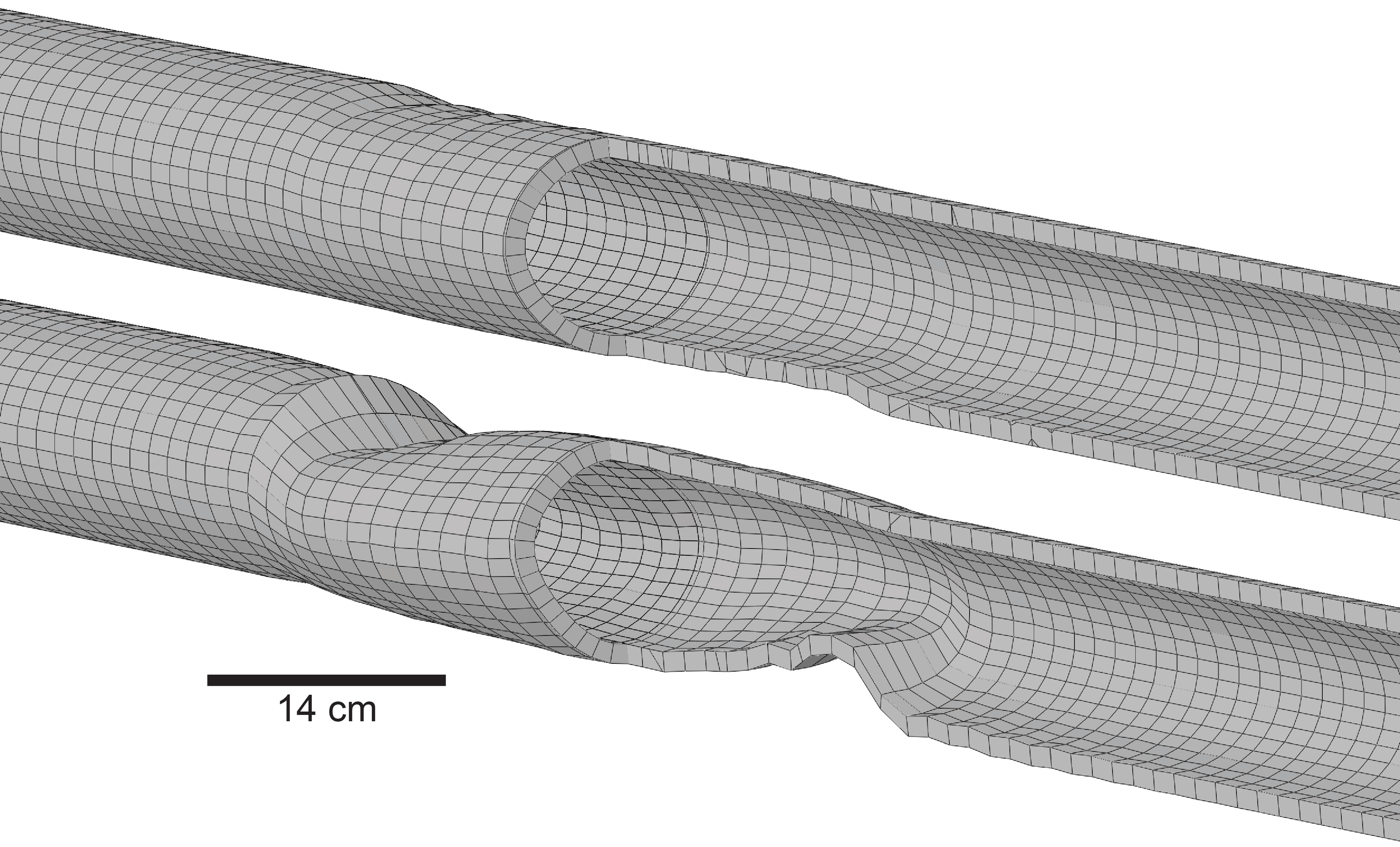
Figure 1. 3D model results showing deformed casing subjected to 5 cm (top) and 15 cm (bottom) of bedding-plane slip.
Accomplishments
The large-scale 3D models confirm that bedding-plane slip is a fundamental deformation response to hydraulic stimulation: (i) bedding-plane slip extends vertically and laterally away from injection sites, and sequential stages contribute to increases in slip magnitude; (ii) slip magnitudes along bedding interfaces that bound injection intervals reach several tens of centimeters (~25 to >50 cm); and (iii) slip tendency for surfaces parallel to bedding increases in layers both above and below injection sites suggesting a higher likelihood of slip. The large-scale models also indicate that injection rate strongly influences the magnitude and distribution of bedding-plane slip: (i) maximum bedding-plane slip magnitude is substantially higher (~2x) for 80 bpm (base case) compared to 40 bpm; and (ii) higher injection rates lead to greater slip laterally along bedding interfaces as well as stratigraphically upwards and downwards. Results of the small-scale (refined) 3D simulations show that bedding-plane slip exceeding 5 cm can result in substantial deformation to casing (Figure 1): (i) ovality of ≥10%; and (ii) reduction in minimum casing diameter of ≥3 cm (≥26%). The style and intensity of casing deformation vary with position relative to bedding-plane intersection: (i) where a dipping bedding plane intersects the top of the horizontal casing, deformation is characterized by high ovality and reduction in casing diameter (vertically) as well as flattening of the upper part of the casing; (ii) where the dipping bedding plane intersects the bottom of the horizontal casing, deformation is characterized by high ovality and reduction in casing diameter (vertically) as well as flattening of the lower part of the casing; and (iii) where the bedding plane intersects the sides of the casing, deformation is characterized by moderate ovality and reduction in casing diameter (often but not always horizontally). The style and intensity of casing deformation is also influenced by the nature (strength) of the interface behavior between casing-cement and cement-rock where the more strongly bonded interfaces generally lead to greater deformation of casing (higher ovality, larger reduction in casing diameter). Finally, the style and intensity of casing deformation are influenced by casing position (i.e., cement thickness) where variation in cement thickness resulting from non-centered casing impacts both magnitude and shape of deformed casing.
Publications
Smart, Kevin J., Cawood, Adam J., Ferrill, David A. Mechanical stratigraphy, bedding-plane slip, and casing deformation. Frontiers in Earth Science, in preparation.
Presentations
Smart, Kevin J., Cawood, Adam J., Ferrill, David A. (2025) Mechanical stratigraphy, bedding-plane slip, and casing deformation. IMAGE 2025 – International Meeting for Applied Geoscience & Energy, Houston, TX, Aug. 25 – Aug. 28, 2025