


Background
As exploration continues into the solar system, we have begun to reevaluate many solar system bodies as ocean worlds, past or present. The structural response of icy lithospheres with underlying oceans is poorly understood, yet remains critical toward interpreting the geologic history and potential for habitability. Multi-ring impact basins on icy moons demonstrate a link from the flow of material in the lower ductile layer to deformation in the upper brittle-elastic layer, but fully three-dimensional experimental models had yet to be implemented.
Approach
The objective of the project was to perform scaled physical models of multi-ring basin formation on Europa post-impact and subsequent deformation due to ductile flow and graben development. Ten experimental models were performed, spanning a range of layer thicknesses, cohesions and viscosities.
Accomplishments
Our model results suggest that current values from the literature may be over or under estimated for some values of brittle crust strength, ductile viscosity (and thus strain rate) and depth to the brittle-ductile transition. Our experimental results suggest that the strain rates are likely lower, with the ductile layer having a higher viscosity than estimated. The models produced an unique flower-petal radial extension style not yet described, but may be applicable to other impact-tectonic features in the solar system and thus should be explored further.
This project also resulted in notable innovations. First, we were able to build upon previous photogrammetry research to implement a laboratory-based, four camera configuration capable of capturing images at a rapid cadence over the model experiment domain. This technology allows for the creation of digital elevation surfaces to be created throughout model evolution. Second, we expanded our capabilities in tracking high-resolution (sub-mm) strain across the model domain over its evolution, allowing for detailed deformation analyses to be conducted.
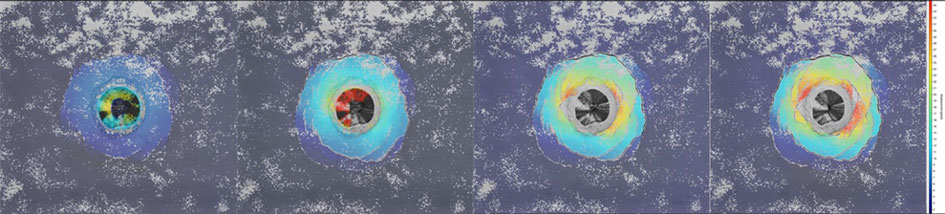
Figure 1: Displacement tracking using Digital Image Correlation illustrates the partitioning of strain during multi-ring graben evolution. This unique flower-petal pattern, comprising of a series of radial, imbricate normal faults, was produced in models with medium cohesion brittle material and low viscosity ductile material. This new ability to track strain at high temporal cadence during model evolution is a critical new capability at SwRI.