


Background
SwRI scientists, engineers, and program managers have played many key roles in the leadership, operations, and scientific productivity of the New Horizons Mission to Pluto and the Kuiper Belt.
The role of New Horizons in studying the outer heliosphere continues to grow. The next critical heliophysics event will be the termination shock crossing, which may occur as early as 2027. In addition to visiting the termination shock at a different location and point in time than the two Voyager spacecraft (the only spacecraft to have explored this region before New Horizons), New Horizons has some key heliophysics sensor capabilities that the Voyagers did not have. As a result, New Horizons will be able to study a broader energy range and more details about how pick-up ions transition across the termination shock, as well as make dust and UV measurements that the Voyagers did not.
Approach
The New Horizons spacecraft termination shock crossing may occur in a matter of days (possibly up to a week), so preparatory work for both operations and science must be completed to optimize the data collected and the science return from the termination shock crossing. This project will develop the termination shock science story, scientific and instrument requirements, software tools, and the termination crossing concept of operations. We will also increase the scientific community’s awareness of the exciting science to come by New Horizons by publishing much of this information in a series of papers.
Accomplishments
The work for this project is in progress, and during the past fiscal year, the following were accomplished:
- A large effort for the preparation and submittal of budget and project plan information to NASA.
- Preparation of the first manuscript from this work that lays the groundwork for predicting the timing of the New Horizons termination shock crossing, and submission to a scientific journal.
- Numerous updates to the Solar Wind Around Pluto (SWAP) instrument website and tools.
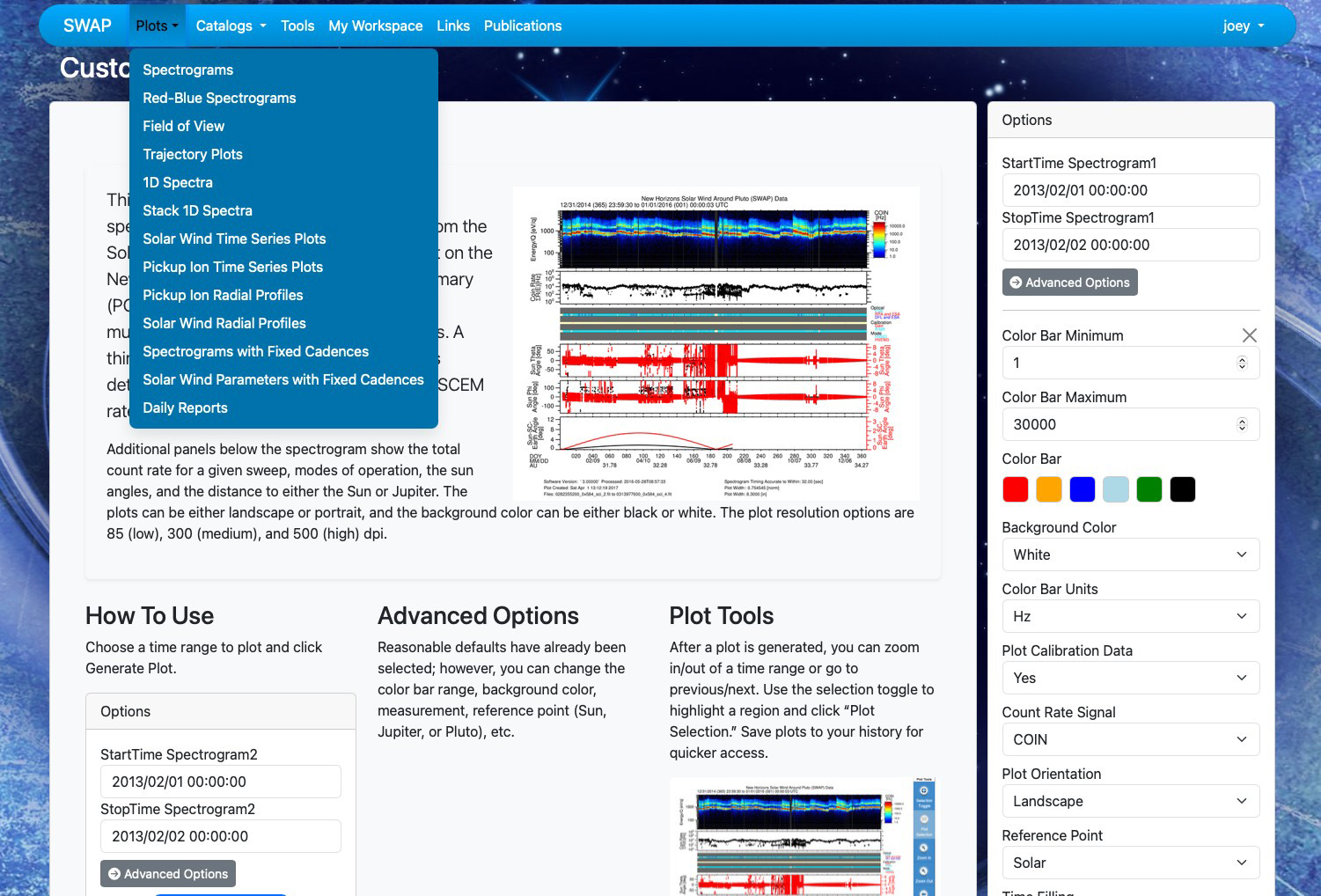
Figure 1: Example updates to the Solar Wind Around Pluto (SWAP) instrument website and tools.
Presentations
Gasser, J., Sokol, J., Dayeh, M., Elliott, H., Singer, K., Stern, A., Opher, M. “Forecasting long-term variations of solar wind parameters: What’s next for the global heliosphere?” Solar Wind-Interstellar Medium Workshop, August 12, 2025.