


Background
This project supports a Focused Internal Research and Development (IR&D) Program initiated to position SwRI at the forefront of applied large language model (LLM) innovation. LLMs are transforming how information is accessed and decisions are supported, but their safe and effective use in technical domains remains an open challenge. LAMP was created to explore novel applications, demonstrate practical value, and establish best practices for responsible deployment within SwRI and for our clients. Projects span diverse domains — from transportation to robotics, life sciences, defense, space science, and beyond — as shown in the figure below.
Approach
The program uses a competitive, staged process to maximize innovation while focusing resources on the most promising concepts. The first Announcement of Opportunity (AO1) generated 22 proposals, with 10 Phase A (four-month proof-of-concept) projects awarded. Eight of those teams submitted Phase B proposals, and four were selected for one-year full projects. The second call (AO2) produced 9 proposals, with 3 Phase A projects awarded; all three advanced to Phase B consideration, and two were awarded. This two-stage structure — Phase A to test feasibility, Phase B to expand promising concepts — ensures broad participation while maintaining selectivity. Each round emphasizes knowledge sharing through demos and presentations, encouraging cross-domain collaboration.
Accomplishments
Projects employed both closed-source models (e.g., GPT-4) and open-source approaches (e.g., Llama, Mistral), with Retrieval-Augmented Generation widely adopted. Automation emerged as a common theme, from workflow aids to advanced decision support prototypes. A key insight was the role of LLMs in workforce resiliency: by preserving and extending subject matter expertise, projects demonstrated a path to reducing knowledge loss from retirements and improving onboarding for new staff. Importantly, LAMP also enabled deployment of a FedRAMP GPT instance, giving SwRI staff secure access to generative AI tools for productivity and client support. This capability extends the program’s impact beyond research projects, providing immediate benefit across the Institute.
LAMP has strengthened cross-Institute communication and provided tangible demonstrations of LLM impact across diverse domains. Lessons learned are informing client proposals and guiding internal guidelines for safe, transparent adoption. Continued emphasis will be placed on refining technical best practices, exploring high-value use cases, and ensuring LLM innovation aligns with SwRI’s mission to benefit government, industry, and mankind.
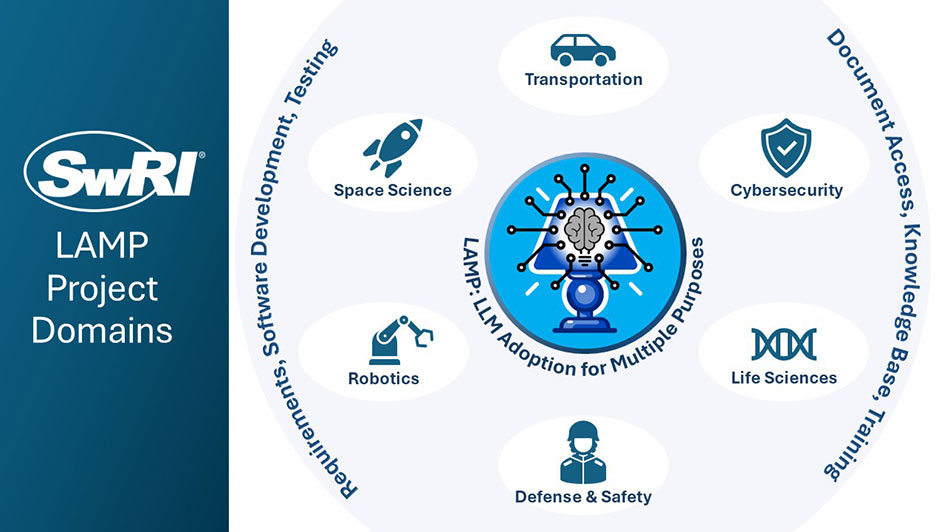
Figure 1: LAMP logo. Figure 2: LAMP project domains.
Presentations:
Randolph, L. “Large Language Models, The Promise, the Perils, and the Path Forward.” SwRI Tom Talks, San Antonio, Texas, Oct. 3, 2024.
Randolph, L. “Artificial Intelligence, Teaching Computers to Think.” Northside Independent School District, San Antonio, Texas, Jan. 8, 2025.
Randolph, L. “Artificial Intelligence, Teaching Computers to Think.” SwRI Annual Meeting, San Antonio, Texas, Jan. 13, 2025.
Randolph, L. “Responsible AI in Transportation.” ITS-NY Annual Meeting, Saratoga Springs, NY, June 4, 2025.
Randolph, L. Lynne Randolph. “Enhancing Skills With LLMs.” San Antonio Chamber of Commerce Women in Leadership Seminar, San Antonio, Texas, July 11, 2025.
Randolph, L. “Innovating ITS With LLMs.” ITS World Congress, Atlanta, Georgia, Aug. 25, 2025.