


This project was funded (or partially funded) by The University of Texas at Dallas Office of Research and Innovation and Southwest Research Institute through the SPRINT grant program.
Background
Geospace, the space environment near Earth made up of the upper atmosphere and nearby outer space, contains ionized and neutral components that are separately studied and defined as the ionosphere and thermosphere (IT), respectively. Neutral winds largely drive the dynamics of the region, serving as the primary regulators and redistributors of the mass, momentum and energy and largely determining “space weather.” However, the lack of direct measurements of neutral winds has impeded advancements in both IT and space weather research. The project offers a unique opportunity to test the Neutral Wind Meter (NWM) in an environment that simulates the actual conditions in geospace. The integration of novel sensor technologies and molecular beam testing methodologies via a well-reasoned and innovative strategy will address critical gaps in understanding space weather impacts.
Approach
The overarching goal of this project is to verify sensor performance and demonstrate its technical readiness level, which in turn makes the instrument more likely to be selected for upcoming missions.
Researchers from Southwest Research Institute (SwRI) and The University of Texas at Dallas (UTD) collaborate to evaluate a next-generation sensor designed to measure neutral gas velocities in the Earth’s upper atmosphere. We leverage our new Molecular Beam Facility (MBF) to validate and enhance the measurement capabilities of UTD’s NWM, establish development procedures, and significantly improve the signal-to-noise ratio.
Accomplishments
The project successfully achieved its intended goal on schedule and within budget. Key achievements include the successful integration of the NWM (conducted at UTD) and the verification of its performance through two test campaigns (conduced at SwRI). The 1st joint test in late June validated sensor alignment, responsiveness, and noise characteristics under various gas and velocity conditions. Analysis of the test data demonstrated accurate angular sensitivity and confirmed the sensor’s key performance metrics. Subsequent enhancements improved the signal-to-noise ratio, and the 2nd test campaign in August further validated the results, showing strong agreement with model predictions. Detailed analyses also identified resolution and noise limitations, highlighting areas for future refinement under flight-like conditions. Together, these activities represent major strides toward technical readiness for space deployment, advancing the sensor from TRL 5 to TRL 6.
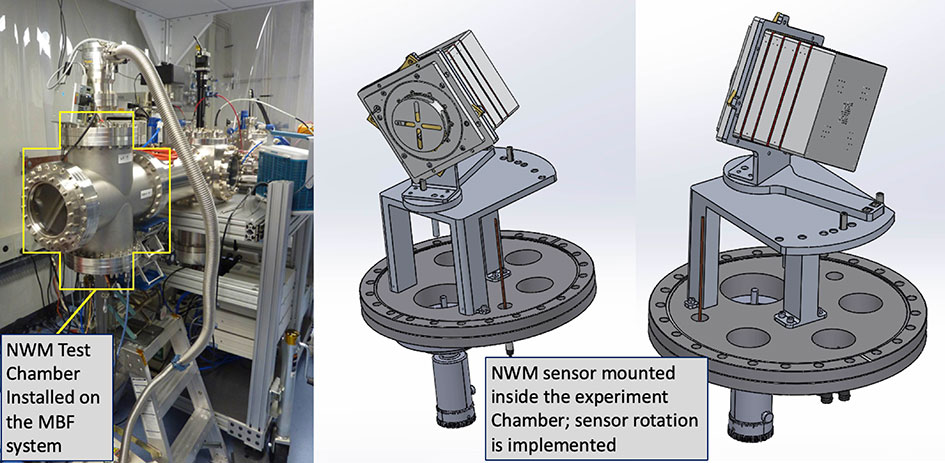
Figure 1. The MBF chamber, shown with the experiment chamber attached, houses the NWM sensor. The experiment chamber was custom-built to rotate the sensor and simulate diverse ionospheric wind conditions for thorough performance validation.
Presentations
Technical Seminar at KTH Royal Institute of Technology, Stockholm, Sweden “The Cross-Track wind Sensor for the SYSTER Rocket Campaign” Michael Perdue – Instrumentation Systems Engineer, Sept 18, 2025.