


Background
As the hydrogen economy continues to grow, there is an increasing need for innovations in compression technologies to improve safety, efficiency, and reliability of the compression process with hazardous gases. The current state of the art for hydrogen compressors is not sufficient in terms of reliability and efficiency, particularly at elevated pressures needed for heavy-duty vehicle refueling purposes. The development of a thermal compressor to replace mechanical pumps or compressors is a promising solution to the current issues experienced with conventional compression technologies. The thermal compressor can benefit a liquid hydrogen (LH2) to pressurized gaseous hydrogen fueling system, liquid nitrogen (LN2) compression, and cryogenic carbon dioxide (CO2) capture systems, which are decarbonized technologies. It has the potential to improve the efficiency of these systems and provide an alternative to traditional compression methods. It is a scalable concept for cryogenic gas compression, and post-combustion cryogenic carbon capture that can be applied to a wide range of power generation and industrial applications.
The simplified process diagram shown in Figure 1 demonstrates how a thermal compressor, identified as a “thermal pump”, can be used to vaporize and pressurize LH2 and feed a cascading pressure storage system for hydrogen refueling system dispensing. Other envisioned systems utilizing this technology replace the cascading pressure storage with thermal compressors that feed directly into the dispenser, further simplifying the process.
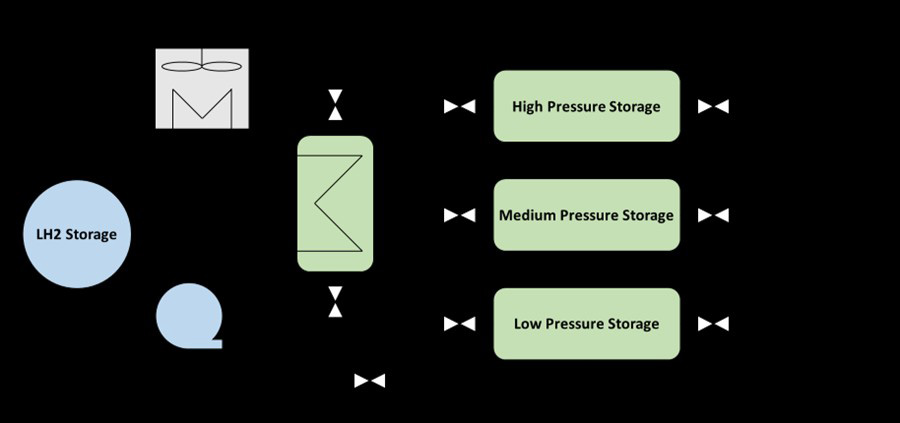
Figure 1: Simplified process diagram of a proposed hydrogen refueling system (HRS) (relief valves and other components and instrumentation are not shown).
Approach
The technical development of the project will proceed as follows:
- Develop an analytical model in process software and compare the phase change energy and density predictions to literature. Ensure the software can predict properties of the substances before and after constant volume compression to within 10% of the expected values from literature.
- Develop transient process models for LN2, LH2, and solid CO2, estimating the initial and final properties of the constant volume warming and compression into a high-pressure condition.
- Plan and procure the necessary equipment to run a small-scale test with LN2 and solid CO2, using simple warming to raise the pressure within a vessel. Complete tests with constant volume phase change of these materials. Compare results from before and after, estimating the performance of the thermal compressor.
- Develop an estimate of performance, including pressure ratio, energy required for warming the denser material, and the impact on the target commercial application. Use LN2 performance to predict LH2 performance, adjusting based on the predicted performance based on the difference in physical properties between the two fluids.
Accomplishments
The project is currently underway and has been primarily focused on identifying and sourcing the appropriate high-pressure equipment that can operate in cryogenic conditions to fulfill the small-scale test campaign intended to validate the performance models. Maximum pressure limitation of 2,000 psi was defined based on the material purchase limitations of the project. Final design of the test rig is nearing completion with testing and further cycle modeling and validation to follow.